



 Chat with AI
Exam 8: Investment Decision Rules

Exam 1: Corporate Finance and the Financial Manager86 Questions
Exam 2: Introduction to Financial Statement Analysis106 Questions
Exam 3: Time Value of Money: an Introduction112 Questions
Exam 4: Time Value of Money: Valuing Cash Flow Streams62 Questions
Exam 5: Interest Rates109 Questions
Exam 6: Bonds109 Questions
Exam 7: Stock Valuation63 Questions
Exam 8: Investment Decision Rules124 Questions
Exam 9: Fundamentals of Capital Budgeting111 Questions
Exam 10: Stock Valuation: a Second Look48 Questions
Exam 11: Risk and Return in Capital Markets110 Questions
Exam 12: Systematic Risk and the Equity Risk Premium103 Questions
Exam 13: The Cost of Capital110 Questions
Exam 14: Raising Equity Capital110 Questions
Exam 15: Debt Financing99 Questions
Exam 16: Capital Structure109 Questions
Exam 17: Payout Policy110 Questions
Exam 18: Financial Modeling and Pro Forma Analysis95 Questions
Exam 19: Working Capital Management110 Questions
Exam 20: Short-Term Financial Planning108 Questions
Exam 21: Option Applications and Corporate Finance102 Questions
Exam 22: Mergers and Acquisitions47 Questions
Exam 23: International Corporate Finance108 Questions
Exam 24: Leasing46 Questions
Exam 25: Insurance and Risk Management38 Questions
Exam 26: Corporate Governance45 Questions
Select questions type


What is the decision criteria using internal rate of return (IRR) rule?
(Essay)
4.8/5  (77)
(77) The cash flows for four investments have been identified as follows:
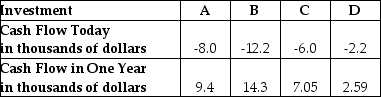 Based on the above information, and with an interest rate of 5%, which is the best investment?
 (Multiple Choice)
4.8/5 (82)
(82) Jenkins Security has learned that a rival has offered to supply a parking garage with security for ten years for $45,000 up front and a further $15,000 per year. If Jenkins Security offers to provide security for eight years for an upfront cost of $60,000 and a separate yearly payment, by what maximum amount can this yearly payment be over $20,000, so that Jenkins' offer matches the equivalent annual annuity of their rival's offer? (Assume a cost of capital of 5%.)
(Multiple Choice)
4.7/5 (78)
(78) Preference for cash today versus cash in the future in part determines net present value (NPV).
(True/False)
4.8/5 (77)
(77) Use the table for the question(s) below.
Consider the following list of projects:
 -Assuming that your capital is constrained, which investment tool should you use to determine the correct investment decisions?
 (Multiple Choice)
4.9/5 (75)
(75) Consider the following two projects:
 The net present value (NPV) of project A is closest to ________.
 (Multiple Choice)
4.8/5 (65)
(65) A garage is comparing the cost of buying two different car hoists. Hoist A will cost $20,000, will require servicing of $1000 every two years, and last ten years. Hoist B will cost $15,000, require servicing of $800 per year, and last eight years. If the cost of capital is 7%, which is the better option, given that the firm has an ongoing requirement for a hoist?
(Multiple Choice)
4.8/5 (87)
(87) Which of the following is NOT a limitation of the payback rule?
(Multiple Choice)
4.8/5 (78)
(78) Consider the following two projects:
 The payback period for project B is closest to ________.
 (Multiple Choice)
4.8/5 (90)
(90) The profitability index can break down completely when dealing with multiple resource restraints.
(True/False)
4.8/5 (66)
(66) A local government awards a landscaping company a contract worth $1.5 million per year for five years for maintaining public parks. The landscaping company will need to buy some new machinery before they can take on the contract. If the cost of capital is 6%, what is the most that this equipment could cost if the contract is to be worthwhile for the landscaping company?
(Multiple Choice)
4.9/5 (73)
(73) Use the information for the question(s) below. 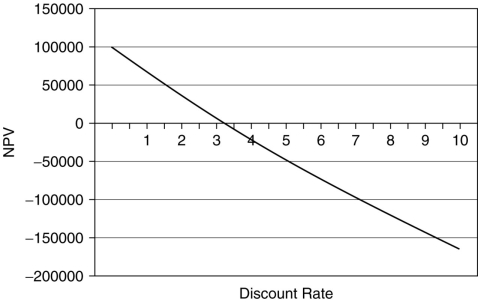 -The owner of a hair salon spends $1,000,000 to renovate its premises, estimating that this will increase her cash flow by $220,000 per year. She constructs the above graph, which shows the net present value (NPV) as a function of the discount rate. If her discount rate is 6%, should she accept the project?
 (Multiple Choice)
4.9/5 (82)
(82) Which of the following is a disadvantage of the Net Present Value rule?
(Multiple Choice)
4.9/5 (85)
(85) An investor has the opportunity to invest in four new retail stores. The amount that can be invested in each store, along with the expected cash flow at the end of the first year, the growth rate of the concern, and the cost of capital is shown for each case. It is assumed each investment will operate in perpetuity after the initial investment. Which investment should the investor choose?
(Multiple Choice)
4.8/5 (86)
(86) A car dealership offers a car for $14,000, with up to one year to pay for the car. If the interest rate is 5%, what is the net present value (NPV) of this offer to buyers who elect not to pay for the car for one year?
(Multiple Choice)
5.0/5 (84)
(84) Net present value (NPV) is the difference between the present value (PV) of the benefits and the present value (PV) of the costs of a project or investment.
(True/False)
4.8/5 (79)
(79) Two mutually exclusive investment opportunities require an initial investment of $7 million. Investment A pays $1.5 million per year in perpetuity, while investment B pays $1.2 million in the first year, with cash flows increasing by 3% per year after that. At what cost of capital would an investor regard both opportunities as being equivalent?
(Multiple Choice)
4.9/5 (81)
(81) Peter has a business opportunity that requires him to invest $10,000 today, and receive $12,000 in one year. He can either use $10,000 that he already has for this investment or borrow the money from his bank at an interest rate of 10%. However, the $10,000 he has right now is needed for urgent repairs to his home, repairs that will cost at least $15,000 if he delays them for a year. What is the best alternative for Peter out of the following choices?
(Multiple Choice)
4.8/5 (77)
(77) Consider the following two projects:
 The profitability index for project A is closest to ________.
 (Multiple Choice)
5.0/5 (88)
(88) 
Filters
- Essay(0)
- Multiple Choice(0)
- Short Answer(0)
- True False(0)
- Matching(0)