



 Chat with AI
Exam 11: Risk and Return in Capital Markets

Exam 1: Corporate Finance and the Financial Manager86 Questions
Exam 2: Introduction to Financial Statement Analysis106 Questions
Exam 3: Time Value of Money: an Introduction112 Questions
Exam 4: Time Value of Money: Valuing Cash Flow Streams62 Questions
Exam 5: Interest Rates109 Questions
Exam 6: Bonds109 Questions
Exam 7: Stock Valuation63 Questions
Exam 8: Investment Decision Rules124 Questions
Exam 9: Fundamentals of Capital Budgeting111 Questions
Exam 10: Stock Valuation: a Second Look48 Questions
Exam 11: Risk and Return in Capital Markets110 Questions
Exam 12: Systematic Risk and the Equity Risk Premium103 Questions
Exam 13: The Cost of Capital110 Questions
Exam 14: Raising Equity Capital110 Questions
Exam 15: Debt Financing99 Questions
Exam 16: Capital Structure109 Questions
Exam 17: Payout Policy110 Questions
Exam 18: Financial Modeling and Pro Forma Analysis95 Questions
Exam 19: Working Capital Management110 Questions
Exam 20: Short-Term Financial Planning108 Questions
Exam 21: Option Applications and Corporate Finance102 Questions
Exam 22: Mergers and Acquisitions47 Questions
Exam 23: International Corporate Finance108 Questions
Exam 24: Leasing46 Questions
Exam 25: Insurance and Risk Management38 Questions
Exam 26: Corporate Governance45 Questions
Select questions type


Consider the following average annual returns:
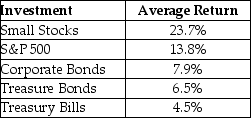 What is the excess return for the S&P 500?
 (Multiple Choice)
5.0/5  (97)
(97) Your investment over one year yielded a capital gains yield of 5% and no dividend yield. If the sale price was $114 per share, what was the cost of the investment?
(Multiple Choice)
4.9/5 (83)
(83) Suppose you invested $100 in the Ishares High Yield Fund (HYG) a month ago. It paid a dividend of $2 today and then you sold it for $100. What was your dividend yield and capital gains yield on the investment?
(Multiple Choice)
5.0/5 (84)
(84) Consider the following average annual returns:
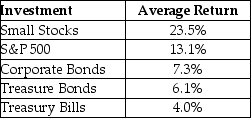 What is the excess return for the portfolio of small stocks?
 (Multiple Choice)
4.7/5 (96)
(96) Consider an economy with two types of firms, S and I. S firms always move together, but I firms move independently of each other. For both types of firms there is a 60% probability that the firm will have a 20% return and a 40% probability that the firm will have a -30% return.
The standard deviation for the return on a portfolio of 20 type I firms is closest to ________.
(Multiple Choice)
4.9/5 (65)
(65) If asset A's return is exactly two times asset B's return, then following risk return tradeoff, the standard deviation of asset A should be ________ times the standard deviation of asset B.
(Multiple Choice)
4.8/5 (80)
(80) While ________ seems to be a reasonable measure of risk when evaluating a large portfolio, the ________ of an individual security does not explain the size of its average return.
(Multiple Choice)
4.9/5 (79)
(79) The standard deviation of returns of ________.
I. small stocks is higher than that of large stocks
II. large stocks is lower than that of corporate bonds
III. corporate bonds is higher than that of Treasury bills
Which statement is true?
(Multiple Choice)
4.8/5 (81)
(81) There is a clear link between the volatility of returns for individual stocks and the returns for individual stocks.
(True/False)
4.8/5 (84)
(84) Comment on the accuracy of the statement that as we put more stocks in a portfolio, its risk gets eliminated to zero.
(Essay)
5.0/5 (73)
(73) Investors should earn a risk premium for bearing unsystematic risk.
(True/False)
4.8/5 (72)
(72) Big Cure and Little Cure are both pharmaceutical companies. Big Cure presently has a potential "blockbuster" drug before the Food and Drug Administration (FDA) waiting for approval. If approved, Big Cure's blockbuster drug will produce $1 billion in net income for Big Cure. Little Cure has ten separate, less important drugs before the FDA waiting for approval. If approved, each of Little Cure's drugs would produce $100 million in net income. The probability of the FDA approving a drug is 40%.
What is the expected payoff for Big Cure's blockbuster drug?
(Multiple Choice)
4.8/5 (72)
(72) Rational investors ________ fluctuations in the value of their investments.
(Multiple Choice)
4.8/5 (83)
(83) Consider an economy with two types of firms, S and I. S firms always move together, but I firms move independently of each other. For both types of firms there is a 70% probability that the firm will have a 20% return and a 30% probability that the firm will have a -30% return.
The standard deviation for the return on an portfolio of 20 type S firms is closest to ________.
(Multiple Choice)
4.7/5 (91)
(91) Which of the following investments offered the highest overall return over the past eighty years?
(Multiple Choice)
4.8/5 (75)
(75) Consider the following realized annual returns:
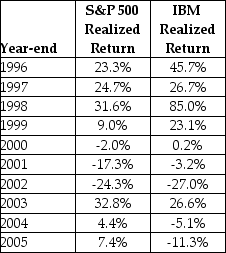 The average annual return on IBM from 1996 to 2005 is closest to ________.
 (Multiple Choice)
5.0/5 (86)
(86) McCoy paid a one-time special dividend of $3.40 on October 18, 2010. Suppose you bought McCoy stock for $47.00 on July 18, 2010, and sold it immediately after the dividend was paid for $63.52. What was your realized return from holding McCoy?
(Multiple Choice)
4.7/5 (84)
(84) What is the diversification achieved by an investor if he invests in Dell, IBM, and Microsoft?
(Essay)
5.0/5 (75)
(75) 
Filters
- Essay(0)
- Multiple Choice(0)
- Short Answer(0)
- True False(0)
- Matching(0)