



 Chat with AI
Exam 32: A Macroeconomic Theory of the Open Economy

Exam 1: Ten Principles of Economics439 Questions
Exam 2: Thinking Like an Economist617 Questions
Exam 3: Interdependence and the Gains From Trade527 Questions
Exam 4: The Market Forces of Supply and Demand697 Questions
Exam 5: Elasticity and Its Application594 Questions
Exam 6: Supply, Demand, and Government Policies645 Questions
Exam 7: Consumers, Producers, and the Efficiency of Markets549 Questions
Exam 8: Application: the Costs of Taxation513 Questions
Exam 9: Application: International Trade492 Questions
Exam 10: Externalities524 Questions
Exam 11: Public Goods and Common Resources433 Questions
Exam 12: The Design of the Tax System549 Questions
Exam 13: The Costs of Production420 Questions
Exam 14: Firms in Competitive Markets543 Questions
Exam 15: Monopoly637 Questions
Exam 16: Monopolistic Competition580 Questions
Exam 17: Oligopoly488 Questions
Exam 18: The Markets for the Factors of Production564 Questions
Exam 19: Earnings and Discrimination490 Questions
Exam 20: Income Inequality and Poverty455 Questions
Exam 21: The Theory of Consumer Choice431 Questions
Exam 22: Frontiers of Microeconomics440 Questions
Exam 23: Measuring a Nations Income520 Questions
Exam 24: Measuring the Cost of Living529 Questions
Exam 25: Production and Growth505 Questions
Exam 26: Saving, Investment, and the Financial System564 Questions
Exam 27: The Basic Tools of Finance500 Questions
Exam 28: Unemployment678 Questions
Exam 29: The Monetary System515 Questions
Exam 30: Money Growth and Inflation481 Questions
Exam 31: Open-Economy Macroeconomics: Basic Concepts522 Questions
Exam 32: A Macroeconomic Theory of the Open Economy475 Questions
Exam 33: Aggregate Demand and Aggregate Supply562 Questions
Exam 34: The Influence of Monetary and Fiscal Policy on Aggregate Demand508 Questions
Exam 35: The Short-Run Trade-Off Between Inflation and Unemployment491 Questions
Exam 36: Six Debates Over Macroeconomic Policy372 Questions
Select questions type


Other things the same, a decrease in the real interest rate
(Multiple Choice)
4.9/5  (78)
(78) If U.S. citizens decide to save a larger fraction of their incomes, the real interest rate
(Multiple Choice)
4.9/5 (81)
(81) In the open-economy macroeconomic model, the market for loanable funds equates national saving with
(Multiple Choice)
4.8/5 (70)
(70) What is the source of the demand for loanable funds in the open-economy macroeconomic model ?
(Short Answer)
4.9/5 (79)
(79) Suppose the U.S. removes an import quota on steel. U.S. exports
(Multiple Choice)
4.7/5 (83)
(83) Refer to Budget Reform. This policy change causes net capital outflow to change. How is this change in net capital outflow shown in the market for foreign-currency exchange? What happens to the exchange rate?
(Essay)
4.7/5 (71)
(71) In 2002, the United States placed higher tariffs on imports of steel. According to the open-economy macroeconomic model this policy should have
(Multiple Choice)
4.9/5 (88)
(88) Which of the following would tend to shift the supply of dollars in the market for foreign-currency exchange in the open-economy macroeconomic model to the right?
(Multiple Choice)
4.8/5 (89)
(89) When a country suffers from capital flight, the demand for loanable funds in that country shifts
(Multiple Choice)
4.8/5 (87)
(87) Other things the same, an increase in the U.S. real interest rate induces
(Multiple Choice)
5.0/5 (71)
(71) A country has national saving of $50 billion, government expenditures of $30 billion, domestic investment of $10 billion, and net capital outflow of $40 billion. What is its supply of loanable funds?
(Multiple Choice)
4.8/5 (92)
(92) If a U.S. resident purchases a foreign bond, her transactions are included
(Multiple Choice)
4.9/5 (83)
(83) In the open-economy macroeconomic model, the amount of net capital outflow represents the quantity of dollars
(Multiple Choice)
4.8/5 (79)
(79) In the open-economy macroeconomic model, other things the same, which of the following both make the exchange rate fall?
(Multiple Choice)
4.8/5 (92)
(92) Which of the following is most likely to increase exports?
(Multiple Choice)
4.9/5 (66)
(66) A country has output of $600 billion, consumption of $350 billion, government expenditures of $90 billion and investment of $60 billion. What is its supply of loanable funds?
(Multiple Choice)
5.0/5 (93)
(93) If the U.S. raised its tariff on tires, then at the original exchange rate there would be a
(Multiple Choice)
4.9/5 (76)
(76) Figure 32-2 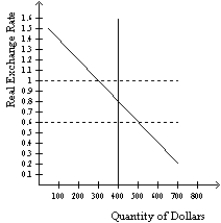 -Refer to Figure 32-2. If the real exchange rate is 1, then there is a
 (Multiple Choice)
4.8/5 (92)
(92) When Mexico suffered from capital flight in 1994, the U.S. real interest rate
(Multiple Choice)
4.9/5 (78)
(78) Which of the following would not be a consequence of an increase in the U.S. government budget deficit?
(Multiple Choice)
5.0/5 (82)
(82) 
Filters
- Essay(0)
- Multiple Choice(0)
- Short Answer(0)
- True False(0)
- Matching(0)