



 Chat with AI
Exam 29: The Monetary System

Exam 1: Ten Principles of Economics439 Questions
Exam 2: Thinking Like an Economist617 Questions
Exam 3: Interdependence and the Gains From Trade527 Questions
Exam 4: The Market Forces of Supply and Demand697 Questions
Exam 5: Elasticity and Its Application594 Questions
Exam 6: Supply, Demand, and Government Policies645 Questions
Exam 7: Consumers, Producers, and the Efficiency of Markets549 Questions
Exam 8: Application: the Costs of Taxation513 Questions
Exam 9: Application: International Trade492 Questions
Exam 10: Externalities524 Questions
Exam 11: Public Goods and Common Resources433 Questions
Exam 12: The Design of the Tax System549 Questions
Exam 13: The Costs of Production420 Questions
Exam 14: Firms in Competitive Markets543 Questions
Exam 15: Monopoly637 Questions
Exam 16: Monopolistic Competition580 Questions
Exam 17: Oligopoly488 Questions
Exam 18: The Markets for the Factors of Production564 Questions
Exam 19: Earnings and Discrimination490 Questions
Exam 20: Income Inequality and Poverty455 Questions
Exam 21: The Theory of Consumer Choice431 Questions
Exam 22: Frontiers of Microeconomics440 Questions
Exam 23: Measuring a Nations Income520 Questions
Exam 24: Measuring the Cost of Living529 Questions
Exam 25: Production and Growth505 Questions
Exam 26: Saving, Investment, and the Financial System564 Questions
Exam 27: The Basic Tools of Finance500 Questions
Exam 28: Unemployment678 Questions
Exam 29: The Monetary System515 Questions
Exam 30: Money Growth and Inflation481 Questions
Exam 31: Open-Economy Macroeconomics: Basic Concepts522 Questions
Exam 32: A Macroeconomic Theory of the Open Economy475 Questions
Exam 33: Aggregate Demand and Aggregate Supply562 Questions
Exam 34: The Influence of Monetary and Fiscal Policy on Aggregate Demand508 Questions
Exam 35: The Short-Run Trade-Off Between Inflation and Unemployment491 Questions
Exam 36: Six Debates Over Macroeconomic Policy372 Questions
Select questions type


Which of the following best illustrates the concept of a store of value?
(Multiple Choice)
4.7/5  (75)
(75) Explain why banks can influence the money supply if the required reserve ratio is less than 100 percent.
(Essay)
4.7/5 (77)
(77) A bank has a 5 percent reserve requirement, $5,000 in deposits, and has loaned out all it can given the reserve requirement.
(Multiple Choice)
4.7/5 (80)
(80) Table 29-9
Metropolis National Bank is currently holding 2% of its deposits as excess reserves.  -Refer to Table 29-9. Metropolis National Bank is currently holding 2% of deposits as excess reserves. Assume that no banks in the economy want to hold excess reserves and that people only hold deposits and no currency. How much does the money supply ultimately increase when Metropolis National Bank lends out its excess reserves?
 (Multiple Choice)
4.8/5 (77)
(77) Derek decides to forego a major appliance purchase and save the money. He transfers $2,100 from his checking account to his money market mutual fund. As a result of this transfer,
(Multiple Choice)
4.8/5 (84)
(84) Marc puts prices on surfboards and skateboards at his sporting goods store. He is using money as a unit of account.
(True/False)
5.0/5 (69)
(69) Banks cannot influence the money supply if they are required to hold all deposits in reserve.
(True/False)
4.9/5 (65)
(65) Consider five individuals with different occupations. 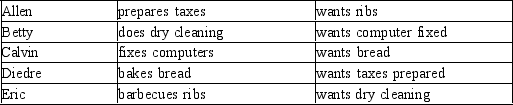 In a barter system which of the following pairs has a double coincidence of wants?
 (Multiple Choice)
4.9/5 (90)
(90) Which of the three functions of money are commonly met by each of the following assets in the U.S. economy?
a. paper dollar
b. precious metals
c. collectibles such as baseball cards, stamps, and antiques
(Essay)
4.7/5 (71)
(71) Other things the same if reserve requirements are decreased, the reserve ratio
(Multiple Choice)
4.8/5 (76)
(76) Designers of the Federal Reserve System were concerned that the Fed might form policy favorable to one part of the country or to a particular party. What are some ways that the organization of the Fed reflects such concerns?
(Essay)
4.9/5 (83)
(83) The banking system currently has $50 billion of reserves, none of which are excess. People hold only deposits and no currency, and the reserve requirement is 10 percent. If the Fed raises the reserve requirement to 12.5 percent and at the same time sells $10 billion worth of bonds, then by how much does the money supply change?
(Multiple Choice)
4.9/5 (71)
(71) Suppose a bank has $3,000 in reserves, $25,000 of deposits, and a 10 percent reserve requirement. What is the amount of excess reserves?
(Short Answer)
4.8/5 (70)
(70) One plausible explanation for the large amount of U.S. currency outstanding is that many dollars are held abroad.
(True/False)
4.8/5 (86)
(86) 
Filters
- Essay(0)
- Multiple Choice(0)
- Short Answer(0)
- True False(0)
- Matching(0)