



 Chat with AI
Exam 23: Measuring a Nations Income

Exam 1: Ten Principles of Economics439 Questions
Exam 2: Thinking Like an Economist617 Questions
Exam 3: Interdependence and the Gains From Trade527 Questions
Exam 4: The Market Forces of Supply and Demand697 Questions
Exam 5: Elasticity and Its Application594 Questions
Exam 6: Supply, Demand, and Government Policies645 Questions
Exam 7: Consumers, Producers, and the Efficiency of Markets549 Questions
Exam 8: Application: the Costs of Taxation513 Questions
Exam 9: Application: International Trade492 Questions
Exam 10: Externalities524 Questions
Exam 11: Public Goods and Common Resources433 Questions
Exam 12: The Design of the Tax System549 Questions
Exam 13: The Costs of Production420 Questions
Exam 14: Firms in Competitive Markets543 Questions
Exam 15: Monopoly637 Questions
Exam 16: Monopolistic Competition580 Questions
Exam 17: Oligopoly488 Questions
Exam 18: The Markets for the Factors of Production564 Questions
Exam 19: Earnings and Discrimination490 Questions
Exam 20: Income Inequality and Poverty455 Questions
Exam 21: The Theory of Consumer Choice431 Questions
Exam 22: Frontiers of Microeconomics440 Questions
Exam 23: Measuring a Nations Income520 Questions
Exam 24: Measuring the Cost of Living529 Questions
Exam 25: Production and Growth505 Questions
Exam 26: Saving, Investment, and the Financial System564 Questions
Exam 27: The Basic Tools of Finance500 Questions
Exam 28: Unemployment678 Questions
Exam 29: The Monetary System515 Questions
Exam 30: Money Growth and Inflation481 Questions
Exam 31: Open-Economy Macroeconomics: Basic Concepts522 Questions
Exam 32: A Macroeconomic Theory of the Open Economy475 Questions
Exam 33: Aggregate Demand and Aggregate Supply562 Questions
Exam 34: The Influence of Monetary and Fiscal Policy on Aggregate Demand508 Questions
Exam 35: The Short-Run Trade-Off Between Inflation and Unemployment491 Questions
Exam 36: Six Debates Over Macroeconomic Policy372 Questions
Select questions type


The overall effect of accounting for purchases of foreign goods in GDP reduces GDP.
(True/False)
4.8/5  (84)
(84) Changes in inventory are included in the investment component of GDP.
(True/False)
5.0/5 (87)
(87) One bag of flour is sold for $1.00 to a bakery, which uses the flour to bake bread that is sold for $3.00 to consumers. A second bag of flour is sold for $1 to a grocery store who sells it to a consumer for $2.00. Taking these four transactions into account, what is the effect on GDP?
(Multiple Choice)
4.9/5 (75)
(75) Figure 23-1. 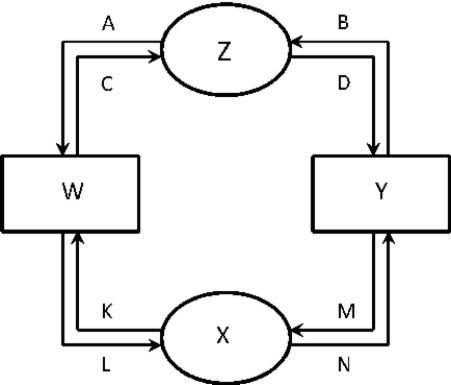 -Refer to Figure 23-1. Which of the following pairs correctly identify X and Z?
 (Multiple Choice)
4.9/5 (86)
(86) Which of the following statements about recessions is true?
(Multiple Choice)
4.7/5 (73)
(73) If total spending rises from one year to the next, then which of the following could not be true?
(Multiple Choice)
4.9/5 (73)
(73) Table 23-2
The table below contains data for country A for the year 2010.  -Refer to Table 23-2. What were country A's net exports in 2010?
 (Multiple Choice)
4.9/5 (75)
(75) Table 23-2
The table below contains data for country A for the year 2010.
-Refer to Table 23-2. What were country A's government purchases in 2010?
-Refer to Table 23-2. What were country A's government purchases in 2010? (Multiple Choice)
4.8/5 (75)
(75) Which of the following is included in the investment component of GDP?
(Multiple Choice)
4.7/5 (80)
(80) In 2011 a country had a real GDP of $13.89 trillion and GDP deflator of 110. In 2012 it had a nominal GDP of $17.8 trillion and real GDP of 14.24 trillion. What is the rate of inflation in 2012?
(Short Answer)
4.9/5 (94)
(94) If an economy's GDP falls, then it must be the case that the economy's
(Multiple Choice)
4.9/5 (74)
(74) In early 2010 Molly paid $200,000 for a house built in 2000. She spent $30,000 on new materials to remodel the house. Although Molly lived in the house after she remodeled it, its rental value rose. Which of the following contributed to real GDP in 2010?
(Multiple Choice)
4.8/5 (82)
(82) Over time, people have come to rely more on market-produced goods and services and less on goods and services they produce for themselves. For example, busy people with high incomes, rather than cleaning their own houses, hire people to clean their houses. By itself, this change has
(Multiple Choice)
4.8/5 (85)
(85) Figure 23-1.
-Refer to Figure 23-1. Which of the following pairs correctly identify W and Y?
-Refer to Figure 23-1. Which of the following pairs correctly identify W and Y? (Multiple Choice)
5.0/5 (74)
(74) Table 23-7
The table below contains data for the country of Togogo. The base year is 1974.  -Refer to Table 23-7. Which of the following is not correct?
 (Multiple Choice)
4.8/5 (86)
(86) Table 23-11
The country of Batavia produces only chocolates and watches. Below is a table with recent information on Batavia production and prices. The base year is 2009.
Prices and Quantities  -Refer to Table 23-11.
What was nominal GDP, real GDP, and the GDP deflator for 2011? Show your work.
-Refer to Table 23-11.
What was nominal GDP, real GDP, and the GDP deflator for 2011? Show your work. (Essay)
4.8/5 (88)
(88) 
Filters
- Essay(0)
- Multiple Choice(0)
- Short Answer(0)
- True False(0)
- Matching(0)