



 Chat with AI
Exam 5: Elasticity and Its Application

Exam 1: Ten Principles of Economics439 Questions
Exam 2: Thinking Like an Economist617 Questions
Exam 3: Interdependence and the Gains From Trade527 Questions
Exam 4: The Market Forces of Supply and Demand697 Questions
Exam 5: Elasticity and Its Application594 Questions
Exam 6: Supply, Demand, and Government Policies645 Questions
Exam 7: Consumers, Producers, and the Efficiency of Markets549 Questions
Exam 8: Application: the Costs of Taxation513 Questions
Exam 9: Application: International Trade492 Questions
Exam 10: Externalities524 Questions
Exam 11: Public Goods and Common Resources433 Questions
Exam 12: The Design of the Tax System549 Questions
Exam 13: The Costs of Production420 Questions
Exam 14: Firms in Competitive Markets543 Questions
Exam 15: Monopoly637 Questions
Exam 16: Monopolistic Competition580 Questions
Exam 17: Oligopoly488 Questions
Exam 18: The Markets for the Factors of Production564 Questions
Exam 19: Earnings and Discrimination490 Questions
Exam 20: Income Inequality and Poverty455 Questions
Exam 21: The Theory of Consumer Choice431 Questions
Exam 22: Frontiers of Microeconomics440 Questions
Exam 23: Measuring a Nations Income520 Questions
Exam 24: Measuring the Cost of Living529 Questions
Exam 25: Production and Growth505 Questions
Exam 26: Saving, Investment, and the Financial System564 Questions
Exam 27: The Basic Tools of Finance500 Questions
Exam 28: Unemployment678 Questions
Exam 29: The Monetary System515 Questions
Exam 30: Money Growth and Inflation481 Questions
Exam 31: Open-Economy Macroeconomics: Basic Concepts522 Questions
Exam 32: A Macroeconomic Theory of the Open Economy475 Questions
Exam 33: Aggregate Demand and Aggregate Supply562 Questions
Exam 34: The Influence of Monetary and Fiscal Policy on Aggregate Demand508 Questions
Exam 35: The Short-Run Trade-Off Between Inflation and Unemployment491 Questions
Exam 36: Six Debates Over Macroeconomic Policy372 Questions
Select questions type


Figure 5-4 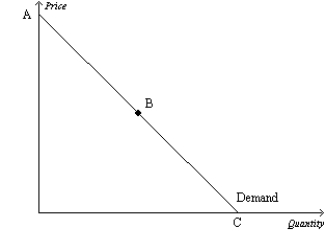 -Refer to Figure 5-4. If the price increases in the region of the demand curve between points A and B, we can expect total revenue to
 (Multiple Choice)
4.9/5  (84)
(84) Farm programs that pay farmers not to plant crops on all their land
(Multiple Choice)
4.9/5 (84)
(84) Suppose that good X is a luxury and that good Y is a necessity. Which good would you expect to have more price inelastic demand?
(Short Answer)
5.0/5 (84)
(84) An advantage of using the midpoint method to calculate the price elasticity of demand is that it uses the metric system.
(True/False)
4.9/5 (71)
(71) Figure 5-9  -Refer to Figure 5-9. If the price falls from point A to point B, total revenue
 (Multiple Choice)
4.8/5 (75)
(75) Table 5-9  -Refer to Table 5-9. Which of the three supply curves represents the least elastic supply?
 (Multiple Choice)
4.9/5 (74)
(74) Figure 5-8  -Refer to Figure 5-8. An increase in price from $10 to $15 would
 (Multiple Choice)
4.9/5 (85)
(85) Using the midpoint method, the price elasticity of demand for a good is computed to be approximately 0.75. Which of the following events is consistent with a 10 percent decrease in the quantity of the good demanded?
(Multiple Choice)
4.9/5 (78)
(78) You are in charge of the local city-owned aquatic center. You need to increase the revenue generated by the aquatic center to meet expenses. The mayor advises you to increase the price of a day pass. The city manager recommends reducing the price of a day pass. You realize that
(Multiple Choice)
4.9/5 (89)
(89) When quantity demanded responds strongly to changes in price, demand is said to be
(Multiple Choice)
4.9/5 (73)
(73) If a supply curve is horizontal, then supply is said to be perfectly elastic, and the price elasticity of supply approaches infinity.
(True/False)
4.8/5 (65)
(65) If the price of natural gas rises, when is the price elasticity of demand likely to be the highest?
(Multiple Choice)
4.9/5 (88)
(88) If the price elasticity of supply is 1.5, and a price increase led to a 3% increase in quantity supplied, then the price increase is about
(Multiple Choice)
4.8/5 (85)
(85) If the cross-price elasticity of demand for two goods is negative, then the two goods are substitutes.
(True/False)
4.9/5 (71)
(71) Suppose that demand is inelastic within a certain price range. For that price range,
(Multiple Choice)
4.9/5 (87)
(87) Figure 5-11  -Refer to Figure 5-11. A decrease in price from $20 to $10 leads to a
 (Multiple Choice)
4.9/5 (92)
(92) Which of the following is likely to have the most price inelastic demand?
(Multiple Choice)
4.9/5 (75)
(75) Frequently, in the short run, the quantity supplied of a good is
(Multiple Choice)
4.7/5 (85)
(85) 
Filters
- Essay(0)
- Multiple Choice(0)
- Short Answer(0)
- True False(0)
- Matching(0)