



 Chat with AI
Exam 17: Analysis of Financial Statements

Exam 1: Accounting in Business245 Questions
Exam 2: Analyzing and Recording Transactions201 Questions
Exam 3: Adjusting Accounts and Preparing Financial Statements227 Questions
Exam 4: Completing the Accounting Cycle177 Questions
Exam 5: Accounting for Merchandising Operations189 Questions
Exam 6: Inventories and Cost of Sales194 Questions
Exam 7: Accounting Information Systems166 Questions
Exam 8: Cash and Internal Controls195 Questions
Exam 9: Accounting for Receivables162 Questions
Exam 10: Long-Term Assets208 Questions
Exam 11: Current Liabilities and Payroll Accounting178 Questions
Exam 12: Accounting for Partnerships141 Questions
Exam 13: Accounting for Corporations210 Questions
Exam 14: Long-Term Liabilities158 Questions
Exam 15: Investments and International Operations156 Questions
Exam 16: Statement of Cash Flows173 Questions
Exam 17: Analysis of Financial Statements182 Questions
Exam 18: Managerial Accounting Concepts and Principles199 Questions
Exam 19: Job Order Cost Accounting165 Questions
Exam 20: Process Cost Accounting172 Questions
Exam 21: Cost Allocation and Performance Measurement173 Questions
Exam 22: Cost-Volume-Profit Analysis190 Questions
Exam 23: Master Budgets and Planning166 Questions
Exam 24: Flexible Budgets and Standard Costs178 Questions
Exam 25: Capital Budgeting and Managerial Decisions153 Questions
Select questions type


Refer to the following selected financial information from Fennie's, LLC. Compute the company's accounts receivable turnover for Year 2. 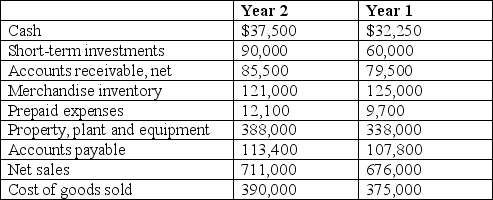
(Multiple Choice)
4.9/5  (72)
(72) The background on a company, its industry, and its economic setting is usually included in which of the following sections of a financial statement analysis report?
(Multiple Choice)
4.9/5 (81)
(81) Liquidity and efficiency are considered to be building blocks of financial statement analysis.
(True/False)
5.0/5 (80)
(80) Ratios, like other analysis tools, are only historically oriented.
(True/False)
4.7/5 (79)
(79) Financial statements with data for two or more successive accounting periods placed in columns side by side, sometimes with changes shown in dollar amounts and percents, are referred to as:
(Multiple Choice)
4.8/5 (79)
(79) Refer to the following selected financial information from Fennie's, LLC. Compute the company's days' sales in inventory for Year 2. 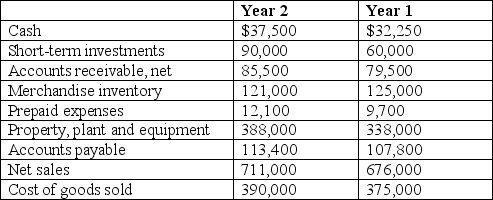
(Multiple Choice)
4.8/5 (84)
(84) Refer to the following selected financial information from Hansen's, LLC. Compute the company's times interest earned for Year 2.
(Multiple Choice)
4.9/5 (71)
(71) A corporation reported cash of $14,000 and total assets of $178,300. Its common-size percent for cash equals:
(Multiple Choice)
4.9/5 (61)
(61) Intracompany analysis is based on comparisons with competitors.
(True/False)
4.8/5 (73)
(73) Vertical analysis is the comparison of a company's financial condition and performance across time.
(True/False)
4.8/5 (61)
(61) The ability to generate positive market expectations is called:
(Multiple Choice)
4.9/5 (85)
(85) Refer to the following selected financial information from Fennie's, LLC. Compute the company's current ratio for Year 2. 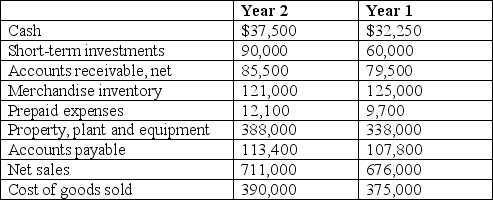
(Multiple Choice)
4.8/5 (82)
(82) Measures taken from a selected competitor or a group of competitors are often excellent standards of comparison for analysis.
(True/False)
4.9/5 (97)
(97) Use the following selected information from Farris, LLC to determine the Year 2 and Year 1 trend percents for cost of goods sold using Year 1 as the base.
(Multiple Choice)
4.8/5 (71)
(71) Use the following selected information from Farris, LLC to determine the Year 2 and Year 1 common size percents for cost of goods sold using Year 1 net sales as the base.
(Multiple Choice)
4.9/5 (80)
(80) Horizontal analysis is the comparison of a company's financial condition and performance to a base amount.
(True/False)
4.9/5 (86)
(86) 
Filters
- Essay(0)
- Multiple Choice(0)
- Short Answer(0)
- True False(0)
- Matching(0)