



 Chat with AI
Exam 17: Analysis of Financial Statements

Exam 1: Accounting in Business245 Questions
Exam 2: Analyzing and Recording Transactions201 Questions
Exam 3: Adjusting Accounts and Preparing Financial Statements227 Questions
Exam 4: Completing the Accounting Cycle177 Questions
Exam 5: Accounting for Merchandising Operations189 Questions
Exam 6: Inventories and Cost of Sales194 Questions
Exam 7: Accounting Information Systems166 Questions
Exam 8: Cash and Internal Controls195 Questions
Exam 9: Accounting for Receivables162 Questions
Exam 10: Long-Term Assets208 Questions
Exam 11: Current Liabilities and Payroll Accounting178 Questions
Exam 12: Accounting for Partnerships141 Questions
Exam 13: Accounting for Corporations210 Questions
Exam 14: Long-Term Liabilities158 Questions
Exam 15: Investments and International Operations156 Questions
Exam 16: Statement of Cash Flows173 Questions
Exam 17: Analysis of Financial Statements182 Questions
Exam 18: Managerial Accounting Concepts and Principles199 Questions
Exam 19: Job Order Cost Accounting165 Questions
Exam 20: Process Cost Accounting172 Questions
Exam 21: Cost Allocation and Performance Measurement173 Questions
Exam 22: Cost-Volume-Profit Analysis190 Questions
Exam 23: Master Budgets and Planning166 Questions
Exam 24: Flexible Budgets and Standard Costs178 Questions
Exam 25: Capital Budgeting and Managerial Decisions153 Questions
Select questions type


The standards for comparisons in financial statement analysis include (1) _____________, (2) ______________, (3) _______________, and (4) _____________.
(Essay)
4.8/5  (76)
(76) Use the following information from the current year financial statements of a company to calculate the ratios below:
(a) Current ratio.
(b) Accounts receivable turnover. (Assume the prior year's accounts receivable balance was $100,000.)
(c) Days' sales uncollected.
(d) Inventory turnover. (Assume the prior year's inventory was $50,200.)
(e) Times interest earned ratio.
(f) Return on ordinary shareholders'equity. (Assume the prior year's share capital on ordinary shares balance was $480,000 and the retained earnings balance was $128,000.)
(g) Earnings per share (assuming the corporation has a simple capital structure, with only ordinary shares outstanding).
(h) Price earnings ratio. (Assume the company's shares are selling for $26 per share.)
(i) Divided yield ratio. (Assume that the company paid $1.25 per share in cash dividends.)
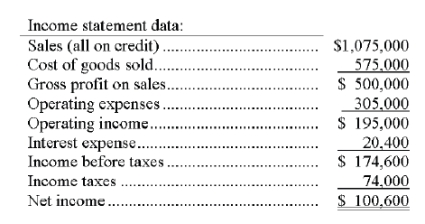
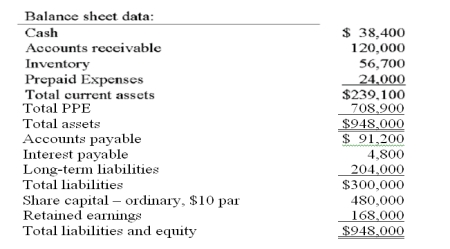
(Essay)
4.8/5 (86)
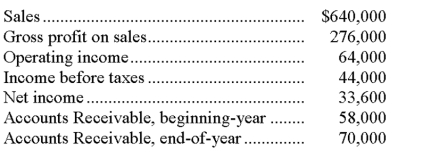
(86) The following current year information is available from a manufacturing company:
Calculate the company's accounts receivable turnover and its days' sales uncollected.
(Essay)
4.9/5 (77)
(77) The comparison of a company's financial condition and performance to a base amount is known as ___________________________.
(Essay)
4.9/5 (83)
(83) Three of the most common tools of financial analysis are (1) _______________________, (2) _________________________, and (3) ____________________________.
(Essay)
4.8/5 (85)
(85) Capital structure refers to a company's long-run financial viability and its ability to cover long-term obligations.
(True/False)
4.8/5 (79)
(79) The comparison of a company's financial condition and performance across time is known as:
(Multiple Choice)
4.8/5 (81)
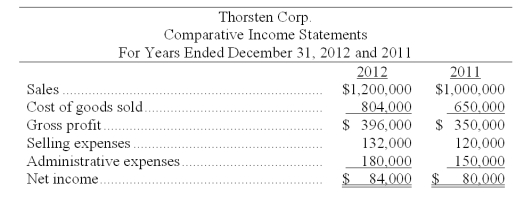
(81) Express the following income statement information in common-size percents (round to nearest whole percent). Comment on the results.
(Essay)
5.0/5 (84)
(84) Explain the purpose of financial statement analysis for both external and internal users.
(Essay)
4.7/5 (84)
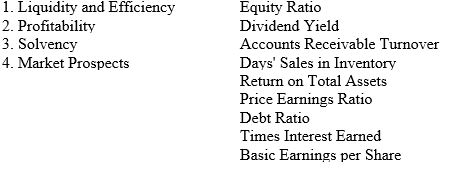
(84) Identify the financial analysis building block most appropriately associated with each ratio listed below by placing the letter of the building block a through d beside each ratio 1 through 10. Each building block may be used more than once.
(Essay)
4.9/5 (76)
(76) Working capital is computed as current liabilities minus current assets.
(True/False)
4.7/5 (73)
(73) The ability to generate future revenues and meet long-term obligations is referred to as:
(Multiple Choice)
4.8/5 (75)
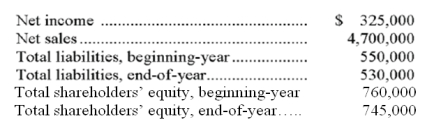
(75) Selected current year end financial information for a company is presented below. Calculate the following company ratios:
(a) Profit margin.
(b) Total asset turnover.
(c) Return on total assets.
(d) Return on ordinary shareholders' equity (assume the company has no preference shares).
(Essay)
4.8/5 (79)
(79) Use the following selected information from Farris, LLC to determine the Year 2 and Year 1 trend percents for net sales using Year 1 as the base.
(Multiple Choice)
4.7/5 (76)
(76) Refer to the following selected financial information from Hansen's, LLC. Compute the company's return on total assets for Year 2.
(Multiple Choice)
4.9/5 (80)
(80) The gross margin ratio, return on total assets, and basic earnings per share are all _____________ ratios.
(Essay)
4.9/5 (83)
(83) An advantage of common-size statements is that they reflect the dollar magnitude (size) of the different companies under analysis.
(True/False)
4.9/5 (80)
(80) The current ratio and acid-test ratio are used to reflect the ____________ of a business.
(Essay)
4.9/5 (67)
(67) 
Filters
- Essay(0)
- Multiple Choice(0)
- Short Answer(0)
- True False(0)
- Matching(0)