



 Chat with AI
Exam 17: Analysis of Financial Statements

Exam 1: Accounting in Business245 Questions
Exam 2: Analyzing and Recording Transactions201 Questions
Exam 3: Adjusting Accounts and Preparing Financial Statements227 Questions
Exam 4: Completing the Accounting Cycle177 Questions
Exam 5: Accounting for Merchandising Operations189 Questions
Exam 6: Inventories and Cost of Sales194 Questions
Exam 7: Accounting Information Systems166 Questions
Exam 8: Cash and Internal Controls195 Questions
Exam 9: Accounting for Receivables162 Questions
Exam 10: Long-Term Assets208 Questions
Exam 11: Current Liabilities and Payroll Accounting178 Questions
Exam 12: Accounting for Partnerships141 Questions
Exam 13: Accounting for Corporations210 Questions
Exam 14: Long-Term Liabilities158 Questions
Exam 15: Investments and International Operations156 Questions
Exam 16: Statement of Cash Flows173 Questions
Exam 17: Analysis of Financial Statements182 Questions
Exam 18: Managerial Accounting Concepts and Principles199 Questions
Exam 19: Job Order Cost Accounting165 Questions
Exam 20: Process Cost Accounting172 Questions
Exam 21: Cost Allocation and Performance Measurement173 Questions
Exam 22: Cost-Volume-Profit Analysis190 Questions
Exam 23: Master Budgets and Planning166 Questions
Exam 24: Flexible Budgets and Standard Costs178 Questions
Exam 25: Capital Budgeting and Managerial Decisions153 Questions
Select questions type


A company reported net income of $78,000 and had 15,000 common shares outstanding throughout the current year. At year-end, the price per share of the company's shares was $49.40. What is the company's year-end price-earnings ratio?
(Essay)
4.8/5  (75)
(75) A company's board of directors analyzes financial statements to assess future company prospects for making operating decisions.
(True/False)
4.8/5 (76)
(76) ______________________________ applies analytical tools to general-purpose financial statements and related data for making business decisions.
(Essay)
4.8/5 (85)
(85) A company had a market price of $37.50 per share, earnings per share of $1.25, and dividends per share of $0.40. Its price-earnings ratio equals:
(Multiple Choice)
4.8/5 (88)
(88) Express the following balance sheets for Alberts Company in common-size percents.
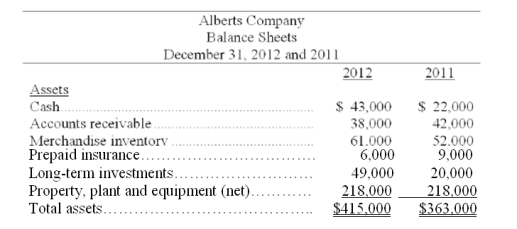
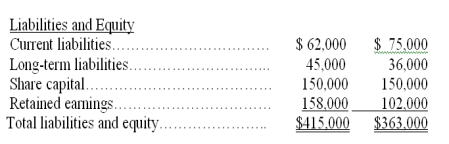
(Essay)
4.7/5 (82)
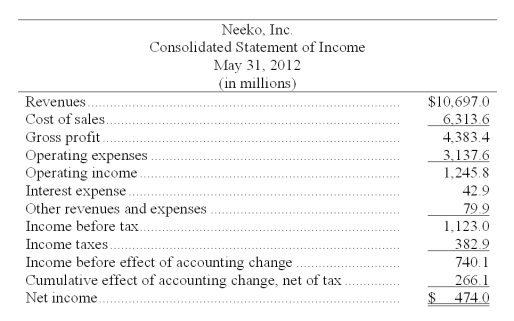
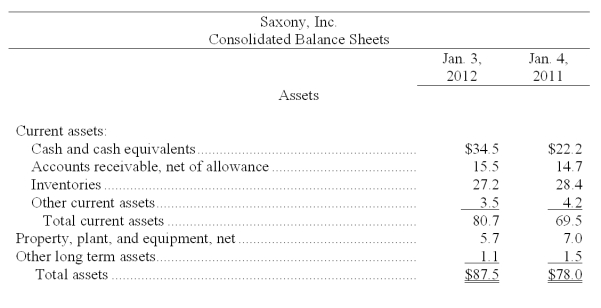
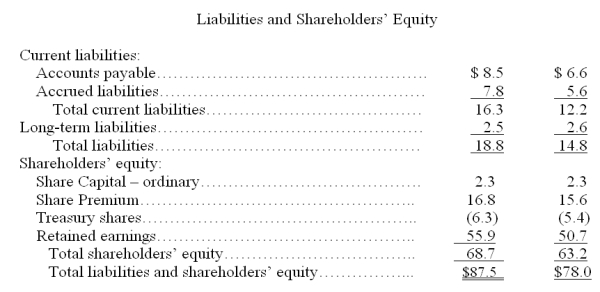
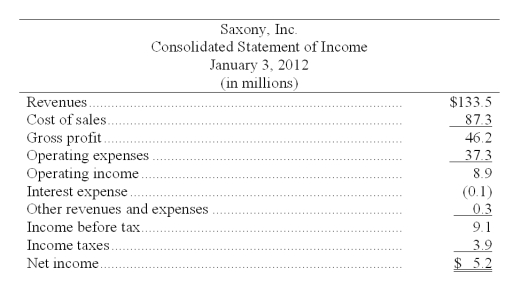
(82) The following summaries from the income statements and balance sheets of Neeko, Inc. and Saxony, Inc. are presented below.
(1) For both companies for 2012, compute the
(a) Current ratio
(b) Acid-test ratio
(c) Accounts receivable turnover
(d) Inventory turnover
(e) Days' sales in inventory
(f) Days' sales uncollected
Which company do you consider to be the better short-term credit risk? Explain.
(2) For both companies for 2012, compute the
(a) Profit margin ratio
(b) Return on total assets
(c) Return on ordinary shareholders'equity
Which company do you consider to have better profitability ratios?
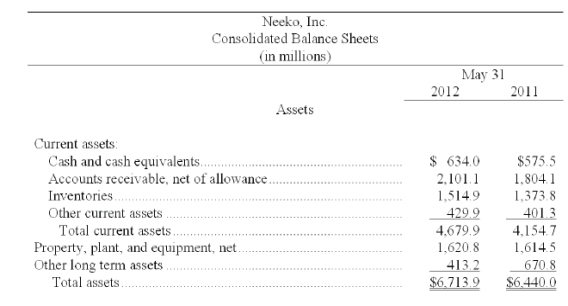
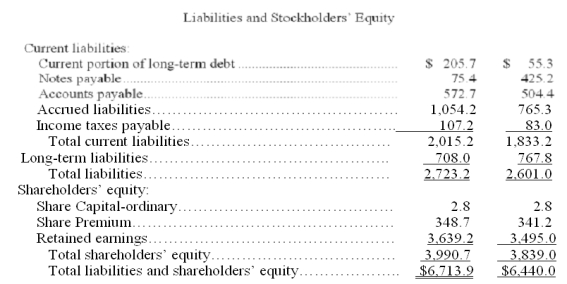
(Essay)
4.9/5 (89)
(89) The ability to provide financial rewards sufficient to attract and retain financing is called:
(Multiple Choice)
4.8/5 (81)
(81) For the following financial statement items, calculate trend percents using 2009 as the base year:

(Essay)
4.7/5 (90)
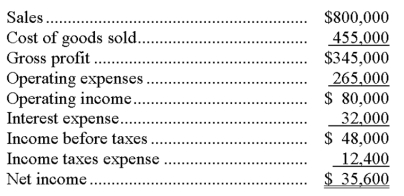
(90) Information from a manufacturing company's current year income statement is as follows. Calculate the company's (a) profit margin ratio, (b) gross margin ratio, and (c) times interest earned.
(Essay)
4.8/5 (91)
(91) Comparative financial statements in which each individual financial statement amount is expressed as a percentage of a base amount are called:
(Multiple Choice)
5.0/5 (77)
(77) Identify and describe three common tools of financial statement analysis.
(Essay)
4.9/5 (72)
(72) Trend percentage is calculated by dividing _________________________ by ___________________________ and multiplying the result by 100.
(Essay)
5.0/5 (83)
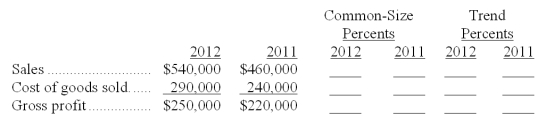
(83) Express the following income statement information in common-size percents and in trend percents using 2011 as the base year.
(Essay)
4.9/5 (81)
(81) A corporation reported cash of $14,000 and total assets of $178,300. Its common-size percent for cash equals 7.85%.
($14,000/$178,300) x 100 = 7.85%
(True/False)
4.8/5 (87)
(87) Phoenix Company reported sales of $400,000 for Year 1, $450,000 for Year 2, and $500,000 for Year 3. Using Year 1 as the base year, what were the percentage increases for Year 2 and Year 3 compared to the base year?
(Multiple Choice)
4.9/5 (74)
(74) Comparative financial statements in which each individual financial statement amount is expressed as a percentage of a base amount, and in which the base amount is expressed as 100%, are called:
(Multiple Choice)
5.0/5 (85)
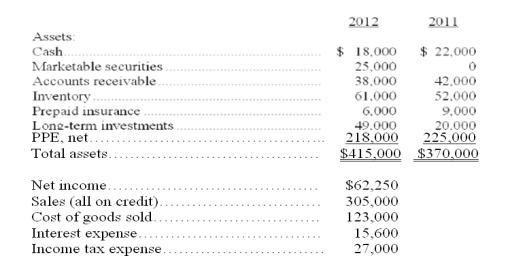
(85) Financial information for Omega Corporation is presented below. Calculate the following ratios for 2012:
(a) Inventory turnover.
(b) Accounts receivable turnover.
(c) Return on total assets.
(d) Times interest earned.
(e) Total asset turnover.
(Essay)
4.8/5 (83)
(83) A company that has days' sales uncollected of 30 days and days' sales in inventory of 18 days implies that inventory will be converted to cash in about 12 days.
(True/False)
4.8/5 (79)
(79) 
Filters
- Essay(0)
- Multiple Choice(0)
- Short Answer(0)
- True False(0)
- Matching(0)