



 Chat with AI
Exam 17: Analysis of Financial Statements

Exam 1: Accounting in Business245 Questions
Exam 2: Analyzing and Recording Transactions201 Questions
Exam 3: Adjusting Accounts and Preparing Financial Statements227 Questions
Exam 4: Completing the Accounting Cycle177 Questions
Exam 5: Accounting for Merchandising Operations189 Questions
Exam 6: Inventories and Cost of Sales194 Questions
Exam 7: Accounting Information Systems166 Questions
Exam 8: Cash and Internal Controls195 Questions
Exam 9: Accounting for Receivables162 Questions
Exam 10: Long-Term Assets208 Questions
Exam 11: Current Liabilities and Payroll Accounting178 Questions
Exam 12: Accounting for Partnerships141 Questions
Exam 13: Accounting for Corporations210 Questions
Exam 14: Long-Term Liabilities158 Questions
Exam 15: Investments and International Operations156 Questions
Exam 16: Statement of Cash Flows173 Questions
Exam 17: Analysis of Financial Statements182 Questions
Exam 18: Managerial Accounting Concepts and Principles199 Questions
Exam 19: Job Order Cost Accounting165 Questions
Exam 20: Process Cost Accounting172 Questions
Exam 21: Cost Allocation and Performance Measurement173 Questions
Exam 22: Cost-Volume-Profit Analysis190 Questions
Exam 23: Master Budgets and Planning166 Questions
Exam 24: Flexible Budgets and Standard Costs178 Questions
Exam 25: Capital Budgeting and Managerial Decisions153 Questions
Select questions type


Profitability is the ability to generate positive market expectations.
(True/False)
4.9/5  (78)
(78) What is the purpose of a good financial statement analysis report? What are the key components?
(Essay)
4.9/5 (79)
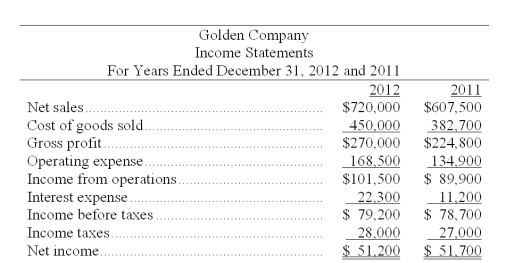
(79) The comparative income statements for Golden Company are shown below. Calculate the following ratios for 2012:
(a) profit margin.
(b) gross margin.
(c) times interest earned.
(Essay)
4.8/5 (94)
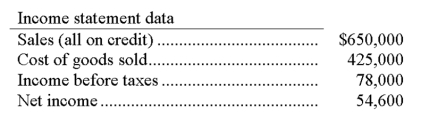
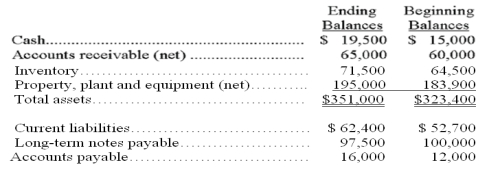
(94) Use the financial data shown below to calculate the following ratios for the current year:
(a) Current ratio.
(b) Acid-test ratio.
(c) Accounts receivable turnover.
(d) Days' sales uncollected.
(e) Inventory turnover.
(f) Days' sales in inventory.
(g) Accounts payable turnover.
(Essay)
4.7/5 (79)
(79) Financial statement analysis is the application of analytical tools to general-purpose financial statements and related data for making business decisions.
(True/False)
4.9/5 (72)
(72) The building blocks of financial statement analysis include:
(Multiple Choice)
4.9/5 (90)
(90) Comparative financial statements are reports that show financial amounts placed side by side in columns on a single statement for analysis purposes.
(True/False)
4.9/5 (77)
(77) Selected current year company information follows: 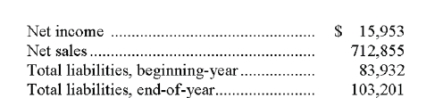 Total shareholders' equity, beginning-year.. 198,935
Total shareholders' equity, end-of-year…… 121,851
The return on total assets is:
Total shareholders' equity, beginning-year.. 198,935
Total shareholders' equity, end-of-year…… 121,851
The return on total assets is: (Multiple Choice)
4.8/5 (78)
(78) A high level of expected risk suggests a low price-earnings ratio.
(True/False)
4.9/5 (79)
(79) The dollar change for a financial statement item is calculated by:
(Multiple Choice)
4.9/5 (79)
(79) Standards for comparisons in financial statement analysis include:
(Multiple Choice)
4.9/5 (73)
(73) The current ratio is calculated as current liabilities divided by current assets.
(True/False)
4.8/5 (83)
(83) Standards for comparison are necessary when making judgments about a company's performance.
(True/False)
4.9/5 (82)
(82) Market prospects are the ability to provide financial rewards sufficient to attract and retain financing.
(True/False)
4.9/5 (71)
(71) 
Filters
- Essay(0)
- Multiple Choice(0)
- Short Answer(0)
- True False(0)
- Matching(0)