



 Chat with AI
Exam 22: The Short-Run Trade-Off Between Inflation and Unemployment

Exam 1: Ten Principles of Economics438 Questions
Exam 2: Thinking Like an Economist620 Questions
Exam 3: Interdependence and the Gains From Trade527 Questions
Exam 4: The Market Forces of Supply and Demand700 Questions
Exam 5: Elasticity and Its Application598 Questions
Exam 6: Supply, Demand, and Government Policies648 Questions
Exam 7: Consumers, Producers, and the Efficiency of Markets547 Questions
Exam 8: Application: the Costs of Taxation514 Questions
Exam 9: Application: International Trade496 Questions
Exam 10: Measuring a Nations Income522 Questions
Exam 11: Measuring the Cost of Living545 Questions
Exam 12: Production and Growth507 Questions
Exam 13: Saving, Investment, and the Financial System567 Questions
Exam 14: The Basic Tools of Finance513 Questions
Exam 15: Unemployment699 Questions
Exam 16: The Monetary System517 Questions
Exam 17: Money Growth and Inflation487 Questions
Exam 18: Open-Economy Macroeconomics: Basic Concepts522 Questions
Exam 19: A Macroeconomic Theory of the Open Economy484 Questions
Exam 20: Aggregate Demand and Aggregate Supply563 Questions
Exam 21: The Influence of Monetary and Fiscal Policy on Aggregate Demand511 Questions
Exam 22: The Short-Run Trade-Off Between Inflation and Unemployment516 Questions
Exam 23: Six Debates Over Macroeconomic Policy372 Questions
Select questions type


If the Federal Reserve increases the rate at which it increases the money supply, then unemployment is lower
(Multiple Choice)
4.9/5  (81)
(81) Suppose that a small economy that produces mostly agricultural goods experiences a year with exceptionally good conditions for growing crops. The good weather would
(Multiple Choice)
4.9/5 (82)
(82) How would a decrease in the natural rate of unemployment affect the long-run Phillips curve?
(Multiple Choice)
4.9/5 (73)
(73) Why does a downward-sloping Phillips curve imply a positive sacrifice ratio?
(Essay)
5.0/5 (68)
(68) Which of the following would reduce the natural rate of unemployment?
(Multiple Choice)
4.8/5 (93)
(93) In the long run, a decrease in the money supply growth rate
(Multiple Choice)
4.9/5 (85)
(85) Figure 35-1. The left-hand graph shows a short-run aggregate-supply SRAS) curve and two aggregate-demand AD) curves. On the right-hand diagram, U represents the unemployment rate.
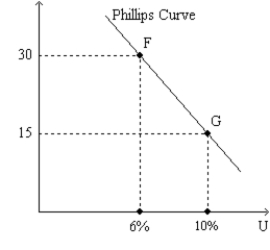
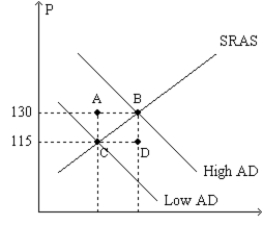 -Refer to Figure 35-1. The curve that is depicted on the righthand graph offers policymakers a "menu" of combinations
 (Multiple Choice)
4.8/5 (99)
(99) In the late 1970s, proponents of rational expectations argued that
(Multiple Choice)
4.9/5 (89)
(89) Refer to Monetary Policy in Mokania. The Bank of Mokania reduced inflation to its announced goal of 5%. However its efforts made the unemployment rate rise by 10 percentage points for a year while output fell by 30 percent for a year. Which of the following is correct?
(Multiple Choice)
4.9/5 (90)
(90) In response to the financial crisis of 2007-2008, policymakers used
(Multiple Choice)
4.8/5 (80)
(80) In 1979, when the Fed was deciding how aggressively to fight inflation, the typical estimate of the sacrifice ratio was
(Multiple Choice)
4.9/5 (86)
(86) If the Fed announced a policy to reduce inflation and people found it credible, the short-run Phillips curve would shift
(Multiple Choice)
4.7/5 (88)
(88) According to Friedman and Phelps's analysis of the Phillips curve,
(Multiple Choice)
4.8/5 (87)
(87) Figure 35-6
Use the graph below to answer the following questions.  -Refer to Figure 35-6. Curve 2 is the
 (Multiple Choice)
4.9/5 (84)
(84) Just as the aggregate-demand curve slopes downward only in the short run, the trade-off between inflation and unemployment holds only in the long run.
(True/False)
4.9/5 (74)
(74) Suppose the Fed decreased the growth rate of the money supply. Which of the following would be lower in the long run?
(Multiple Choice)
4.9/5 (72)
(72) Milton Friedman and Edmund Phelps argued in the late 1960s that in the long run the Phillips curve is
(Multiple Choice)
4.8/5 (78)
(78) If a central bank reduced inflation by 4 percentage points and this made output fall by 5 percent for one year and 3 percent for another year and the unemployment rate rise 2.5 percent above its natural rate for one year and 1.5 percent above its natural rate for another year, the sacrifice ratio was
(Multiple Choice)
4.8/5 (80)
(80) 
Filters
- Essay(0)
- Multiple Choice(0)
- Short Answer(0)
- True False(0)
- Matching(0)