



 Chat with AI
Exam 22: The Short-Run Trade-Off Between Inflation and Unemployment

Exam 1: Ten Principles of Economics438 Questions
Exam 2: Thinking Like an Economist620 Questions
Exam 3: Interdependence and the Gains From Trade527 Questions
Exam 4: The Market Forces of Supply and Demand700 Questions
Exam 5: Elasticity and Its Application598 Questions
Exam 6: Supply, Demand, and Government Policies648 Questions
Exam 7: Consumers, Producers, and the Efficiency of Markets547 Questions
Exam 8: Application: the Costs of Taxation514 Questions
Exam 9: Application: International Trade496 Questions
Exam 10: Measuring a Nations Income522 Questions
Exam 11: Measuring the Cost of Living545 Questions
Exam 12: Production and Growth507 Questions
Exam 13: Saving, Investment, and the Financial System567 Questions
Exam 14: The Basic Tools of Finance513 Questions
Exam 15: Unemployment699 Questions
Exam 16: The Monetary System517 Questions
Exam 17: Money Growth and Inflation487 Questions
Exam 18: Open-Economy Macroeconomics: Basic Concepts522 Questions
Exam 19: A Macroeconomic Theory of the Open Economy484 Questions
Exam 20: Aggregate Demand and Aggregate Supply563 Questions
Exam 21: The Influence of Monetary and Fiscal Policy on Aggregate Demand511 Questions
Exam 22: The Short-Run Trade-Off Between Inflation and Unemployment516 Questions
Exam 23: Six Debates Over Macroeconomic Policy372 Questions
Select questions type


A central bank sets out to reduce unemployment by changing the money supply growth rate. The long-run Phillips curve shows that in comparison to their original rates, this policy will eventually lead to
(Multiple Choice)
4.8/5  (86)
(86) A central bank raises the money supply growth rate and keeps it higher. As the economy moves from the short-run equilibrium created by the increase in the money supply growth back to long-run equilibrium what happens to the unemployment rate?
(Essay)
4.8/5 (78)
(78) If a central bank reduced inflation by 2 percentage points and that made output fall by 3 percentage points for 2 years and the unemployment rate rise from 3 percent to 5 percent for 2 years, the sacrifice ratio is
(Multiple Choice)
4.8/5 (95)
(95) The short-run relationship between inflation and unemployment is often called
(Multiple Choice)
4.9/5 (74)
(74) Figure 35-8
Use this graph to answer the questions below. 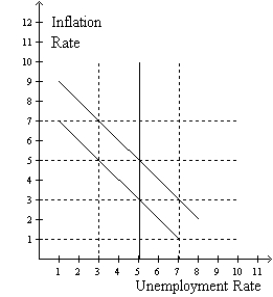 -Refer to figure 35-8. If the economy starts at 5% unemployment and 5% inflation then if the Federal Reserve pursues a contractionary monetary policy, in the short run the economy moves to
 (Multiple Choice)
4.9/5 (77)
(77) How is a decrease in the natural rate of unemployment shown in the Phillips curve diagram? Does this decrease change the inflation rate?
(Essay)
4.7/5 (70)
(70) Suppose that the central bank unexpectedly increases the growth rate of the money supply. In the short run the effects of this are shown by
(Multiple Choice)
4.7/5 (81)
(81) If inflation is greater than expected, then the unemployment rate is
(Multiple Choice)
4.8/5 (81)
(81) Unexpectedly high inflation reduces unemployment in the short run, but as inflation expectations adjust the unemployment rate returns to its natural rate.
(True/False)
4.8/5 (70)
(70) How does a central bank's accommodation of an adverse supply shock change the longrun results of the shock?
(Essay)
4.8/5 (76)
(76) Which of the following is correct if there is a favorable supply shock?
(Multiple Choice)
4.8/5 (83)
(83) Which of the following would shift the long-run Phillips curve to the right?
(Multiple Choice)
5.0/5 (91)
(91) When they are confronted with an adverse shock to aggregate supply, policymakers face a difficult choice in that
(Multiple Choice)
4.8/5 (79)
(79) 
Filters
- Essay(0)
- Multiple Choice(0)
- Short Answer(0)
- True False(0)
- Matching(0)