



 Chat with AI
Exam 22: The Short-Run Trade-Off Between Inflation and Unemployment

Exam 1: Ten Principles of Economics438 Questions
Exam 2: Thinking Like an Economist620 Questions
Exam 3: Interdependence and the Gains From Trade527 Questions
Exam 4: The Market Forces of Supply and Demand700 Questions
Exam 5: Elasticity and Its Application598 Questions
Exam 6: Supply, Demand, and Government Policies648 Questions
Exam 7: Consumers, Producers, and the Efficiency of Markets547 Questions
Exam 8: Application: the Costs of Taxation514 Questions
Exam 9: Application: International Trade496 Questions
Exam 10: Measuring a Nations Income522 Questions
Exam 11: Measuring the Cost of Living545 Questions
Exam 12: Production and Growth507 Questions
Exam 13: Saving, Investment, and the Financial System567 Questions
Exam 14: The Basic Tools of Finance513 Questions
Exam 15: Unemployment699 Questions
Exam 16: The Monetary System517 Questions
Exam 17: Money Growth and Inflation487 Questions
Exam 18: Open-Economy Macroeconomics: Basic Concepts522 Questions
Exam 19: A Macroeconomic Theory of the Open Economy484 Questions
Exam 20: Aggregate Demand and Aggregate Supply563 Questions
Exam 21: The Influence of Monetary and Fiscal Policy on Aggregate Demand511 Questions
Exam 22: The Short-Run Trade-Off Between Inflation and Unemployment516 Questions
Exam 23: Six Debates Over Macroeconomic Policy372 Questions
Select questions type


Figure 35-2
Use the pair of diagrams below to answer the following questions.
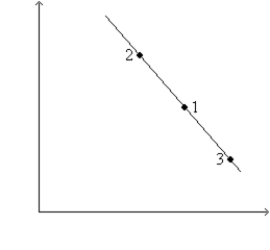
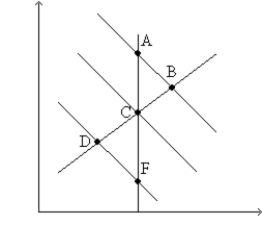 -Refer to Figure 35-2. If the economy starts at C and 1, then in the short run, an increase in the money supply growth rate moves the economy to
 (Multiple Choice)
4.7/5  (83)
(83) A central bank pledges to reduce the inflation rate from 10% to 3%. People reduce their inflation expectations to 5%, but the central bank reduces inflation to 3%. What happens to the unemployment rate?
(Essay)
4.9/5 (92)
(92) The short-run Phillips curve is based on the classical dichotomy.
(True/False)
4.9/5 (84)
(84) If the central bank raises the rate at which it increases the money supply, then in the short run unemployment is
(Multiple Choice)
4.9/5 (88)
(88) Which of the following scenarios is consistent with typical estimates of the sacrifice ratio?
(Multiple Choice)
4.8/5 (75)
(75) If a government redesigned its unemployment insurance programs so that the unemployed had greater incentives to quickly find appropriate jobs, then which of the following curves would shift right?
(Multiple Choice)
5.0/5 (75)
(75) Economist A.W. Phillips found a negative correlation between
(Multiple Choice)
4.8/5 (77)
(77) If the Federal Reserve increases the growth rate of the money supply, in the long run
(Multiple Choice)
4.9/5 (91)
(91) According to the Phillips curve, unemployment and inflation are positively related in
(Multiple Choice)
4.9/5 (74)
(74) Suppose the central bank pursues an unexpectedly tight monetary policy. In the short-run the effects of this are shown by
(Multiple Choice)
5.0/5 (86)
(86) Some countries have inflation around or in excess of 8 percent. Suppose that the sacrifice ratio is 2.5. What is the cost of reducing inflation from 8 percent to 2 percent? In your answer, define the sacrifice ratio and explain how you found the cost of inflation reduction.
(Essay)
4.9/5 (74)
(74) If unemployment is above its natural rate, what happens to move the economy to long-run equilibrium?
(Multiple Choice)
4.8/5 (81)
(81) If inflation expectations rise, the short-run Phillips curve shifts
(Multiple Choice)
4.7/5 (85)
(85) Figure 35-2
Use the pair of diagrams below to answer the following questions.
-Refer to Figure 35-2. If the economy starts at C and 1, then in the short run, a decrease in taxes moves the economy to
-Refer to Figure 35-2. If the economy starts at C and 1, then in the short run, a decrease in taxes moves the economy to (Multiple Choice)
4.9/5 (83)
(83) If people correctly anticipate that inflation will fall by 1%, then
(Multiple Choice)
4.9/5 (77)
(77) 
Filters
- Essay(0)
- Multiple Choice(0)
- Short Answer(0)
- True False(0)
- Matching(0)