



 Chat with AI
Exam 22: The Short-Run Trade-Off Between Inflation and Unemployment

Exam 1: Ten Principles of Economics438 Questions
Exam 2: Thinking Like an Economist620 Questions
Exam 3: Interdependence and the Gains From Trade527 Questions
Exam 4: The Market Forces of Supply and Demand700 Questions
Exam 5: Elasticity and Its Application598 Questions
Exam 6: Supply, Demand, and Government Policies648 Questions
Exam 7: Consumers, Producers, and the Efficiency of Markets547 Questions
Exam 8: Application: the Costs of Taxation514 Questions
Exam 9: Application: International Trade496 Questions
Exam 10: Measuring a Nations Income522 Questions
Exam 11: Measuring the Cost of Living545 Questions
Exam 12: Production and Growth507 Questions
Exam 13: Saving, Investment, and the Financial System567 Questions
Exam 14: The Basic Tools of Finance513 Questions
Exam 15: Unemployment699 Questions
Exam 16: The Monetary System517 Questions
Exam 17: Money Growth and Inflation487 Questions
Exam 18: Open-Economy Macroeconomics: Basic Concepts522 Questions
Exam 19: A Macroeconomic Theory of the Open Economy484 Questions
Exam 20: Aggregate Demand and Aggregate Supply563 Questions
Exam 21: The Influence of Monetary and Fiscal Policy on Aggregate Demand511 Questions
Exam 22: The Short-Run Trade-Off Between Inflation and Unemployment516 Questions
Exam 23: Six Debates Over Macroeconomic Policy372 Questions
Select questions type


Refer to Monetary Policy in Flosserland. Suppose that the Flosserland Department of Finance undertakes a public relations campaign to convince people that it will soon change monetary policy to reduce inflation to 12.5%. If Flosserlanders believe their government then which, if any, curves) shift left?
(Multiple Choice)
4.8/5  (87)
(87) After an oil price shock, which of the following would move unemployment back towards its natural rate?
(Multiple Choice)
4.9/5 (86)
(86) In the equation, Unemployment rate = Natural rate of unemployment - a × Αctual inflation - Expected inflation), the variable a is a parameter that measures how much
(Multiple Choice)
4.8/5 (73)
(73) Refer to the Economy in 2008. The effects of increased prices of world commodities is shown by shifting
(Multiple Choice)
4.9/5 (85)
(85) The Fed increases the money supply growth rate. Assuming inflation expectations remain constant, use a Phillips curve diagram to show the shortrun effects of the Fed's policy.
(Essay)
4.9/5 (72)
(72) In responding to the Phillips curve hypothesis, Friedman argued that the Fed can peg the
(Multiple Choice)
4.9/5 (77)
(77) If a central bank attempts to lower the inflation rate but the public doesn't believe the inflation rate will fall as far as the central bank says, then in the short run unemployment
(Multiple Choice)
4.8/5 (84)
(84) France has a higher natural rate of unemployment than the United States. This suggests that
(Multiple Choice)
4.9/5 (79)
(79) Which of the following played a role in depressing aggregate demand in 2001?
(Multiple Choice)
4.7/5 (76)
(76) Suppose that the Fed unexpectedly pursues contractionary monetary policy. What will happen to unemployment in the short run? What will happen to unemployment in the long run? Justify your answer using the Phillips curves.
(Essay)
4.8/5 (79)
(79) Which of the following is correct according to the long-run Phillips curve?
(Multiple Choice)
4.7/5 (78)
(78) If because they expect the central bank to disinflate, people reduce their inflation expectations, then is the sacrifice ratio larger or smaller the otherwise? Defend your answer by referring to the Phillips curve.
(Essay)
4.9/5 (83)
(83) Figure 35-4. The left-hand graph shows a short-run aggregate-supply SRAS) curve and two aggregate-demand AD) curves. On the left-hand diagram, the price level is measured on the vertical axis; on the right-hand diagram, the inflation rate is measured on the vertical axis. 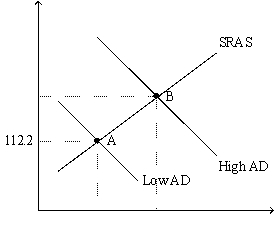
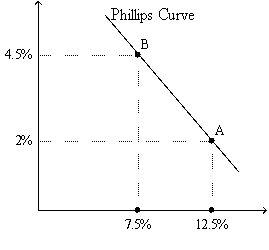 -Refer to Figure 35-4. What is measured along the horizontal axis of the left-hand graph?
 (Multiple Choice)
5.0/5 (81)
(81) An adverse supply shock shifts the short-run Phillips curve right and the short-run aggregate-supply curve left.
(True/False)
4.9/5 (82)
(82) In the late 1960s, Milton Friedman and Edmund Phelps argued that
(Multiple Choice)
4.7/5 (87)
(87) An adverse supply shock will shift short-run aggregate supply
(Multiple Choice)
4.7/5 (66)
(66) If a central bank increases the money supply growth rate, then in the short run
(Multiple Choice)
4.9/5 (80)
(80) 
Filters
- Essay(0)
- Multiple Choice(0)
- Short Answer(0)
- True False(0)
- Matching(0)