



 Chat with AI
Exam 21: The Monetary System

Exam 1: Ten Principles of Economics438 Questions
Exam 2: Thinking Like an Economist620 Questions
Exam 3: Interdependence and the Gains From Trade527 Questions
Exam 4: The Market Forces of Supply and Demand700 Questions
Exam 5: Elasticity and Its Application598 Questions
Exam 6: Supply, Demand, and Government Policies648 Questions
Exam 7: Consumers, Producers, and the Efficiency of Markets550 Questions
Exam 8: Application: The Costs of Taxation514 Questions
Exam 9: Application: International Trade496 Questions
Exam 10: Externalities522 Questions
Exam 11: Public Goods and Common Resources434 Questions
Exam 12: The Costs of Production420 Questions
Exam 13: Firms in Competitive Markets543 Questions
Exam 14: Monopoly637 Questions
Exam 15: Measuring a Nations Income522 Questions
Exam 16: Measuring the Cost of Living545 Questions
Exam 17: Production and Growth507 Questions
Exam 18: Saving, Investment, and the Financial System567 Questions
Exam 19: The Basic Tools of Finance513 Questions
Exam 20: Unemployment699 Questions
Exam 21: The Monetary System518 Questions
Exam 22: Money Growth and Inflation487 Questions
Exam 23: Aggregate Demand and Aggregate Supply563 Questions
Exam 24: The Influence of Monetary and Fiscal Policy on Aggregate Demand512 Questions
Select questions type


Consider the following traders who meet.  Which, if any, pairs of traders has a double coincidence of wants?
 (Multiple Choice)
4.8/5  (74)
(74) Mia puts money into a piggy bank so she can spend it later. What function of money does this illustrate?
(Multiple Choice)
4.9/5 (79)
(79) The is the interest rate at which banks make overnight loans to other banks.
(Short Answer)
4.8/5 (73)
(73) Designers of the Federal Reserve System were concerned that the Fed might form policy favorable to one part of the country or to a particular party. What are some ways that the organization of the Fed reflects such concerns?
(Essay)
4.9/5 (76)
(76) If the reserve requirement is 12 percent and banks desire to hold no excess reserves, when a bank receives a new deposit of $1,000,
(Multiple Choice)
4.8/5 (87)
(87) First National Bank FNB) has a reserve ratio of 20 percent, a required reserve ratio of 10 percent, and deposits of $1,000. If FNB receives an additional deposit of $100,
(Multiple Choice)
4.9/5 (69)
(69) When banks decide to increase their reserves, the money supply will holding all else constant).
(Essay)
4.7/5 (70)
(70) Table 29-1.
The information in the table pertains to an imaginary economy.
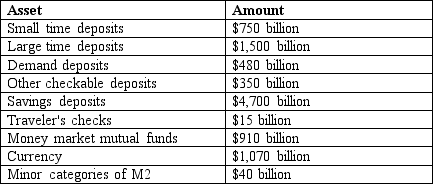 -Refer to Table 29-1. What is the value of M1 in billions of dollars?
 (Multiple Choice)
4.8/5 (74)
(74) Table 29-5.
 -Refer to Table 29-5. If the bank faces a reserve requirement of 20 percent, then it
 (Multiple Choice)
4.8/5 (80)
(80) Explain why banks can influence the money supply if the required reserve ratio is less than 100 percent.
(Essay)
4.9/5 (84)
(84) Bottles of very fine wine are less liquid than demand deposits.
(True/False)
4.8/5 (78)
(78) Which of the following is an asset of a bank and a liability for its customers?
(Multiple Choice)
4.8/5 (85)
(85) Table 29-8
 -Refer to Table 29-8. The required reserve ratio is 12 percent. Which of the following is true?
 (Multiple Choice)
5.0/5 (66)
(66) One plausible explanation for the large amount of U.S. currency outstanding is that many dollars are held abroad.
(True/False)
4.8/5 (81)
(81) 
Filters
- Essay(0)
- Multiple Choice(0)
- Short Answer(0)
- True False(0)
- Matching(0)