



 Chat with AI
Exam 21: The Monetary System

Exam 1: Ten Principles of Economics438 Questions
Exam 2: Thinking Like an Economist620 Questions
Exam 3: Interdependence and the Gains From Trade527 Questions
Exam 4: The Market Forces of Supply and Demand700 Questions
Exam 5: Elasticity and Its Application598 Questions
Exam 6: Supply, Demand, and Government Policies648 Questions
Exam 7: Consumers, Producers, and the Efficiency of Markets550 Questions
Exam 8: Application: The Costs of Taxation514 Questions
Exam 9: Application: International Trade496 Questions
Exam 10: Externalities522 Questions
Exam 11: Public Goods and Common Resources434 Questions
Exam 12: The Costs of Production420 Questions
Exam 13: Firms in Competitive Markets543 Questions
Exam 14: Monopoly637 Questions
Exam 15: Measuring a Nations Income522 Questions
Exam 16: Measuring the Cost of Living545 Questions
Exam 17: Production and Growth507 Questions
Exam 18: Saving, Investment, and the Financial System567 Questions
Exam 19: The Basic Tools of Finance513 Questions
Exam 20: Unemployment699 Questions
Exam 21: The Monetary System518 Questions
Exam 22: Money Growth and Inflation487 Questions
Exam 23: Aggregate Demand and Aggregate Supply563 Questions
Exam 24: The Influence of Monetary and Fiscal Policy on Aggregate Demand512 Questions
Select questions type


Trace the effects on the money supply when the Fed decreases the discount rate.
(Essay)
4.9/5  (82)
(82) If the reserve ratio is 100-percent, then a new deposit of $1000 into a bank account
(Multiple Choice)
4.8/5 (81)
(81) As opposed to a payments system based on barter, a payments system based on money
(Multiple Choice)
4.9/5 (74)
(74) You saved $500 in currency in your piggy bank to purchase a new laptop. The $500 you kept in your piggy bank illustrates money's function as a . The laptop's price is posted as $500. The $500 price illustrates money's function as a . You use the $500 to purchase the laptop. This transaction illustrates money's function as a ______.
(Multiple Choice)
5.0/5 (79)
(79) Explain how each of the following changes the money supply.
a. the Fed buys bonds
b. the Fed auctions credit
c. the Fed raises the discount rate
d. the Fed raises the reserve requirement
(Essay)
4.9/5 (71)
(71) Table 29-1.
The information in the table pertains to an imaginary economy.
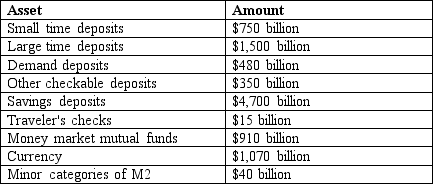 -Refer to Table 29-1. What is the value of M2 in billions of dollars?
 (Multiple Choice)
4.8/5 (73)
(73) If banks hold any amount of their deposits in reserve, then they do not have the ability to influence the money supply.
(True/False)
4.8/5 (78)
(78) The president of each regional Federal Reserve Bank is appointed by
(Multiple Choice)
4.8/5 (73)
(73) John and Jane decide to go on a vacation. As a result, they withdraw $2,500 from their savings account to purchase $2,500 worth of traveler's checks. As a result of these changes,
(Multiple Choice)
4.7/5 (66)
(66) When the federal funds rate is below the target rate, the Fed will bonds.
This action will the money supply.
(Short Answer)
4.7/5 (70)
(70) When you purchase school supplies at the book store using cash, you are using money as a medium of exchange.
(True/False)
4.8/5 (91)
(91) A bank has an 8 percent reserve requirement, $10,000 in deposits, and has loaned out all it can given the reserve requirement.
(Multiple Choice)
4.8/5 (76)
(76) If the Fed increases the reserve ratio from 5 percent to 12.5 percent, then the money multiplier
(Multiple Choice)
4.9/5 (70)
(70) Which of the following items is not included in the most narrow definition of money, M1?
(Multiple Choice)
4.8/5 (87)
(87) The Federal Reserve can alter the size of the money supply by changing reserves or changing reserve requirements.
(True/False)
4.8/5 (82)
(82) 
Filters
- Essay(0)
- Multiple Choice(0)
- Short Answer(0)
- True False(0)
- Matching(0)