



 Chat with AI
Exam 21: The Monetary System

Exam 1: Ten Principles of Economics438 Questions
Exam 2: Thinking Like an Economist620 Questions
Exam 3: Interdependence and the Gains From Trade527 Questions
Exam 4: The Market Forces of Supply and Demand700 Questions
Exam 5: Elasticity and Its Application598 Questions
Exam 6: Supply, Demand, and Government Policies648 Questions
Exam 7: Consumers, Producers, and the Efficiency of Markets550 Questions
Exam 8: Application: The Costs of Taxation514 Questions
Exam 9: Application: International Trade496 Questions
Exam 10: Externalities522 Questions
Exam 11: Public Goods and Common Resources434 Questions
Exam 12: The Costs of Production420 Questions
Exam 13: Firms in Competitive Markets543 Questions
Exam 14: Monopoly637 Questions
Exam 15: Measuring a Nations Income522 Questions
Exam 16: Measuring the Cost of Living545 Questions
Exam 17: Production and Growth507 Questions
Exam 18: Saving, Investment, and the Financial System567 Questions
Exam 19: The Basic Tools of Finance513 Questions
Exam 20: Unemployment699 Questions
Exam 21: The Monetary System518 Questions
Exam 22: Money Growth and Inflation487 Questions
Exam 23: Aggregate Demand and Aggregate Supply563 Questions
Exam 24: The Influence of Monetary and Fiscal Policy on Aggregate Demand512 Questions
Select questions type


In many circumstances, prisoners are not allowed to possess cash. Does this mean there is no money in prison? Explain.
(Essay)
4.9/5  (82)
(82) Given the following information, what are the values of M1 and M2? Small time deposits $2,200 billion
Demand deposits and other checkable deposits $1,700 billion
Savings deposits $2,600 billion
Money market mutual funds $1,500 billion
Traveler's checks $60 billion
Large time deposits $1,500 billion
Currency $350 billion
Miscellaneous categories in M2 $75 billion
(Multiple Choice)
4.8/5 (83)
(83) Consider five high school students working on homework in study hall. 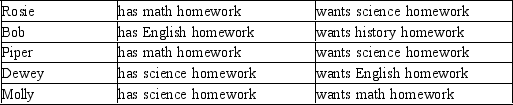 Which of the following pairs of students has a double coincidence of wants?
 (Multiple Choice)
4.9/5 (85)
(85) The Federal Reserve was created in 1913 after a series of bank failures in 1907.
(True/False)
4.9/5 (80)
(80) Table 29-5.
 -Refer to Table 29-5. If the bank is holding $4,000 in excess reserves, then the reserve requirement with which it must comply is
 (Multiple Choice)
4.9/5 (79)
(79) Economists argue that the move from barter to money increased trade and production. How is this possible?
(Essay)
4.9/5 (84)
(84) Federal Reserve governors are given long terms to insulate them from politics.
(True/False)
4.7/5 (74)
(74) When colonists in Virginia used tobacco as money, their money
(Multiple Choice)
4.8/5 (80)
(80) Given the following information, what are the values of M1 and M2? Small time deposits $600 billion
Demand deposits and other checkable deposits $400 billion
Savings deposits $800 billion
Money market mutual funds $700 billion
Traveler's checks $30 billion
Large time deposits $400 billion
Currency $250 billion
Miscellaneous categories in M2 $20 billion
(Multiple Choice)
4.8/5 (81)
(81) In a system of 100-percent-reserve banking, the purpose of a bank is to
(Multiple Choice)
4.9/5 (79)
(79) The banking system currently has $100 billion of reserves, none of which are excess. People hold only deposits and no currency, and the reserve requirement is 10 percent. If the Fed lowers the reserve requirement to 5 percent and at the same time buys $10 billion worth of bonds, then by how much does the money supply change?
(Multiple Choice)
4.8/5 (89)
(89) The Fed purchases $200 worth of government bonds from the public. The reserve requirement is 12.5 percent, people hold no currency, and the banking system keeps no excess reserves. The U.S. money supply eventually increases by
(Multiple Choice)
4.9/5 (87)
(87) 
Filters
- Essay(0)
- Multiple Choice(0)
- Short Answer(0)
- True False(0)
- Matching(0)