



 Chat with AI
Exam 17: Analysis of Financial Statements

Exam 1: Accounting in Business240 Questions
Exam 2: Analyzing and Recording Transactions197 Questions
Exam 3: Adjusting Accounts and Preparing Financial Statements224 Questions
Exam 4: Completing the Accounting Cycle176 Questions
Exam 5: Accounting for Merchandising Operations198 Questions
Exam 6: Inventories and Cost of Sales198 Questions
Exam 7: Accounting Information Systems176 Questions
Exam 8: Cash and Internal Controls196 Questions
Exam 9: Accounting for Receivables191 Questions
Exam 10: Plant Assets, Natural Resources, and Intangibles223 Questions
Exam 11: Current Liabilities and Payroll Accounting193 Questions
Exam 12: Accounting for Partnerships139 Questions
Exam 13: Accounting for Corporations246 Questions
Exam 14: Long-Term Liabilities198 Questions
Exam 15: Investments and International Operations192 Questions
Exam 16: Reporting the Statement of Cash Flows187 Questions
Exam 17: Analysis of Financial Statements187 Questions
Exam 18: Managerial Accounting Concepts and Principles197 Questions
Exam 19: Job Order Cost Accounting164 Questions
Exam 20: Process Cost Accounting174 Questions
Exam 21: Cost Allocation and Performance Measurement170 Questions
Exam 22: Cost-Volume-Profit Analysis186 Questions
Exam 23: Master Budgets and Planning162 Questions
Exam 24: Flexible Budgets and Standard Costs174 Questions
Exam 25: Capital Budgeting and Managerial Decisions150 Questions
Exam 26: Time Value of Money60 Questions
Select questions type


Refer to the following selected financial information from Fennie's, LLC. Compute the company's current ratio for Year 2. 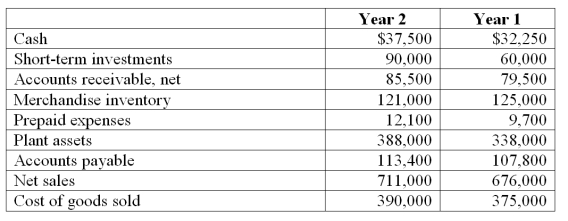
(Multiple Choice)
4.8/5  (79)
(79) Use the balance sheets of Sando shown below to calculate the following ratios for 2012 (round to the hundredths):
(a) Current ratio.
(b) Acid-test ratio.
(c) Debt ratio.
(d) Equity ratio. 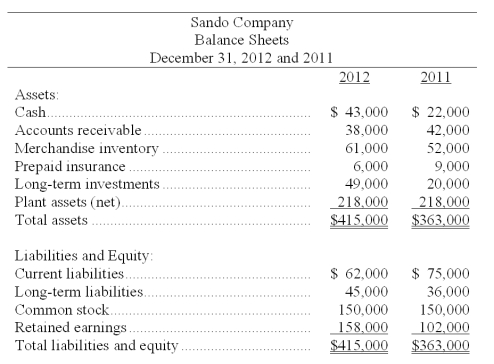
(Not Answered)
This question doesn't have any answer yet
For the following financial statement items, calculate trend percents using 2009 as the base year: 
(Not Answered)
This question doesn't have any answer yet
Working capital is computed as current liabilities minus current assets.
(True/False)
4.8/5 (79)
(79) Use the following selected information from Farris, LLC to determine the Year 2 and Year 1 common size percents for cost of goods sold using Year 1 net sales as the base. 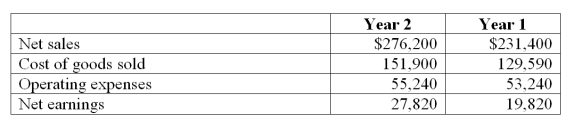
(Multiple Choice)
4.8/5 (69)
(69) A corporation reports the following year-end balance sheet data. Calculate the following ratios:
(a) working capital
(b) acid-test ratio
(c) current ratio
(d) debt ratio
(e) equity ratio
(f) debt-to-equity ratio 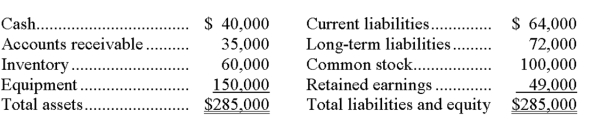
(Not Answered)
This question doesn't have any answer yet
Liquidity refers to the availability of resources to meet short-term cash requirements.
(True/False)
4.8/5 (66)
(66) Refer to the following selected financial information from Hansen's, LLC. Compute the company's times interest earned for Year 2. 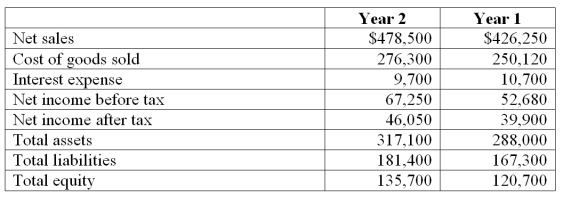
(Multiple Choice)
4.8/5 (75)
(75) Identify and explain the four building blocks of financial statement analysis.
(Essay)
4.9/5 (72)
(72) Graphical analysis of the balance sheet can be useful in assessing sources of financing.
(True/False)
4.9/5 (85)
(85) Financial statement analysis may be used for personal investment decisions.
(True/False)
4.9/5 (88)
(88) General-purpose financial statements include the (1) income statement, (2) balance sheet, (3) statement of stockholders' equity (or statement of retained earnings), (4) statement of cash flows, and (5) notes to these statements.
(True/False)
4.9/5 (80)
(80) Dividing ending inventory by cost of goods sold and multiplying the result by 365 is the:
(Multiple Choice)
4.9/5 (82)
(82) Refer to the following selected financial information from Hansen's, LLC. Compute the company's return on total assets for Year 2. 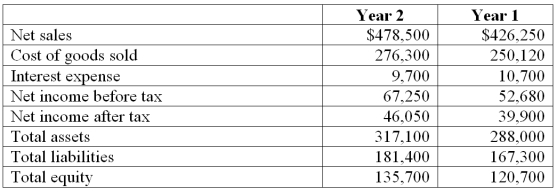
(Multiple Choice)
4.8/5 (93)
(93) Ratios, like other analysis tools, are only historically oriented.
(True/False)
4.7/5 (89)
(89) Intracompany analysis is based on comparisons with competitors.
(True/False)
4.9/5 (84)
(84) What are the standards for comparisons in financial analysis? Give an example of each.
(Essay)
4.9/5 (85)
(85) The following current year information is available from a manufacturing company: 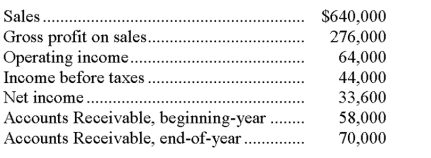 Calculate the company's accounts receivable turnover and its days' sales uncollected.
 (Not Answered)
This question doesn't have any answer yet

Filters
- Essay(0)
- Multiple Choice(0)
- Short Answer(0)
- True False(0)
- Matching(0)