



 Chat with AI
Exam 17: Analysis of Financial Statements

Exam 1: Accounting in Business240 Questions
Exam 2: Analyzing and Recording Transactions197 Questions
Exam 3: Adjusting Accounts and Preparing Financial Statements224 Questions
Exam 4: Completing the Accounting Cycle176 Questions
Exam 5: Accounting for Merchandising Operations198 Questions
Exam 6: Inventories and Cost of Sales198 Questions
Exam 7: Accounting Information Systems176 Questions
Exam 8: Cash and Internal Controls196 Questions
Exam 9: Accounting for Receivables191 Questions
Exam 10: Plant Assets, Natural Resources, and Intangibles223 Questions
Exam 11: Current Liabilities and Payroll Accounting193 Questions
Exam 12: Accounting for Partnerships139 Questions
Exam 13: Accounting for Corporations246 Questions
Exam 14: Long-Term Liabilities198 Questions
Exam 15: Investments and International Operations192 Questions
Exam 16: Reporting the Statement of Cash Flows187 Questions
Exam 17: Analysis of Financial Statements187 Questions
Exam 18: Managerial Accounting Concepts and Principles197 Questions
Exam 19: Job Order Cost Accounting164 Questions
Exam 20: Process Cost Accounting174 Questions
Exam 21: Cost Allocation and Performance Measurement170 Questions
Exam 22: Cost-Volume-Profit Analysis186 Questions
Exam 23: Master Budgets and Planning162 Questions
Exam 24: Flexible Budgets and Standard Costs174 Questions
Exam 25: Capital Budgeting and Managerial Decisions150 Questions
Exam 26: Time Value of Money60 Questions
Select questions type


Evaluation of company performance can include comparison and/or assessment of:
(Multiple Choice)
4.8/5  (80)
(80) Refer to the following selected financial information from Hansen's, LLC. Compute the company's profit margin for Year 2. 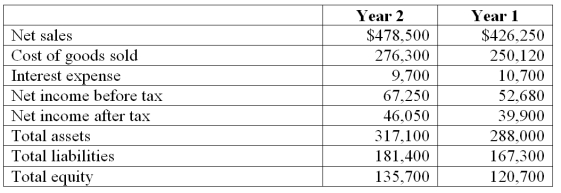
(Multiple Choice)
4.8/5 (87)
(87) ______________________________ applies analytical tools to general-purpose financial statements and related data for making business decisions.
(Short Answer)
4.9/5 (80)
(80) A company paid cash dividends on its preferred stock of $40,000 in the current year when its net income was $120,000 and its average common stockholders' equity was $640,000. What is the company's return on common stockholders' equity?
(Not Answered)
This question doesn't have any answer yet
Vertical analysis is the comparison of a company's financial condition and performance across time.
(True/False)
5.0/5 (77)
(77) A ratio expresses a mathematical relation between two quantities and can be expressed as a percent, rate, or proportion.
(True/False)
4.9/5 (73)
(73) The ability to meet short-term obligations and to efficiently generate revenues is called:
(Multiple Choice)
4.9/5 (84)
(84) A company's board of directors analyzes financial statements to assess future company prospects for making operating decisions.
(True/False)
4.7/5 (93)
(93) Financial information for Omega Corporation is presented below. Calculate the following ratios for 2012:
(a) Inventory turnover.
(b) Accounts receivable turnover.
(c) Return on total assets.
(d) Times interest earned.
(e) Total asset turnover. 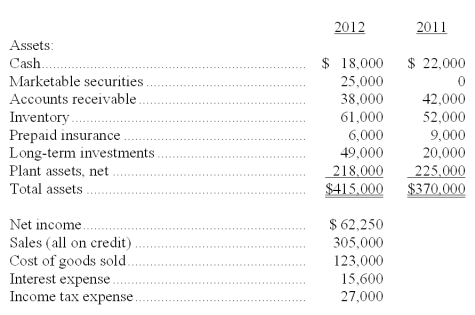
(Not Answered)
This question doesn't have any answer yet
Selected current year end financial information for a company is presented below. Calculate the following company ratios:
(a) Profit margin.
(b) Total asset turnover.
(c) Return on total assets.
(d) Return on common stockholders' equity (assume the company has no preferred stock). 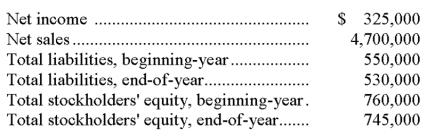
(Not Answered)
This question doesn't have any answer yet
______________________ ratios include the price-earnings ratio and dividend yield.
(Short Answer)
4.7/5 (81)
(81) Trend analysis is a form of horizontal analysis that can reveal patterns in data across successive periods.
(True/False)
4.8/5 (93)
(93) The standards for comparisons in financial statement analysis include (1) _____________, (2) ______________, (3) _______________, and (4) _____________.
(Essay)
4.9/5 (77)
(77) Profitability is the ability to generate future revenues and meet long-term obligations.
(True/False)
4.9/5 (80)
(80) Use the following selected information from Farris, LLC to determine the Year 2 and Year 1 common size percents for operating expenses using Year 1 net sales as the base. 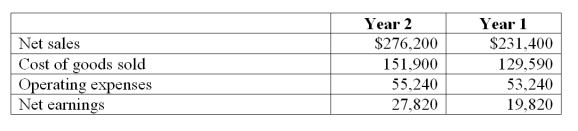
(Multiple Choice)
4.8/5 (79)
(79) A corporation reported cash of $14,000 and total assets of $178,300. Its common-size percent for cash equals 7.85%.
($14,000/$178,300) x 100 = 7.85%
(True/False)
4.9/5 (81)
(81) A company's sales in Year 1 were $250,000 and in Year 2 were $287,500. Using Year 1 as the base year, the sales trend percent for Year 2 is:
(Multiple Choice)
4.7/5 (82)
(82) 
Filters
- Essay(0)
- Multiple Choice(0)
- Short Answer(0)
- True False(0)
- Matching(0)