



 Chat with AI
Exam 17: Analysis of Financial Statements

Exam 1: Accounting in Business240 Questions
Exam 2: Analyzing and Recording Transactions197 Questions
Exam 3: Adjusting Accounts and Preparing Financial Statements224 Questions
Exam 4: Completing the Accounting Cycle176 Questions
Exam 5: Accounting for Merchandising Operations198 Questions
Exam 6: Inventories and Cost of Sales198 Questions
Exam 7: Accounting Information Systems176 Questions
Exam 8: Cash and Internal Controls196 Questions
Exam 9: Accounting for Receivables191 Questions
Exam 10: Plant Assets, Natural Resources, and Intangibles223 Questions
Exam 11: Current Liabilities and Payroll Accounting193 Questions
Exam 12: Accounting for Partnerships139 Questions
Exam 13: Accounting for Corporations246 Questions
Exam 14: Long-Term Liabilities198 Questions
Exam 15: Investments and International Operations192 Questions
Exam 16: Reporting the Statement of Cash Flows187 Questions
Exam 17: Analysis of Financial Statements187 Questions
Exam 18: Managerial Accounting Concepts and Principles197 Questions
Exam 19: Job Order Cost Accounting164 Questions
Exam 20: Process Cost Accounting174 Questions
Exam 21: Cost Allocation and Performance Measurement170 Questions
Exam 22: Cost-Volume-Profit Analysis186 Questions
Exam 23: Master Budgets and Planning162 Questions
Exam 24: Flexible Budgets and Standard Costs174 Questions
Exam 25: Capital Budgeting and Managerial Decisions150 Questions
Exam 26: Time Value of Money60 Questions
Select questions type


Refer to the following selected financial information from Fennie's, LLC. Compute the company's acid-test ratio for Year 2. 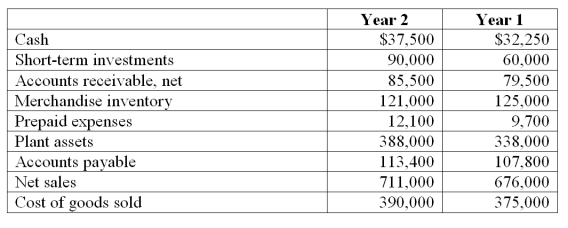
(Multiple Choice)
4.8/5  (87)
(87) The gross margin ratio, return on total assets, and basic earnings per share are all _____________ ratios.
(Short Answer)
4.9/5 (77)
(77) Refer to the following selected financial information from Fennie's, LLC. Compute the company's working capital for Year 2. 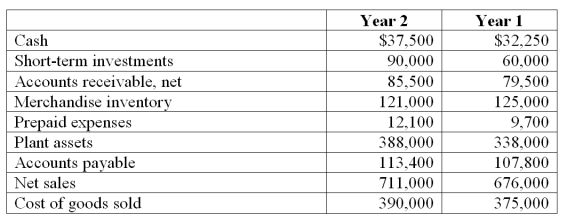
(Multiple Choice)
4.9/5 (76)
(76) The average number of times a company's inventory is sold during an accounting period, calculated by dividing cost of goods sold by the average inventory balance, is the:
(Multiple Choice)
4.8/5 (79)
(79) A company's calendar-year financial data are shown below. The company had total assets of $339,000 and total equity of $144,400 for the prior year. No additional shares of common stock were issued during the year. The December 31 market price per share is $49.50. Cash dividends of $19,500 were paid during the year. Calculate the following ratios for the company:
(a) profit margin ratio.
(b) gross margin ratio.
(c) return on total assets.
(d) return on common stockholders' equity.
(e) book value per common share.
(f) basic earnings per share.
(g) price earnings ratio.
(h) dividend yield. 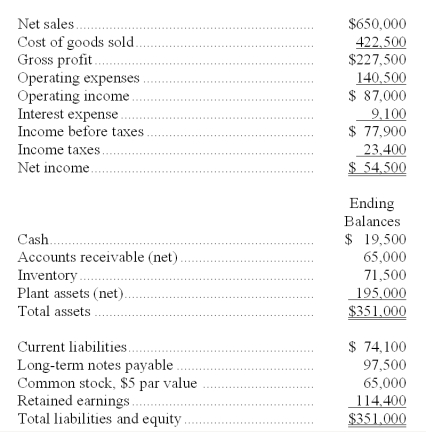
(Not Answered)
This question doesn't have any answer yet
The following information is available for the McCartney Corporation: 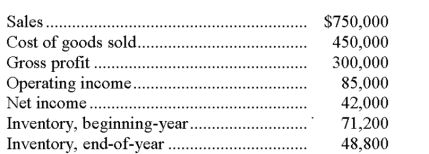 Calculate the company's inventory turnover and its days' sales in inventory.
 (Not Answered)
This question doesn't have any answer yet
Efficiency refers to how productive a company is in using its assets, and is usually measured relative to how much revenue is generated from a certain level of assets.
(True/False)
4.7/5 (89)
(89) Comparative financial statements in which each individual financial statement amount is expressed as a percentage of a base amount are called:
(Multiple Choice)
5.0/5 (94)
(94) The ability to provide financial rewards sufficient to attract and retain financing is called:
(Multiple Choice)
4.9/5 (75)
(75) Refer to the following selected financial information from Fennie's, LLC. Compute the company's days' sales uncollected for Year 2. 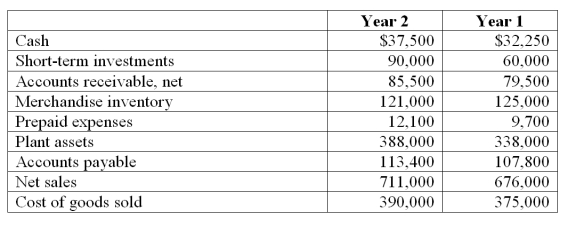
(Multiple Choice)
4.8/5 (61)
(61) The ability to generate future revenues and meet long-term obligations is referred to as:
(Multiple Choice)
4.8/5 (91)
(91) Dividing accounts receivable, net by net sales and multiplying the result by 365 is the:
(Multiple Choice)
4.9/5 (92)
(92) The percent change is computed by subtracting the analysis period amount from the base period amount, dividing the result by the base period amount and multiplying that result by 100.
(True/False)
4.8/5 (73)
(73) General-purpose financial statements include the (1) _________________, (2) _________________, (3) ___________________________ (4) ________________________ and (5) ___________________________.
(Essay)
4.9/5 (76)
(76) Financial statement analysis lessens the need for expert judgment.
(True/False)
4.9/5 (84)
(84) 
Filters
- Essay(0)
- Multiple Choice(0)
- Short Answer(0)
- True False(0)
- Matching(0)