



 Chat with AI
Exam 17: Analysis of Financial Statements

Exam 1: Accounting in Business240 Questions
Exam 2: Analyzing and Recording Transactions197 Questions
Exam 3: Adjusting Accounts and Preparing Financial Statements224 Questions
Exam 4: Completing the Accounting Cycle176 Questions
Exam 5: Accounting for Merchandising Operations198 Questions
Exam 6: Inventories and Cost of Sales198 Questions
Exam 7: Accounting Information Systems176 Questions
Exam 8: Cash and Internal Controls196 Questions
Exam 9: Accounting for Receivables191 Questions
Exam 10: Plant Assets, Natural Resources, and Intangibles223 Questions
Exam 11: Current Liabilities and Payroll Accounting193 Questions
Exam 12: Accounting for Partnerships139 Questions
Exam 13: Accounting for Corporations246 Questions
Exam 14: Long-Term Liabilities198 Questions
Exam 15: Investments and International Operations192 Questions
Exam 16: Reporting the Statement of Cash Flows187 Questions
Exam 17: Analysis of Financial Statements187 Questions
Exam 18: Managerial Accounting Concepts and Principles197 Questions
Exam 19: Job Order Cost Accounting164 Questions
Exam 20: Process Cost Accounting174 Questions
Exam 21: Cost Allocation and Performance Measurement170 Questions
Exam 22: Cost-Volume-Profit Analysis186 Questions
Exam 23: Master Budgets and Planning162 Questions
Exam 24: Flexible Budgets and Standard Costs174 Questions
Exam 25: Capital Budgeting and Managerial Decisions150 Questions
Exam 26: Time Value of Money60 Questions
Select questions type


One purpose of financial statement analysis for internal users is to provide information helpful in improving the company's efficiency and effectiveness in providing products and services.
(True/False)
4.8/5  (83)
(83) Comparative calendar-year financial data for a company are shown below. Calculate the following ratios for the company for 2012:
(a) accounts receivable turnover
(b) day's sales uncollected
(c) inventory turnover
(d) days' sales in inventory 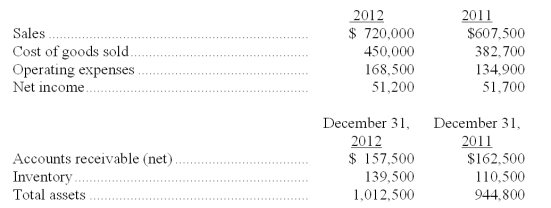
(Not Answered)
This question doesn't have any answer yet
Financial analysis only refers to the communication of relevant financial information to decision makers.
(True/False)
5.0/5 (74)
(74) Vertical analysis is a tool to evaluate individual financial statement items or groups of items in terms of a specific base amount.
(True/False)
4.8/5 (68)
(68) All of the following statements regarding a business segment are True except:
(Multiple Choice)
4.8/5 (76)
(76) A company reported net income of $78,000 and had 15,000 common shares outstanding throughout the current year. At year-end, the price per share of the company's stock was $49.40. What is the company's year-end price-earnings ratio?
(Not Answered)
This question doesn't have any answer yet
What is the purpose of a good financial statement analysis report? What are the key components?
(Essay)
4.9/5 (83)
(83) The return on total assets can be calculated as profit margin times total asset turnover.
(True/False)
4.9/5 (81)
(81) The greater the times interest earned ratio, the greater the risk a company is exposed to.
(True/False)
4.8/5 (85)
(85) The comparative income statements for Golden Company are shown below. Calculate the following ratios for 2012:
(a) profit margin.
(b) gross margin.
(c) times interest earned. 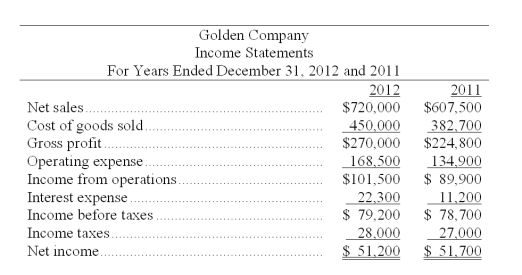
(Not Answered)
This question doesn't have any answer yet
A rough guideline states that for a company with no discounts offered, days' sales uncollected should not exceed 1 1/3 times the days in its credit period.
(True/False)
4.9/5 (79)
(79) The current year-end balance sheet data for a company are shown below. Calculate the company's:
(a) working capital.
(b) current ratio.
(c) acid-test ratio. 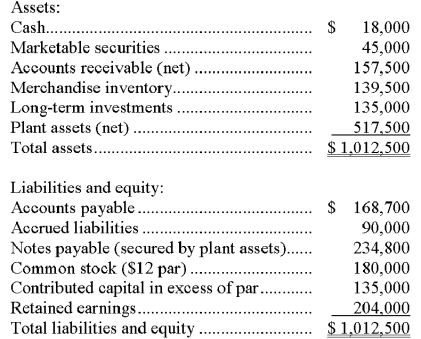
(Not Answered)
This question doesn't have any answer yet
Use the financial data shown below to calculate the following ratios for the current year:
(a) Current ratio.
(b) Acid-test ratio.
(c) Accounts receivable turnover.
(d) Days' sales uncollected.
(e) Inventory turnover.
(f) Days' sales in inventory. 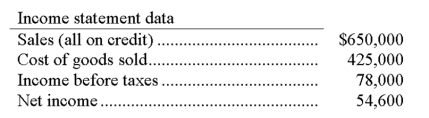
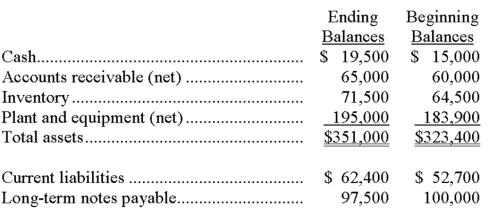
(Not Answered)
This question doesn't have any answer yet
The background on a company, its industry, and its economic setting is usually included in which of the following sections of a financial statement analysis report?
(Multiple Choice)
4.9/5 (86)
(86) 
Filters
- Essay(0)
- Multiple Choice(0)
- Short Answer(0)
- True False(0)
- Matching(0)