



 Chat with AI
Exam 17: Analysis of Financial Statements

Exam 1: Accounting in Business240 Questions
Exam 2: Analyzing and Recording Transactions197 Questions
Exam 3: Adjusting Accounts and Preparing Financial Statements224 Questions
Exam 4: Completing the Accounting Cycle176 Questions
Exam 5: Accounting for Merchandising Operations198 Questions
Exam 6: Inventories and Cost of Sales198 Questions
Exam 7: Accounting Information Systems176 Questions
Exam 8: Cash and Internal Controls196 Questions
Exam 9: Accounting for Receivables191 Questions
Exam 10: Plant Assets, Natural Resources, and Intangibles223 Questions
Exam 11: Current Liabilities and Payroll Accounting193 Questions
Exam 12: Accounting for Partnerships139 Questions
Exam 13: Accounting for Corporations246 Questions
Exam 14: Long-Term Liabilities198 Questions
Exam 15: Investments and International Operations192 Questions
Exam 16: Reporting the Statement of Cash Flows187 Questions
Exam 17: Analysis of Financial Statements187 Questions
Exam 18: Managerial Accounting Concepts and Principles197 Questions
Exam 19: Job Order Cost Accounting164 Questions
Exam 20: Process Cost Accounting174 Questions
Exam 21: Cost Allocation and Performance Measurement170 Questions
Exam 22: Cost-Volume-Profit Analysis186 Questions
Exam 23: Master Budgets and Planning162 Questions
Exam 24: Flexible Budgets and Standard Costs174 Questions
Exam 25: Capital Budgeting and Managerial Decisions150 Questions
Exam 26: Time Value of Money60 Questions
Select questions type


A company that has days' sales uncollected of 30 days and days' sales in inventory of 18 days implies that inventory will be converted to cash in about 12 days.
(True/False)
4.9/5  (74)
(74) The return on common stockholder's equity measures a company's success in reaching the goal of earning net income for its owners.
(True/False)
4.8/5 (69)
(69) Calculate the percent increase or decrease for each of the following financial statement items: 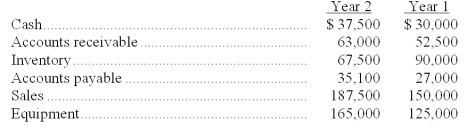
(Not Answered)
This question doesn't have any answer yet
Evaluation of company performance does not include analysis of (1) past and current performance, (2) current financial position, and (3) future performance and risk.
(True/False)
4.9/5 (80)
(80) Identify and describe three common tools of financial statement analysis.
(Essay)
4.9/5 (84)
(84) The debt ratio, the equity ratio, pledged assets to secured liabilities, and times interest earned are all ___________________ ratios.
(Short Answer)
4.8/5 (80)
(80) Annual cash dividends per share divided by market price per share is the:
(Multiple Choice)
4.9/5 (84)
(84) An advantage of common-size statements is that they reflect the dollar magnitude (size) of the different companies under analysis.
(True/False)
4.9/5 (77)
(77) Profitability is the ability to generate positive market expectations.
(True/False)
4.9/5 (89)
(89) The comparative balance sheet for Golden Co. is shown below. Express the balance sheet in common-size percents. 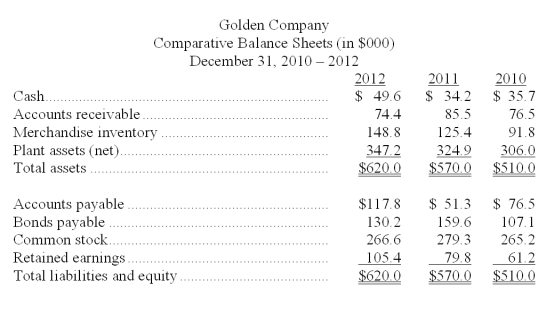
(Not Answered)
This question doesn't have any answer yet
The higher the accounts receivable turnover, the less quickly accounts receivable are collected.
(True/False)
4.7/5 (72)
(72) Standards for comparison when interpreting financial statement analysis include competitor and industry performance data.
(True/False)
4.8/5 (89)
(89) The comparison of a company's financial condition and performance across time is known as:
(Multiple Choice)
4.8/5 (80)
(80) Refer to the following selected financial information from Fennie's, LLC. Compute the company's days' sales in inventory for Year 2. 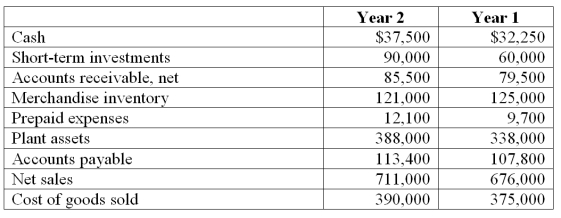
(Multiple Choice)
4.9/5 (76)
(76) Net sales divided by average accounts receivable, net is the:
(Multiple Choice)
4.8/5 (72)
(72) The ability to generate positive market expectations is called:
(Multiple Choice)
4.9/5 (77)
(77) Standards for comparison are necessary when making judgments about a company's performance.
(True/False)
4.8/5 (86)
(86) Express the following balance sheets for Alberts Company in common-size percents. 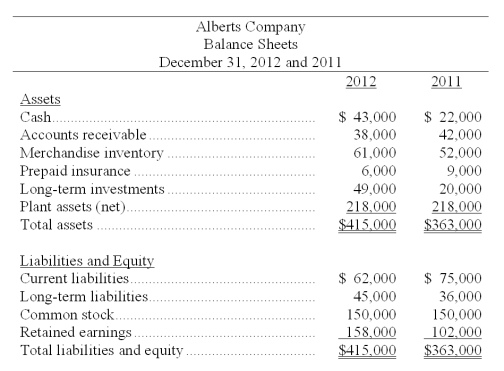
(Not Answered)
This question doesn't have any answer yet
Describe the purpose of horizontal financial statement analysis and how it is applied.
(Essay)
4.9/5 (65)
(65) Use the following selected information from Farris, LLC to determine the Year 2 and Year 1 trend percents for net sales using Year 1 as the base. 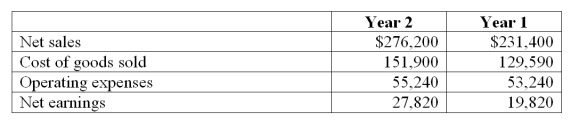
(Multiple Choice)
4.9/5 (76)
(76) 
Filters
- Essay(0)
- Multiple Choice(0)
- Short Answer(0)
- True False(0)
- Matching(0)