



 Chat with AI
Exam 10: Meiosis and Sexual Life Cycles

Exam 1: Introduction: Evolution and the Foundations of Biology36 Questions
Exam 2: The Chemical Context of Life137 Questions
Exam 3: Carbon and the Molecular Diversity of Life136 Questions
Exam 4: A Tour of the Cell75 Questions
Exam 5: Membrane Transport and Cell Signaling97 Questions
Exam 6: An Introduction to Metabolism79 Questions
Exam 7: Cellular Respiration and Fermentation100 Questions
Exam 8: Photosynthesis72 Questions
Exam 9: The Cell Cycle56 Questions
Exam 10: Meiosis and Sexual Life Cycles62 Questions
Exam 11: Mendel and the Gene Idea63 Questions
Exam 12: The Chromosomal Basis of Inheritance46 Questions
Exam 13: The Molecular Basis of Inheritance67 Questions
Exam 14: Gene Expression: From Gene to Protein80 Questions
Exam 15: Regulation of Gene Expression50 Questions
Exam 16: Development, Stem Cells, and Cancer34 Questions
Exam 17: Viruses35 Questions
Exam 18: Genomes and Their Evolution29 Questions
Exam 19: Descent With Modification55 Questions
Exam 20: Phylogeny60 Questions
Exam 21: The Evolution of Populations70 Questions
Exam 22: The Origin of Species67 Questions
Exam 23: Broad Patterns of Evolution45 Questions
Exam 24: Early Life and the Diversification of Prokaryotes88 Questions
Exam 25: The Origin and Diversification of Eukaryotes71 Questions
Exam 26: The Colonization of Land by Plants and Fungi126 Questions
Exam 27: The Rise of Animal Diversity88 Questions
Exam 28: Plant Structure and Growth59 Questions
Exam 29: Resource Acquisition, Nutrition, and Transport in Vascular Plants110 Questions
Exam 30: Reproduction and Domestication of Flowering Plants67 Questions
Exam 31: Plant Responses to Internal and External Signals75 Questions
Exam 32: Homeostasis and Endocrine Signaling120 Questions
Exam 33: Animal Nutrition67 Questions
Exam 34: Circulation and Gas Exchange88 Questions
Exam 35: The Immune System91 Questions
Exam 36: Reproduction and Development118 Questions
Exam 37: Neurons, Synapses, and Signaling76 Questions
Exam 38: Nervous and Sensory Systems99 Questions
Exam 39: Motor Mechanisms and Behavior79 Questions
Exam 40: Population Ecology and the Distribution of Organisms93 Questions
Exam 41: Species Interactions60 Questions
Exam 42: Ecosystems and Energy90 Questions
Exam 43: Global Ecology and Conservation Biology72 Questions
Select questions type


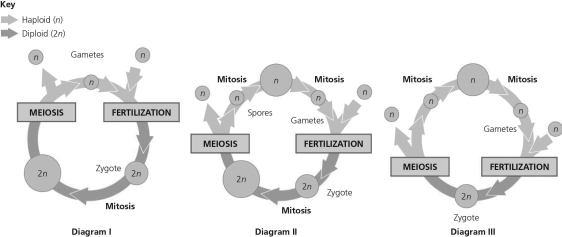 Figure 10.1
-Refer to the life cycles illustrated in Figure 10.1. Which of the life cycles is (are) typical for animals?
Figure 10.1
-Refer to the life cycles illustrated in Figure 10.1. Which of the life cycles is (are) typical for animals? (Multiple Choice)
4.9/5  (82)
(82)  Figure 10.4
-A certain (hypothetical) organism is diploid, has either blue or orange wings as the consequence of one of its genes on chromosome 12, and has either long or short antennae as the result of a second gene on chromosome 19, as shown in Figure 10.4. If a female of this species has one chromosome 12 with a blue gene and another chromosome 12 with an orange gene, and has both number 19 chromosomes with short genes, she will produce which of the following egg types?
Figure 10.4
-A certain (hypothetical) organism is diploid, has either blue or orange wings as the consequence of one of its genes on chromosome 12, and has either long or short antennae as the result of a second gene on chromosome 19, as shown in Figure 10.4. If a female of this species has one chromosome 12 with a blue gene and another chromosome 12 with an orange gene, and has both number 19 chromosomes with short genes, she will produce which of the following egg types? (Multiple Choice)
4.9/5 (91)
(91) Figure 10.1
-In part III of Figure 10.1, the progression of events corresponds to which of the following series?
Figure 10.1
-In part III of Figure 10.1, the progression of events corresponds to which of the following series? (Multiple Choice)
4.9/5 (75)
(75) Please use the following information to answer the question(s) below.
A woman who has blood type A positive has a daughter who is type O positive and a son who is type B negative. Rh positive is a trait that shows simple dominance over Rh negative and is designated by the alleles R and r, respectively. A third gene for the MN blood group has codominant alleles M and N.
-Which of these statements is true?
(Multiple Choice)
4.7/5 (73)
(73) 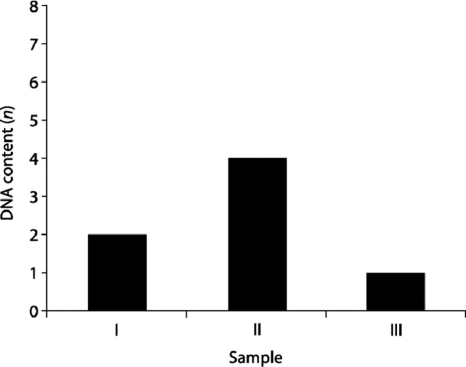 Figure 10.3
-You have isolated DNA from three different cell types of an organism, determined the relative DNA content for each type, and plotted the results on the graph shown in Figure 10.3. Which sample(s) might represent an animal cell in the G2 phase of the cell cycle?
Figure 10.3
-You have isolated DNA from three different cell types of an organism, determined the relative DNA content for each type, and plotted the results on the graph shown in Figure 10.3. Which sample(s) might represent an animal cell in the G2 phase of the cell cycle? (Multiple Choice)
4.9/5 (69)
(69) In a human karyotype, chromosomes are arranged in 23 pairs. If we choose one of these pairs, such as pair 14, which of the following do the two chromosomes of the pair have in common?
(Multiple Choice)
4.7/5 (82)
(82) Please use the following information to answer the question(s) below.
A woman who has blood type A positive has a daughter who is type O positive and a son who is type B negative. Rh positive is a trait that shows simple dominance over Rh negative and is designated by the alleles R and r, respectively. A third gene for the MN blood group has codominant alleles M and N.
-Which of these is a way that the sexual life cycle increases genetic variation in a species?
(Multiple Choice)
4.8/5 (81)
(81) For the following question(s), match the key event of meiosis with the stages listed below.
I. prophase I V. prophase II
II. metaphase I VI. metaphase II
III. anaphase I VII. anaphase II
IV. telophase I VIII. telophase II
-Independent assortment of chromosomes during meiosis is a result of
(Multiple Choice)
4.8/5 (66)
(66) Figure 10.4
-A certain (hypothetical) organism is diploid, has either blue or orange wings as the consequence of one of its genes on chromosome 12, and has either long or short antennae as the result of a second gene on chromosome 19, as shown in Figure 10.4. A female with a paternal set of one orange and one long gene chromosome and a maternal set composed of one blue and one short gene chromosome is expected to produce which of the following types of eggs after meiosis?
Figure 10.4
-A certain (hypothetical) organism is diploid, has either blue or orange wings as the consequence of one of its genes on chromosome 12, and has either long or short antennae as the result of a second gene on chromosome 19, as shown in Figure 10.4. A female with a paternal set of one orange and one long gene chromosome and a maternal set composed of one blue and one short gene chromosome is expected to produce which of the following types of eggs after meiosis? (Multiple Choice)
4.7/5 (76)
(76) The karyotype of one species of primate has 48 chromosomes. In a particular female, cell division malfunctions, and she produces one of her eggs with an extra chromosome (25). The most probable source of this error would be a mistake in which of the following?
(Multiple Choice)
4.9/5 (76)
(76) Figure 10.4
-A certain (hypothetical) organism is diploid, has either blue or orange wings as the consequence of one of its genes on chromosome 12, and has either long or short antennae as the result of a second gene on chromosome 19, as shown in Figure 10.4. A certain female's number 12 chromosomes both have the blue gene and number 19 chromosomes both have the long gene. As cells in her ovaries undergo meiosis, her resulting eggs (ova) may have which of the following?
Figure 10.4
-A certain (hypothetical) organism is diploid, has either blue or orange wings as the consequence of one of its genes on chromosome 12, and has either long or short antennae as the result of a second gene on chromosome 19, as shown in Figure 10.4. A certain female's number 12 chromosomes both have the blue gene and number 19 chromosomes both have the long gene. As cells in her ovaries undergo meiosis, her resulting eggs (ova) may have which of the following? (Multiple Choice)
4.8/5 (74)
(74) How do cells at the completion of meiosis compare with cells that have replicated their DNA and are just about to begin meiosis?
(Multiple Choice)
4.9/5 (76)
(76) Please use the following information to answer the question(s) below.
A woman who has blood type A positive has a daughter who is type O positive and a son who is type B negative. Rh positive is a trait that shows simple dominance over Rh negative and is designated by the alleles R and r, respectively. A third gene for the MN blood group has codominant alleles M and N.
-The human X and Y chromosomes
(Multiple Choice)
4.9/5 (83)
(83) Figure 10.3
-You have isolated DNA from three different cell types of an organism, determined the relative DNA content for each type, and plotted the results on the graph shown in Figure 10.3.
Which sample(s) might represent a zygote?
Figure 10.3
-You have isolated DNA from three different cell types of an organism, determined the relative DNA content for each type, and plotted the results on the graph shown in Figure 10.3.
Which sample(s) might represent a zygote? (Multiple Choice)
4.9/5 (88)
(88) For the following question(s), match the key event of meiosis with the stages listed below.
I. prophase I V. prophase II
II. metaphase I VI. metaphase II
III. anaphase I VII. anaphase II
IV. telophase I VIII. telophase II
-During which process does independent assortment of chromosomes occur?
(Multiple Choice)
4.8/5 (72)
(72) For the following question(s), match the key event of meiosis with the stages listed below.
I. prophase I V. prophase II
II. metaphase I VI. metaphase II
III. anaphase I VII. anaphase II
IV. telophase I VIII. telophase II
-Synaptonemal complexes form or are still present.
(Multiple Choice)
4.8/5 (91)
(91) Please use the following information to answer the question(s) below.
A woman who has blood type A positive has a daughter who is type O positive and a son who is type B negative. Rh positive is a trait that shows simple dominance over Rh negative and is designated by the alleles R and r, respectively. A third gene for the MN blood group has codominant alleles M and N.
-At which stage of mitosis are chromosomes usually photographed in the preparation of a karyotype?
(Multiple Choice)
4.8/5 (78)
(78) Please use the following information to answer the question(s) below.
A woman who has blood type A positive has a daughter who is type O positive and a son who is type B negative. Rh positive is a trait that shows simple dominance over Rh negative and is designated by the alleles R and r, respectively. A third gene for the MN blood group has codominant alleles M and N.
-Which of the following is true of a species that has a chromosome number of 2n = 16?
(Multiple Choice)
4.8/5 (80)
(80) For the following question(s), match the key event of meiosis with the stages listed below.
I. prophase I V. prophase II
II. metaphase I VI. metaphase II
III. anaphase I VII. anaphase II
IV. telophase I VIII. telophase II
-Which of the following statements best describes how often crossing over occurs in humans?
(Multiple Choice)
4.8/5 (63)
(63) 
Filters
- Essay(0)
- Multiple Choice(0)
- Short Answer(0)
- True False(0)
- Matching(0)