



 Chat with AI
Exam 10: Meiosis and Sexual Life Cycles

Exam 1: Introduction: Evolution and the Foundations of Biology36 Questions
Exam 2: The Chemical Context of Life137 Questions
Exam 3: Carbon and the Molecular Diversity of Life136 Questions
Exam 4: A Tour of the Cell75 Questions
Exam 5: Membrane Transport and Cell Signaling97 Questions
Exam 6: An Introduction to Metabolism79 Questions
Exam 7: Cellular Respiration and Fermentation100 Questions
Exam 8: Photosynthesis72 Questions
Exam 9: The Cell Cycle56 Questions
Exam 10: Meiosis and Sexual Life Cycles62 Questions
Exam 11: Mendel and the Gene Idea63 Questions
Exam 12: The Chromosomal Basis of Inheritance46 Questions
Exam 13: The Molecular Basis of Inheritance67 Questions
Exam 14: Gene Expression: From Gene to Protein80 Questions
Exam 15: Regulation of Gene Expression50 Questions
Exam 16: Development, Stem Cells, and Cancer34 Questions
Exam 17: Viruses35 Questions
Exam 18: Genomes and Their Evolution29 Questions
Exam 19: Descent With Modification55 Questions
Exam 20: Phylogeny60 Questions
Exam 21: The Evolution of Populations70 Questions
Exam 22: The Origin of Species67 Questions
Exam 23: Broad Patterns of Evolution45 Questions
Exam 24: Early Life and the Diversification of Prokaryotes88 Questions
Exam 25: The Origin and Diversification of Eukaryotes71 Questions
Exam 26: The Colonization of Land by Plants and Fungi126 Questions
Exam 27: The Rise of Animal Diversity88 Questions
Exam 28: Plant Structure and Growth59 Questions
Exam 29: Resource Acquisition, Nutrition, and Transport in Vascular Plants110 Questions
Exam 30: Reproduction and Domestication of Flowering Plants67 Questions
Exam 31: Plant Responses to Internal and External Signals75 Questions
Exam 32: Homeostasis and Endocrine Signaling120 Questions
Exam 33: Animal Nutrition67 Questions
Exam 34: Circulation and Gas Exchange88 Questions
Exam 35: The Immune System91 Questions
Exam 36: Reproduction and Development118 Questions
Exam 37: Neurons, Synapses, and Signaling76 Questions
Exam 38: Nervous and Sensory Systems99 Questions
Exam 39: Motor Mechanisms and Behavior79 Questions
Exam 40: Population Ecology and the Distribution of Organisms93 Questions
Exam 41: Species Interactions60 Questions
Exam 42: Ecosystems and Energy90 Questions
Exam 43: Global Ecology and Conservation Biology72 Questions
Select questions type


Which of the following cell types or organisms can utilize both mitosis and meiosis in the correct circumstances?
(Multiple Choice)
4.8/5  (86)
(86) Please use the following information to answer the question(s) below.
A woman who has blood type A positive has a daughter who is type O positive and a son who is type B negative. Rh positive is a trait that shows simple dominance over Rh negative and is designated by the alleles R and r, respectively. A third gene for the MN blood group has codominant alleles M and N.
-Referring to a plant's sexual life cycle, which of the following processes leads directly to the formation of gametes?
(Multiple Choice)
4.9/5 (83)
(83) After telophase I of meiosis, the chromosomal makeup of each daughter cell is
(Multiple Choice)
4.9/5 (76)
(76) Please use the following information to answer the question(s) below.
There is a group of invertebrate animals called rotifers, among which a particular group of species reproduces, as far as is known, only asexually. These rotifers, however, have survived a long evolutionary history without evidence of having been overcome by excessive mutations.
-How is natural selection related to sexual reproduction as opposed to asexual reproduction?
(Multiple Choice)
4.8/5 (71)
(71) 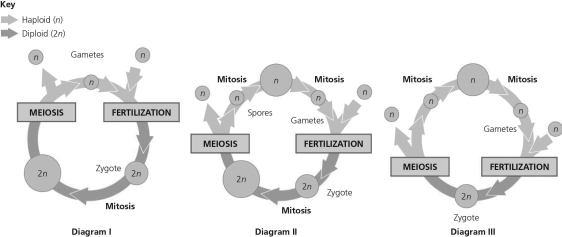 Figure 10.1
-Refer to the life cycles illustrated in Figure 10.1. Which of the life cycles is (are) typical for plants and some algae?
Figure 10.1
-Refer to the life cycles illustrated in Figure 10.1. Which of the life cycles is (are) typical for plants and some algae? (Multiple Choice)
4.9/5 (88)
(88) Figure 10.1
-In a life cycle such as that shown in part III of Figure 10.1, if the zygote's chromosome number is 10, which of the following will be true?
Figure 10.1
-In a life cycle such as that shown in part III of Figure 10.1, if the zygote's chromosome number is 10, which of the following will be true? (Multiple Choice)
4.7/5 (70)
(70) For the following question(s), match the key event of meiosis with the stages listed below.
I. prophase I V. prophase II
II. metaphase I VI. metaphase II
III. anaphase I VII. anaphase II
IV. telophase I VIII. telophase II
-When homologous chromosomes cross over, what is the result?
(Multiple Choice)
4.9/5 (64)
(64) Please use the following information to answer the question(s) below.
A woman who has blood type A positive has a daughter who is type O positive and a son who is type B negative. Rh positive is a trait that shows simple dominance over Rh negative and is designated by the alleles R and r, respectively. A third gene for the MN blood group has codominant alleles M and N.
-Which of the following is the smallest unit that would contain a complete copy of the entire human genome?
(Multiple Choice)
4.9/5 (79)
(79) Which of the following events occurs in meiosis but not in mitosis?
(Multiple Choice)
5.0/5 (85)
(85) Which of the following structures is found in a pair of homologous chromosomes?
(Multiple Choice)
5.0/5 (71)
(71) For the following question(s), match the key event of meiosis with the stages listed below.
I. prophase I V. prophase II
II. metaphase I VI. metaphase II
III. anaphase I VII. anaphase II
IV. telophase I VIII. telophase II
-Centromeres of sister chromatids disjoin and chromatids separate.
(Multiple Choice)
5.0/5 (80)
(80) 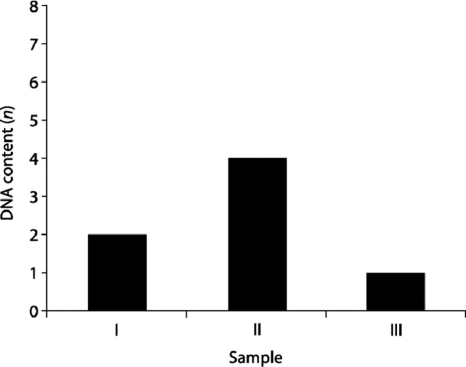 Figure 10.3
-You have isolated DNA from three different cell types of an organism, determined the relative DNA content for each type, and plotted the results on the graph shown in Figure 10.3. Which sample(s) of DNA might be from a skin cell arrested in G0 of the cell cycle?
Figure 10.3
-You have isolated DNA from three different cell types of an organism, determined the relative DNA content for each type, and plotted the results on the graph shown in Figure 10.3. Which sample(s) of DNA might be from a skin cell arrested in G0 of the cell cycle? (Multiple Choice)
4.9/5 (65)
(65) Which of the following statements best describes a karyotype?
(Multiple Choice)
4.9/5 (80)
(80) Please use the following information to answer the question(s) below.
There is a group of invertebrate animals called rotifers, among which a particular group of species reproduces, as far as is known, only asexually. These rotifers, however, have survived a long evolutionary history without evidence of having been overcome by excessive mutations.
-If we continued to follow the cell lineage from question 3, the DNA content of a cell at metaphase of meiosis II would be
(Multiple Choice)
4.9/5 (78)
(78) Figure 10.1
-Refer to the life cycles illustrated in Figure 10.1. Which of the life cycles is (are) typical for most fungi and some protists?
Figure 10.1
-Refer to the life cycles illustrated in Figure 10.1. Which of the life cycles is (are) typical for most fungi and some protists? (Multiple Choice)
4.8/5 (83)
(83) Please use the following information to answer the question(s) below.
There is a group of invertebrate animals called rotifers, among which a particular group of species reproduces, as far as is known, only asexually. These rotifers, however, have survived a long evolutionary history without evidence of having been overcome by excessive mutations.
-Because the rotifers develop from eggs, but asexually, what can you predict?
(Multiple Choice)
5.0/5 (75)
(75) Please use the following information to answer the question(s) below.
A woman who has blood type A positive has a daughter who is type O positive and a son who is type B negative. Rh positive is a trait that shows simple dominance over Rh negative and is designated by the alleles R and r, respectively. A third gene for the MN blood group has codominant alleles M and N.
-Eukaryotic sexual life cycles show tremendous variation. Which of the following elements do all sexual life cycles have in common?
I. alternation of generations
II. meiosis
III. fertilization
IV. gametes
V. spores
(Multiple Choice)
4.8/5 (78)
(78) The somatic cells of a privet shrub each contain 46 chromosomes. To be as different as they are from human cells, which have the same number of chromosomes, which of the following must be true?
(Multiple Choice)
4.9/5 (83)
(83) When we see chiasmata under a microscope, that lets us know that which of the following processes has occurred?
(Multiple Choice)
4.8/5 (83)
(83) Please use the following information to answer the question(s) below.
A woman who has blood type A positive has a daughter who is type O positive and a son who is type B negative. Rh positive is a trait that shows simple dominance over Rh negative and is designated by the alleles R and r, respectively. A third gene for the MN blood group has codominant alleles M and N.
-Which of the following is a true statement about sexual versus asexual reproduction?
(Multiple Choice)
4.9/5 (83)
(83) 
Filters
- Essay(0)
- Multiple Choice(0)
- Short Answer(0)
- True False(0)
- Matching(0)