



 Chat with AI
Exam 15: Regulation of Gene Expression

Exam 1: Introduction: Evolution and the Foundations of Biology36 Questions
Exam 2: The Chemical Context of Life137 Questions
Exam 3: Carbon and the Molecular Diversity of Life136 Questions
Exam 4: A Tour of the Cell75 Questions
Exam 5: Membrane Transport and Cell Signaling97 Questions
Exam 6: An Introduction to Metabolism79 Questions
Exam 7: Cellular Respiration and Fermentation100 Questions
Exam 8: Photosynthesis72 Questions
Exam 9: The Cell Cycle56 Questions
Exam 10: Meiosis and Sexual Life Cycles62 Questions
Exam 11: Mendel and the Gene Idea63 Questions
Exam 12: The Chromosomal Basis of Inheritance46 Questions
Exam 13: The Molecular Basis of Inheritance67 Questions
Exam 14: Gene Expression: From Gene to Protein80 Questions
Exam 15: Regulation of Gene Expression50 Questions
Exam 16: Development, Stem Cells, and Cancer34 Questions
Exam 17: Viruses35 Questions
Exam 18: Genomes and Their Evolution29 Questions
Exam 19: Descent With Modification55 Questions
Exam 20: Phylogeny60 Questions
Exam 21: The Evolution of Populations70 Questions
Exam 22: The Origin of Species67 Questions
Exam 23: Broad Patterns of Evolution45 Questions
Exam 24: Early Life and the Diversification of Prokaryotes88 Questions
Exam 25: The Origin and Diversification of Eukaryotes71 Questions
Exam 26: The Colonization of Land by Plants and Fungi126 Questions
Exam 27: The Rise of Animal Diversity88 Questions
Exam 28: Plant Structure and Growth59 Questions
Exam 29: Resource Acquisition, Nutrition, and Transport in Vascular Plants110 Questions
Exam 30: Reproduction and Domestication of Flowering Plants67 Questions
Exam 31: Plant Responses to Internal and External Signals75 Questions
Exam 32: Homeostasis and Endocrine Signaling120 Questions
Exam 33: Animal Nutrition67 Questions
Exam 34: Circulation and Gas Exchange88 Questions
Exam 35: The Immune System91 Questions
Exam 36: Reproduction and Development118 Questions
Exam 37: Neurons, Synapses, and Signaling76 Questions
Exam 38: Nervous and Sensory Systems99 Questions
Exam 39: Motor Mechanisms and Behavior79 Questions
Exam 40: Population Ecology and the Distribution of Organisms93 Questions
Exam 41: Species Interactions60 Questions
Exam 42: Ecosystems and Energy90 Questions
Exam 43: Global Ecology and Conservation Biology72 Questions
Select questions type


What would be the result of a mutation that deactivates the regulatory gene of a repressible operon in an Escherichia coli cell?
(Multiple Choice)
4.8/5  (92)
(92) Which of the following molecules, when taken up by the cell, binds to the repressor so that the repressor no longer binds to the operator?
(Multiple Choice)
4.9/5 (70)
(70) Please use the following information to answer the question(s) below.
Suppose an experimenter becomes proficient with a technique that allows her to move DNA sequences within a prokaryotic genome.
-If she moves the regulatory gene (lac I), along with its promoter, to a position some several thousand base pairs away from its normal position, which would you expect to occur?
(Multiple Choice)
4.9/5 (83)
(83) 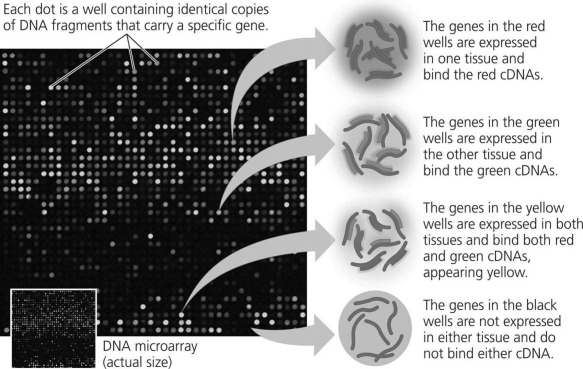 Figure 15.1
In the microarray shown in Figure 15.1, if you were searching for genes whose expression was inhibited by hormone treatment, you would search for sequences spotted on the array that showed ________ fluorescence.
Figure 15.1
In the microarray shown in Figure 15.1, if you were searching for genes whose expression was inhibited by hormone treatment, you would search for sequences spotted on the array that showed ________ fluorescence. (Multiple Choice)
4.7/5 (78)
(78) A type of mutation in the repressor results in a molecule known as a super-repressor because it represses the lac operon permanently. Which of these would characterize such a mutant?
(Multiple Choice)
5.0/5 (80)
(80) Which of the following is a function of the protein called ubiquitin?
(Multiple Choice)
4.9/5 (71)
(71) Which statement about DNA in one of your brain cells is true?
(Multiple Choice)
4.7/5 (74)
(74) Transcription factors in eukaryotes usually have DNA-binding domains as well as other domains that are specific for binding other molecules. In general, which of the following would you expect many of them to be able to bind?
(Multiple Choice)
4.9/5 (73)
(73) You are given an experimental problem involving control of a gene's expression in the embryo of a particular species. One of your first questions is whether the gene's expression is controlled at the level of transcription or translation. Which of the following experiments might best give you an answer?
(Multiple Choice)
4.8/5 (78)
(78) Two potential functions that eukaryotic cells perform to regulate transcription are
(Multiple Choice)
4.9/5 (81)
(81) 
Filters
- Essay(0)
- Multiple Choice(0)
- Short Answer(0)
- True False(0)
- Matching(0)