



 Chat with AI
Exam 26: The Colonization of Land by Plants and Fungi

Exam 1: Introduction: Evolution and the Foundations of Biology36 Questions
Exam 2: The Chemical Context of Life137 Questions
Exam 3: Carbon and the Molecular Diversity of Life136 Questions
Exam 4: A Tour of the Cell75 Questions
Exam 5: Membrane Transport and Cell Signaling97 Questions
Exam 6: An Introduction to Metabolism79 Questions
Exam 7: Cellular Respiration and Fermentation100 Questions
Exam 8: Photosynthesis72 Questions
Exam 9: The Cell Cycle56 Questions
Exam 10: Meiosis and Sexual Life Cycles62 Questions
Exam 11: Mendel and the Gene Idea63 Questions
Exam 12: The Chromosomal Basis of Inheritance46 Questions
Exam 13: The Molecular Basis of Inheritance67 Questions
Exam 14: Gene Expression: From Gene to Protein80 Questions
Exam 15: Regulation of Gene Expression50 Questions
Exam 16: Development, Stem Cells, and Cancer34 Questions
Exam 17: Viruses35 Questions
Exam 18: Genomes and Their Evolution29 Questions
Exam 19: Descent With Modification55 Questions
Exam 20: Phylogeny60 Questions
Exam 21: The Evolution of Populations70 Questions
Exam 22: The Origin of Species67 Questions
Exam 23: Broad Patterns of Evolution45 Questions
Exam 24: Early Life and the Diversification of Prokaryotes88 Questions
Exam 25: The Origin and Diversification of Eukaryotes71 Questions
Exam 26: The Colonization of Land by Plants and Fungi126 Questions
Exam 27: The Rise of Animal Diversity88 Questions
Exam 28: Plant Structure and Growth59 Questions
Exam 29: Resource Acquisition, Nutrition, and Transport in Vascular Plants110 Questions
Exam 30: Reproduction and Domestication of Flowering Plants67 Questions
Exam 31: Plant Responses to Internal and External Signals75 Questions
Exam 32: Homeostasis and Endocrine Signaling120 Questions
Exam 33: Animal Nutrition67 Questions
Exam 34: Circulation and Gas Exchange88 Questions
Exam 35: The Immune System91 Questions
Exam 36: Reproduction and Development118 Questions
Exam 37: Neurons, Synapses, and Signaling76 Questions
Exam 38: Nervous and Sensory Systems99 Questions
Exam 39: Motor Mechanisms and Behavior79 Questions
Exam 40: Population Ecology and the Distribution of Organisms93 Questions
Exam 41: Species Interactions60 Questions
Exam 42: Ecosystems and Energy90 Questions
Exam 43: Global Ecology and Conservation Biology72 Questions
Select questions type


Please use the following information to answer the question(s) below.
Fairy rings are circles of fungi that often appear in open meadows and in forest areas. In the soil beneath the fungi is an ever-extending mycelium. As the mycelium spreads to seek out more food, it sometimes will produce the fungi we see above ground. The figure depicts the outline of a fairy ring that has appeared overnight in an open meadow, as viewed from above. The ring represents the farthest advance of this mycelium through the soil. Locations A-D are all 0.5 meters below the soil surface. 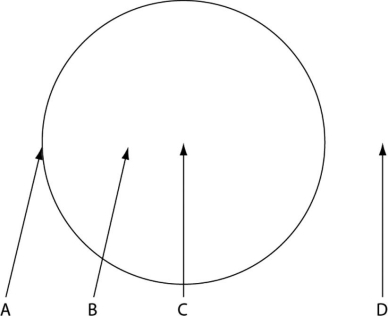 -At which location should one find the lowest concentration of fungal enzymes, assuming that the enzymes do not diffuse far from their source and that no other fungi are present in this habitat?
 (Multiple Choice)
4.9/5  (93)
(93) Please use the following information to answer the question(s) below.
Ecologists often build models to depict the relationships between organisms. In such models, an arrow is used to link two organisms in a relationship. The arrowhead is next to the organism that is affected. If the effect is positive, the arrow is labeled with (+), and if negative, the label is (-).
-All fungi are
(Multiple Choice)
5.0/5 (79)
(79) Which of the following flower parts develops into the pulp of a fleshy fruit?
(Multiple Choice)
4.8/5 (83)
(83) Please use the following information to answer the question(s) below.
For several decades now, amphibian species worldwide have been in decline. A significant proportion of the decline seems to be due to the spread of the chytrid fungus Batrachochytrium dendrobatidis (Bd). Chytrid sporangia reside within the epidermal cells of infected animals, animals that consequently show areas of sloughed skin. Infected animals can also be lethargic, which is expressed through failure to hide and failure to flee. The infection cycle typically takes four to five days, at the end of which zoospores are released from sporangia into the environment. Zoospores are spores of fungi (as well as some algae and protozoans) that use a flagella for swimming locomotion. In some amphibian species, mortality rates approach 100%; other species seem able to survive the infection.
-The fact that infection by Bd causes lethargy in many infected amphibians can have what effect on efforts to accurately census the numbers of dead or dying amphibians at a particular time, in a particular habitat?
I. It can cause underestimation due to infected amphibians preferring to seek out refuges relative to uninfected amphibians.
II. It can cause underestimation due to increased predation on, and removal of, infected amphibians relative to uninfected amphibians.
III. It can cause overestimation because infected frogs should be more readily observable to human census-takers than should uninfected amphibians.
(Multiple Choice)
4.7/5 (80)
(80) Which of the following is a characteristic of hyphate fungi (fungi featuring hyphae)?
(Multiple Choice)
4.9/5 (74)
(74) Which of the following statements is true of the pine life cycle?
(Multiple Choice)
4.8/5 (74)
(74) Considering that the mature sporophytes of true mosses get their nutrition from the gametophytes on which they grow, and considering these generations as individual plants, what is true of the relationship between true moss sporophytes and gametophytes?
(Multiple Choice)
4.9/5 (68)
(68) On a field trip, a student in a marine biology class collects an organism that has differentiated organs, cell walls of cellulose, and chloroplasts with chlorophyll a. Based on this description, the organism could be a brown alga, a red alga, a green alga, a charophyte recently washed into the ocean from a freshwater or brackish water source, or a land plant washed into the ocean. The presence of which of the following features would definitively identify this organism as a land plant?
(Multiple Choice)
4.9/5 (72)
(72) The following question(s) refer to the generalized life cycle for land plants shown in the figure. Each number within a circle represents a specific plant or plant part, and each number in a box refers to a biological process. 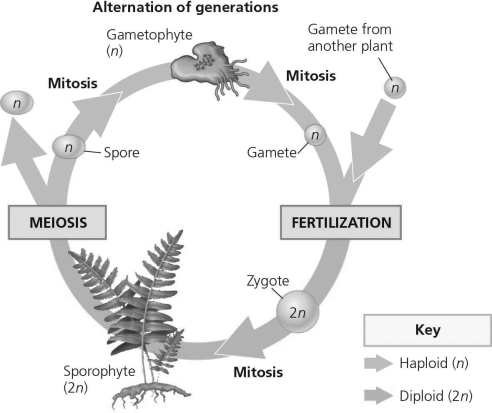 -In the figure, which structure produces haploid spores by meiosis?
 (Multiple Choice)
5.0/5 (78)
(78) Which of the following is most important in making the typical seed more resistant to adverse conditions than the typical spore?
(Multiple Choice)
4.7/5 (75)
(75) Arrange the following in the correct sequence, from earliest to most recent, in which these plant traits originated.
1) sporophyte dominance, gametophyte independence
2) sporophyte dominance, gametophyte dependence
3) gametophyte dominance, sporophyte dependence
(Multiple Choice)
4.8/5 (81)
(81) In the figure, what are the processes for numbers 4, 5, and 6, respectively?
(Multiple Choice)
4.9/5 (65)
(65) You are hiking in a forest and come upon a mysterious plant, which you believe to be a lycophyte or a monilophyte. Which of the following would be most helpful in determining the correct classification of the plant?
(Multiple Choice)
4.9/5 (86)
(86) What is thought to be the correct sequence of the following events during the Carboniferous period?
1) Vascular plants become more prevalent.
2) Megaphylls with large surface areas become more prevalent.
3) Atmospheric CO₂ levels decline dramatically.
4) Global cooling occurs, leading to widespread glaciations.
(Multiple Choice)
4.9/5 (79)
(79) Which of the following terms refers to symbiotic relationships that involve fungi living between the cells in plant leaves?
(Multiple Choice)
4.7/5 (92)
(92) Within a gymnosperm megasporangium, what is the correct sequence in which the following should appear during development, assuming that fertilization occurs?
1) sporophyte embryo
2) female gametophyte
3) egg cell
4) megaspore
(Multiple Choice)
4.9/5 (77)
(77) Please use the following information to answer the question(s) below.
For several decades now, amphibian species worldwide have been in decline. A significant proportion of the decline seems to be due to the spread of the chytrid fungus Batrachochytrium dendrobatidis (Bd). Chytrid sporangia reside within the epidermal cells of infected animals, animals that consequently show areas of sloughed skin. Infected animals can also be lethargic, which is expressed through failure to hide and failure to flee. The infection cycle typically takes four to five days, at the end of which zoospores are released from sporangia into the environment. Zoospores are spores of fungi (as well as some algae and protozoans) that use a flagella for swimming locomotion. In some amphibian species, mortality rates approach 100%; other species seem able to survive the infection.
-If infection primarily involves the outermost layers of adult amphibian skin, and if the chytrids use the skin as their sole source of nutrition, then which term best applies to the chytrids?
(Multiple Choice)
4.9/5 (74)
(74) The following question(s) refer to the following phylogenetic trees. 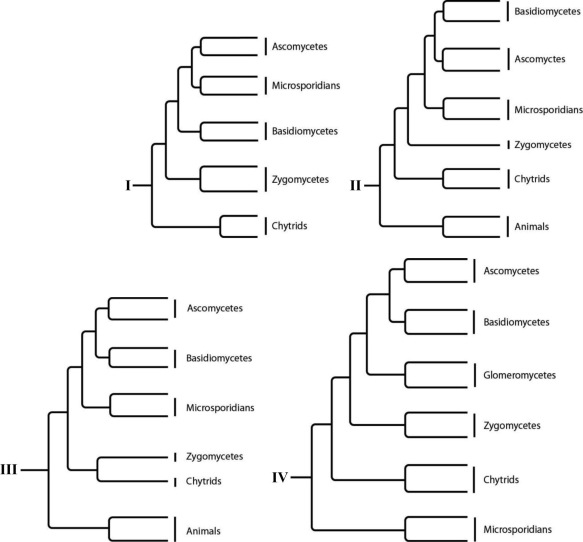 -Which tree depicts the closest relationship between zygomycetes and chytrids?
 (Multiple Choice)
4.8/5 (69)
(69) 
Filters
- Essay(0)
- Multiple Choice(0)
- Short Answer(0)
- True False(0)
- Matching(0)