



 Chat with AI
Exam 28: Plant Structure and Growth

Exam 1: Introduction: Evolution and the Foundations of Biology36 Questions
Exam 2: The Chemical Context of Life137 Questions
Exam 3: Carbon and the Molecular Diversity of Life136 Questions
Exam 4: A Tour of the Cell75 Questions
Exam 5: Membrane Transport and Cell Signaling97 Questions
Exam 6: An Introduction to Metabolism79 Questions
Exam 7: Cellular Respiration and Fermentation100 Questions
Exam 8: Photosynthesis72 Questions
Exam 9: The Cell Cycle56 Questions
Exam 10: Meiosis and Sexual Life Cycles62 Questions
Exam 11: Mendel and the Gene Idea63 Questions
Exam 12: The Chromosomal Basis of Inheritance46 Questions
Exam 13: The Molecular Basis of Inheritance67 Questions
Exam 14: Gene Expression: From Gene to Protein80 Questions
Exam 15: Regulation of Gene Expression50 Questions
Exam 16: Development, Stem Cells, and Cancer34 Questions
Exam 17: Viruses35 Questions
Exam 18: Genomes and Their Evolution29 Questions
Exam 19: Descent With Modification55 Questions
Exam 20: Phylogeny60 Questions
Exam 21: The Evolution of Populations70 Questions
Exam 22: The Origin of Species67 Questions
Exam 23: Broad Patterns of Evolution45 Questions
Exam 24: Early Life and the Diversification of Prokaryotes88 Questions
Exam 25: The Origin and Diversification of Eukaryotes71 Questions
Exam 26: The Colonization of Land by Plants and Fungi126 Questions
Exam 27: The Rise of Animal Diversity88 Questions
Exam 28: Plant Structure and Growth59 Questions
Exam 29: Resource Acquisition, Nutrition, and Transport in Vascular Plants110 Questions
Exam 30: Reproduction and Domestication of Flowering Plants67 Questions
Exam 31: Plant Responses to Internal and External Signals75 Questions
Exam 32: Homeostasis and Endocrine Signaling120 Questions
Exam 33: Animal Nutrition67 Questions
Exam 34: Circulation and Gas Exchange88 Questions
Exam 35: The Immune System91 Questions
Exam 36: Reproduction and Development118 Questions
Exam 37: Neurons, Synapses, and Signaling76 Questions
Exam 38: Nervous and Sensory Systems99 Questions
Exam 39: Motor Mechanisms and Behavior79 Questions
Exam 40: Population Ecology and the Distribution of Organisms93 Questions
Exam 41: Species Interactions60 Questions
Exam 42: Ecosystems and Energy90 Questions
Exam 43: Global Ecology and Conservation Biology72 Questions
Select questions type


Additional vascular tissue produced as secondary growth in a root originates from which cells?
(Multiple Choice)
5.0/5  (73)
(73) Which of the following statements about growth in plants is true?
(Multiple Choice)
4.8/5 (78)
(78) Which cells are no longer capable of carrying out the process of DNA transcription?
(Multiple Choice)
4.9/5 (68)
(68) An association between the roots of a terrestrial plant with soil fungus is referred as
(Multiple Choice)
4.8/5 (85)
(85) The vascular bundle in the shape of a single central cylinder in a root is called the
(Multiple Choice)
4.8/5 (73)
(73) Which of the following environmental factors plays a critical role in plant photosynthesis?
(Multiple Choice)
4.9/5 (72)
(72) Compared to most animals, the growth of most plants is best described as
(Multiple Choice)
5.0/5 (69)
(69) 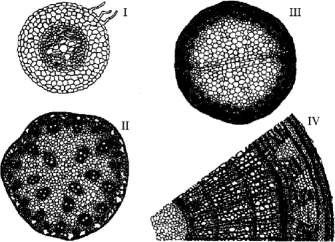 Figure 28.2
-A typical eudicot root is represented by
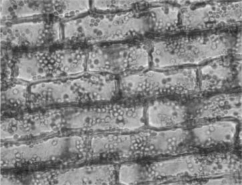 Figure 28.1
-The characteristic feature of typical parenchyma tissue is
Figure 28.1
-The characteristic feature of typical parenchyma tissue is (Multiple Choice)
4.9/5 (77)
(77) Which tissue is responsible for the recovery and rapid growth of damaged leaves of grass grazed by sheep in a pasture?
(Multiple Choice)
4.9/5 (82)
(82) Which of the following tissues played a very critical role in the process of evolution to produce the great biodiversity of flowering plant species?
(Multiple Choice)
4.9/5 (90)
(90) Suppose George Washington completely removed the bark from around the base of a cherry tree but was stopped by his father before cutting the tree down. The leaves retained their normal appearance for several weeks, but the tree eventually died. The tissue(s) that George left functional was/were the
(Multiple Choice)
4.9/5 (83)
(83) Which of the following tissue types transport water and minerals over long distances in angiosperms?
(Multiple Choice)
4.8/5 (77)
(77) Which part of a plant absorbs most of the water and minerals taken up from the soil?
(Multiple Choice)
4.8/5 (77)
(77) Which of the following are most responsible for supporting mature, nongrowing parts of the plant?
(Multiple Choice)
4.7/5 (82)
(82) 
Filters
- Essay(0)
- Multiple Choice(0)
- Short Answer(0)
- True False(0)
- Matching(0)