



 Chat with AI
Exam 30: Reproduction and Domestication of Flowering Plants

Exam 1: Introduction: Evolution and the Foundations of Biology36 Questions
Exam 2: The Chemical Context of Life137 Questions
Exam 3: Carbon and the Molecular Diversity of Life136 Questions
Exam 4: A Tour of the Cell75 Questions
Exam 5: Membrane Transport and Cell Signaling97 Questions
Exam 6: An Introduction to Metabolism79 Questions
Exam 7: Cellular Respiration and Fermentation100 Questions
Exam 8: Photosynthesis72 Questions
Exam 9: The Cell Cycle56 Questions
Exam 10: Meiosis and Sexual Life Cycles62 Questions
Exam 11: Mendel and the Gene Idea63 Questions
Exam 12: The Chromosomal Basis of Inheritance46 Questions
Exam 13: The Molecular Basis of Inheritance67 Questions
Exam 14: Gene Expression: From Gene to Protein80 Questions
Exam 15: Regulation of Gene Expression50 Questions
Exam 16: Development, Stem Cells, and Cancer34 Questions
Exam 17: Viruses35 Questions
Exam 18: Genomes and Their Evolution29 Questions
Exam 19: Descent With Modification55 Questions
Exam 20: Phylogeny60 Questions
Exam 21: The Evolution of Populations70 Questions
Exam 22: The Origin of Species67 Questions
Exam 23: Broad Patterns of Evolution45 Questions
Exam 24: Early Life and the Diversification of Prokaryotes88 Questions
Exam 25: The Origin and Diversification of Eukaryotes71 Questions
Exam 26: The Colonization of Land by Plants and Fungi126 Questions
Exam 27: The Rise of Animal Diversity88 Questions
Exam 28: Plant Structure and Growth59 Questions
Exam 29: Resource Acquisition, Nutrition, and Transport in Vascular Plants110 Questions
Exam 30: Reproduction and Domestication of Flowering Plants67 Questions
Exam 31: Plant Responses to Internal and External Signals75 Questions
Exam 32: Homeostasis and Endocrine Signaling120 Questions
Exam 33: Animal Nutrition67 Questions
Exam 34: Circulation and Gas Exchange88 Questions
Exam 35: The Immune System91 Questions
Exam 36: Reproduction and Development118 Questions
Exam 37: Neurons, Synapses, and Signaling76 Questions
Exam 38: Nervous and Sensory Systems99 Questions
Exam 39: Motor Mechanisms and Behavior79 Questions
Exam 40: Population Ecology and the Distribution of Organisms93 Questions
Exam 41: Species Interactions60 Questions
Exam 42: Ecosystems and Energy90 Questions
Exam 43: Global Ecology and Conservation Biology72 Questions
Select questions type


A parent with an S1S2 genotype exhibiting sporophytic self-incompatibility can potentially fertilize which of the following plant genotypes of the same species with pollen grains?
(Multiple Choice)
4.8/5  (79)
(79) Recent research has shown that fertilization requires that carpels recognize pollen grains as "self" or "non-self." For self-incompatibility, the system requires
(Multiple Choice)
4.8/5 (82)
(82) The pollen produced by wind-pollinated plants is often smaller than the pollen produced by animal-pollinated plants. A reason for this might be that
(Multiple Choice)
4.7/5 (66)
(66) Which of the following is an advantage of flowering plants maintaining an extended gametophyte generation?
(Multiple Choice)
5.0/5 (81)
(81) The following questions refer to the diagram of an embryo sac of an angiosperm shown in Figure 30.1. 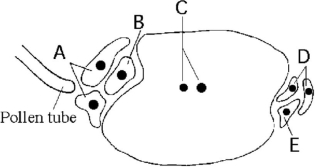 Figure 30.1
-Based on Figure 30.1, which cell(s), after fertilization, give(s) rise to the embryo plant?
Figure 30.1
-Based on Figure 30.1, which cell(s), after fertilization, give(s) rise to the embryo plant? (Multiple Choice)
4.9/5 (79)
(79) Which of the following statements is true of most angiosperms?
(Multiple Choice)
4.9/5 (68)
(68) 
Filters
- Essay(0)
- Multiple Choice(0)
- Short Answer(0)
- True False(0)
- Matching(0)