



 Chat with AI
Exam 30: Reproduction and Domestication of Flowering Plants

Exam 1: Introduction: Evolution and the Foundations of Biology36 Questions
Exam 2: The Chemical Context of Life137 Questions
Exam 3: Carbon and the Molecular Diversity of Life136 Questions
Exam 4: A Tour of the Cell75 Questions
Exam 5: Membrane Transport and Cell Signaling97 Questions
Exam 6: An Introduction to Metabolism79 Questions
Exam 7: Cellular Respiration and Fermentation100 Questions
Exam 8: Photosynthesis72 Questions
Exam 9: The Cell Cycle56 Questions
Exam 10: Meiosis and Sexual Life Cycles62 Questions
Exam 11: Mendel and the Gene Idea63 Questions
Exam 12: The Chromosomal Basis of Inheritance46 Questions
Exam 13: The Molecular Basis of Inheritance67 Questions
Exam 14: Gene Expression: From Gene to Protein80 Questions
Exam 15: Regulation of Gene Expression50 Questions
Exam 16: Development, Stem Cells, and Cancer34 Questions
Exam 17: Viruses35 Questions
Exam 18: Genomes and Their Evolution29 Questions
Exam 19: Descent With Modification55 Questions
Exam 20: Phylogeny60 Questions
Exam 21: The Evolution of Populations70 Questions
Exam 22: The Origin of Species67 Questions
Exam 23: Broad Patterns of Evolution45 Questions
Exam 24: Early Life and the Diversification of Prokaryotes88 Questions
Exam 25: The Origin and Diversification of Eukaryotes71 Questions
Exam 26: The Colonization of Land by Plants and Fungi126 Questions
Exam 27: The Rise of Animal Diversity88 Questions
Exam 28: Plant Structure and Growth59 Questions
Exam 29: Resource Acquisition, Nutrition, and Transport in Vascular Plants110 Questions
Exam 30: Reproduction and Domestication of Flowering Plants67 Questions
Exam 31: Plant Responses to Internal and External Signals75 Questions
Exam 32: Homeostasis and Endocrine Signaling120 Questions
Exam 33: Animal Nutrition67 Questions
Exam 34: Circulation and Gas Exchange88 Questions
Exam 35: The Immune System91 Questions
Exam 36: Reproduction and Development118 Questions
Exam 37: Neurons, Synapses, and Signaling76 Questions
Exam 38: Nervous and Sensory Systems99 Questions
Exam 39: Motor Mechanisms and Behavior79 Questions
Exam 40: Population Ecology and the Distribution of Organisms93 Questions
Exam 41: Species Interactions60 Questions
Exam 42: Ecosystems and Energy90 Questions
Exam 43: Global Ecology and Conservation Biology72 Questions
Select questions type


Which of the following is a scientific concern related to creating genetically modified crops?
(Multiple Choice)
4.7/5  (79)
(79) Which of the following is an effective method to produce plants exhibiting hybrid vigor?
(Multiple Choice)
4.9/5 (77)
(77) Due to the limitation of land and water resources on planet earth, biotechnology can help to increase the crop yields to meet human needs and demands in the years to come. Farmers have to produce ________% more grain per hectare to feed human population in ________.
(Multiple Choice)
4.7/5 (63)
(63) In some angiosperms, other floral parts contribute to what is commonly called the fruit. Which of the following fruits is derived mostly from an enlarged receptacle?
(Multiple Choice)
4.8/5 (76)
(76) Apomixis is a mode of ________ in certain plants that allows hybrid plants to sustain their genome and pass it on to the next generation.
(Multiple Choice)
4.8/5 (73)
(73) In the life cycle of an angiosperm, which of the following stages is diploid?
(Multiple Choice)
4.7/5 (63)
(63) You are studying a plant from the Amazon rain forest that shows strong self-incompatibility. To characterize this reproductive mechanism, you would look for
(Multiple Choice)
4.8/5 (77)
(77) Which of the following types of plants are incapable of self-pollination?
(Multiple Choice)
4.9/5 (74)
(74) What typically results from double fertilization in angiosperms?
(Multiple Choice)
4.8/5 (88)
(88) Which of the following is true about vegetative reproduction?
(Multiple Choice)
4.9/5 (81)
(81) Which of the following is correctly paired with its life cycle generation?
(Multiple Choice)
4.9/5 (79)
(79) Which of the following is the correct sequence of processes that takes place when a flowering plant reproduces?
(Multiple Choice)
4.8/5 (82)
(82) Which of the following is the correct sequence during the alternation of generations life cycle in a flowering plant?
(Multiple Choice)
4.8/5 (81)
(81) The following questions refer to the diagram of an embryo sac of an angiosperm shown in Figure 30.1. 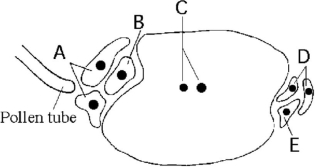 Figure 30.1
-Based on Figure 30.1, which cell(s) become(s) the triploid endosperm?
Figure 30.1
-Based on Figure 30.1, which cell(s) become(s) the triploid endosperm? (Multiple Choice)
4.8/5 (84)
(84) Which of the following is the correct order of floral organs from the outside to the inside of a complete flower?
(Multiple Choice)
4.8/5 (84)
(84) 
Filters
- Essay(0)
- Multiple Choice(0)
- Short Answer(0)
- True False(0)
- Matching(0)