



 Chat with AI
Exam 31: Plant Responses to Internal and External Signals

Exam 1: Introduction: Evolution and the Foundations of Biology36 Questions
Exam 2: The Chemical Context of Life137 Questions
Exam 3: Carbon and the Molecular Diversity of Life136 Questions
Exam 4: A Tour of the Cell75 Questions
Exam 5: Membrane Transport and Cell Signaling97 Questions
Exam 6: An Introduction to Metabolism79 Questions
Exam 7: Cellular Respiration and Fermentation100 Questions
Exam 8: Photosynthesis72 Questions
Exam 9: The Cell Cycle56 Questions
Exam 10: Meiosis and Sexual Life Cycles62 Questions
Exam 11: Mendel and the Gene Idea63 Questions
Exam 12: The Chromosomal Basis of Inheritance46 Questions
Exam 13: The Molecular Basis of Inheritance67 Questions
Exam 14: Gene Expression: From Gene to Protein80 Questions
Exam 15: Regulation of Gene Expression50 Questions
Exam 16: Development, Stem Cells, and Cancer34 Questions
Exam 17: Viruses35 Questions
Exam 18: Genomes and Their Evolution29 Questions
Exam 19: Descent With Modification55 Questions
Exam 20: Phylogeny60 Questions
Exam 21: The Evolution of Populations70 Questions
Exam 22: The Origin of Species67 Questions
Exam 23: Broad Patterns of Evolution45 Questions
Exam 24: Early Life and the Diversification of Prokaryotes88 Questions
Exam 25: The Origin and Diversification of Eukaryotes71 Questions
Exam 26: The Colonization of Land by Plants and Fungi126 Questions
Exam 27: The Rise of Animal Diversity88 Questions
Exam 28: Plant Structure and Growth59 Questions
Exam 29: Resource Acquisition, Nutrition, and Transport in Vascular Plants110 Questions
Exam 30: Reproduction and Domestication of Flowering Plants67 Questions
Exam 31: Plant Responses to Internal and External Signals75 Questions
Exam 32: Homeostasis and Endocrine Signaling120 Questions
Exam 33: Animal Nutrition67 Questions
Exam 34: Circulation and Gas Exchange88 Questions
Exam 35: The Immune System91 Questions
Exam 36: Reproduction and Development118 Questions
Exam 37: Neurons, Synapses, and Signaling76 Questions
Exam 38: Nervous and Sensory Systems99 Questions
Exam 39: Motor Mechanisms and Behavior79 Questions
Exam 40: Population Ecology and the Distribution of Organisms93 Questions
Exam 41: Species Interactions60 Questions
Exam 42: Ecosystems and Energy90 Questions
Exam 43: Global Ecology and Conservation Biology72 Questions
Select questions type


When growing plants in culture, IAA is used to stimulate cell enlargement. Which plant growth regulator has to now be added to stimulate cell division?
(Multiple Choice)
4.8/5  (88)
(88) The detector of light during de-etiolation (greening) of a tomato plant is
(Multiple Choice)
4.9/5 (80)
(80) The plant hormone involved in stimulation of stem elongation is
(Multiple Choice)
4.8/5 (67)
(67) You are part of a desert plant research team trying to discover crops that will be productive in arid climates. You discover a plant that produces a hormone under water-deficit conditions that triggers a suite of drought responses. Most likely the hormone is
(Multiple Choice)
4.7/5 (71)
(71) 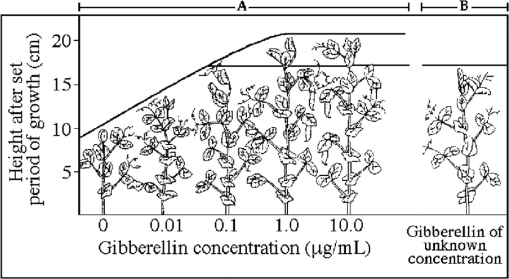 Figure 31.2
-This experiment suggests that the optimum amount of gibberellin in the experiment is approximately
Figure 31.2
-This experiment suggests that the optimum amount of gibberellin in the experiment is approximately (Multiple Choice)
4.9/5 (76)
(76) Many plants flower in response to day-length cues. Which of the following statements best summarizes this phenomenon?
(Multiple Choice)
4.8/5 (77)
(77) Which of the following would only be activated or upregulated after a plant has already been infected by a pathogen?
(Multiple Choice)
4.8/5 (88)
(88) Plants often use changes in day length (photoperiod) to trigger events such as dormancy and flowering. It is logical that plants have evolved this mechanism because photoperiod changes
(Multiple Choice)
4.8/5 (82)
(82) Young leaves and developing seeds are the prime sites for ________ synthesis.
(Multiple Choice)
5.0/5 (68)
(68) The initial response of the root cells of a tomato plant watered with seawater would be to
(Multiple Choice)
4.9/5 (74)
(74) In legumes, it has been shown that "sleep" movements are correlated with
(Multiple Choice)
4.9/5 (82)
(82) In order for a plant to initiate chemical responses to herbivory,
(Multiple Choice)
4.9/5 (70)
(70) If the range of a species of plants expands to a higher latitude, which of the following processes is the most likely to be modified by natural selection?
(Multiple Choice)
4.8/5 (75)
(75) The transduction pathway that activates systemic acquired resistance in plants is initially signaled by
(Multiple Choice)
4.8/5 (81)
(81) Figure 31.2
-The results of this experiment, shown on the left of the graph (area A), may be used to
Figure 31.2
-The results of this experiment, shown on the left of the graph (area A), may be used to (Multiple Choice)
4.9/5 (80)
(80) 
Filters
- Essay(0)
- Multiple Choice(0)
- Short Answer(0)
- True False(0)
- Matching(0)