



 Chat with AI
Exam 31: Plant Responses to Internal and External Signals

Exam 1: Introduction: Evolution and the Foundations of Biology36 Questions
Exam 2: The Chemical Context of Life137 Questions
Exam 3: Carbon and the Molecular Diversity of Life136 Questions
Exam 4: A Tour of the Cell75 Questions
Exam 5: Membrane Transport and Cell Signaling97 Questions
Exam 6: An Introduction to Metabolism79 Questions
Exam 7: Cellular Respiration and Fermentation100 Questions
Exam 8: Photosynthesis72 Questions
Exam 9: The Cell Cycle56 Questions
Exam 10: Meiosis and Sexual Life Cycles62 Questions
Exam 11: Mendel and the Gene Idea63 Questions
Exam 12: The Chromosomal Basis of Inheritance46 Questions
Exam 13: The Molecular Basis of Inheritance67 Questions
Exam 14: Gene Expression: From Gene to Protein80 Questions
Exam 15: Regulation of Gene Expression50 Questions
Exam 16: Development, Stem Cells, and Cancer34 Questions
Exam 17: Viruses35 Questions
Exam 18: Genomes and Their Evolution29 Questions
Exam 19: Descent With Modification55 Questions
Exam 20: Phylogeny60 Questions
Exam 21: The Evolution of Populations70 Questions
Exam 22: The Origin of Species67 Questions
Exam 23: Broad Patterns of Evolution45 Questions
Exam 24: Early Life and the Diversification of Prokaryotes88 Questions
Exam 25: The Origin and Diversification of Eukaryotes71 Questions
Exam 26: The Colonization of Land by Plants and Fungi126 Questions
Exam 27: The Rise of Animal Diversity88 Questions
Exam 28: Plant Structure and Growth59 Questions
Exam 29: Resource Acquisition, Nutrition, and Transport in Vascular Plants110 Questions
Exam 30: Reproduction and Domestication of Flowering Plants67 Questions
Exam 31: Plant Responses to Internal and External Signals75 Questions
Exam 32: Homeostasis and Endocrine Signaling120 Questions
Exam 33: Animal Nutrition67 Questions
Exam 34: Circulation and Gas Exchange88 Questions
Exam 35: The Immune System91 Questions
Exam 36: Reproduction and Development118 Questions
Exam 37: Neurons, Synapses, and Signaling76 Questions
Exam 38: Nervous and Sensory Systems99 Questions
Exam 39: Motor Mechanisms and Behavior79 Questions
Exam 40: Population Ecology and the Distribution of Organisms93 Questions
Exam 41: Species Interactions60 Questions
Exam 42: Ecosystems and Energy90 Questions
Exam 43: Global Ecology and Conservation Biology72 Questions
Select questions type


If a long-day plant has a critical night length of 9 hours, which 24-hour cycle would prevent flowering?
(Multiple Choice)
4.7/5  (85)
(85) 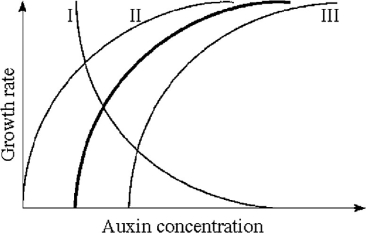 Figure 31.1
The heavy line in Figure 31.1 illustrates the relationship between auxin concentration and cell growth in stem tissues. If the same range of concentrations were applied to lateral buds, what curve(s) would probably be produced?
Figure 31.1
The heavy line in Figure 31.1 illustrates the relationship between auxin concentration and cell growth in stem tissues. If the same range of concentrations were applied to lateral buds, what curve(s) would probably be produced? (Multiple Choice)
4.9/5 (81)
(81) The ripening of fruit and the dropping of leaves and fruit are principally controlled by
(Multiple Choice)
4.8/5 (72)
(72) Which of the following treatments would enhance the level of the Pfr form of phytochrome?
(Multiple Choice)
4.8/5 (87)
(87) Plant hormones can have different effects at different concentrations. This explains how
(Multiple Choice)
4.9/5 (91)
(91) Which of the following statements best summarizes the acid growth hypothesis in an actively growing shoot?
(Multiple Choice)
4.8/5 (79)
(79) What is the probable role of salicylic acid in the defense responses of plants?
(Multiple Choice)
4.7/5 (75)
(75) When an arborist prunes a limb off a valuable tree, he or she usually paints the cut surface. The primary purpose of the paint is to
(Multiple Choice)
4.9/5 (69)
(69) 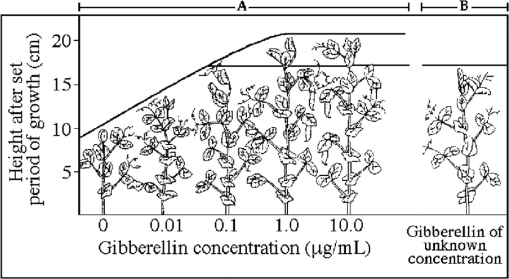 Figure 31.2
-This experiment suggests that the unknown amount of gibberellin in the experimental plant (B) is approximately
Figure 31.2
-This experiment suggests that the unknown amount of gibberellin in the experimental plant (B) is approximately (Multiple Choice)
4.8/5 (78)
(78) ________ promote(s) stomatal closure in plant leaves during drought stress.
(Multiple Choice)
4.8/5 (74)
(74) What do the results of research on gravitropic responses of roots and stems show?
(Multiple Choice)
4.9/5 (83)
(83) In an experiment, a plant physiologist has four groups of bananas of the same species. He exposes each of the four groups of bananas with the same concentration of auxins, gibberellins, abscisic acid, or ethylene. Which of these four groups of bananas ripen the fastest?
(Multiple Choice)
4.8/5 (77)
(77) A botanist discovers a plant that lacks the ability to form starch grains in root cells, yet the roots still grow downward. This evidence refutes the long-standing hypothesis that
(Multiple Choice)
4.9/5 (92)
(92) The signaling molecule for flowering might be released earlier than usual in a long-day plant exposed to flashes of
(Multiple Choice)
4.7/5 (76)
(76) Plants that have their flowering inhibited by being exposed to bright lights at night are
(Multiple Choice)
4.8/5 (90)
(90) Experiments on the positive phototropic response of plants indicate that
(Multiple Choice)
5.0/5 (80)
(80) The aleurone layer is stimulated to release ________ as a result of gibberellin release from the embryo.
(Multiple Choice)
4.8/5 (79)
(79) The application of which of the following hormones would be a logical first choice in an attempt to produce normal growth in mutant dwarf plants?
(Multiple Choice)
4.8/5 (83)
(83) 
Filters
- Essay(0)
- Multiple Choice(0)
- Short Answer(0)
- True False(0)
- Matching(0)