



 Chat with AI
Exam 33: Animal Nutrition

Exam 1: Introduction: Evolution and the Foundations of Biology36 Questions
Exam 2: The Chemical Context of Life137 Questions
Exam 3: Carbon and the Molecular Diversity of Life136 Questions
Exam 4: A Tour of the Cell75 Questions
Exam 5: Membrane Transport and Cell Signaling97 Questions
Exam 6: An Introduction to Metabolism79 Questions
Exam 7: Cellular Respiration and Fermentation100 Questions
Exam 8: Photosynthesis72 Questions
Exam 9: The Cell Cycle56 Questions
Exam 10: Meiosis and Sexual Life Cycles62 Questions
Exam 11: Mendel and the Gene Idea63 Questions
Exam 12: The Chromosomal Basis of Inheritance46 Questions
Exam 13: The Molecular Basis of Inheritance67 Questions
Exam 14: Gene Expression: From Gene to Protein80 Questions
Exam 15: Regulation of Gene Expression50 Questions
Exam 16: Development, Stem Cells, and Cancer34 Questions
Exam 17: Viruses35 Questions
Exam 18: Genomes and Their Evolution29 Questions
Exam 19: Descent With Modification55 Questions
Exam 20: Phylogeny60 Questions
Exam 21: The Evolution of Populations70 Questions
Exam 22: The Origin of Species67 Questions
Exam 23: Broad Patterns of Evolution45 Questions
Exam 24: Early Life and the Diversification of Prokaryotes88 Questions
Exam 25: The Origin and Diversification of Eukaryotes71 Questions
Exam 26: The Colonization of Land by Plants and Fungi126 Questions
Exam 27: The Rise of Animal Diversity88 Questions
Exam 28: Plant Structure and Growth59 Questions
Exam 29: Resource Acquisition, Nutrition, and Transport in Vascular Plants110 Questions
Exam 30: Reproduction and Domestication of Flowering Plants67 Questions
Exam 31: Plant Responses to Internal and External Signals75 Questions
Exam 32: Homeostasis and Endocrine Signaling120 Questions
Exam 33: Animal Nutrition67 Questions
Exam 34: Circulation and Gas Exchange88 Questions
Exam 35: The Immune System91 Questions
Exam 36: Reproduction and Development118 Questions
Exam 37: Neurons, Synapses, and Signaling76 Questions
Exam 38: Nervous and Sensory Systems99 Questions
Exam 39: Motor Mechanisms and Behavior79 Questions
Exam 40: Population Ecology and the Distribution of Organisms93 Questions
Exam 41: Species Interactions60 Questions
Exam 42: Ecosystems and Energy90 Questions
Exam 43: Global Ecology and Conservation Biology72 Questions
Select questions type


 Figure 33.2
-Examine the digestive system structures in the figure above. The agent(s) that help emulsify fats are produced in location
Figure 33.2
-Examine the digestive system structures in the figure above. The agent(s) that help emulsify fats are produced in location (Multiple Choice)
4.8/5  (76)
(76) The absorption of fats differs from that of carbohydrates in that the
(Multiple Choice)
4.9/5 (81)
(81) Hypoglycemia occurs when there are low levels of glucose in the blood of a healthy human. What is a way to "correct" hypoglycemia?
(Multiple Choice)
4.7/5 (83)
(83) When the digestion and absorption of organic carbohydrates result in more energy-rich molecules than are immediately required by an animal, the excess is
(Multiple Choice)
5.0/5 (85)
(85) Independent of whether an organism is an endotherm or ectoderm, the least reliable indicator of an animal's metabolic rate is the amount of
(Multiple Choice)
4.8/5 (79)
(79) Which pair correctly associates a physiological process with the appropriate vitamin?
(Multiple Choice)
4.9/5 (86)
(86) Use the following table showing the contents of a multivitamin supplement and its percentage of recommended daily values (% DV) to answer the following question(s). 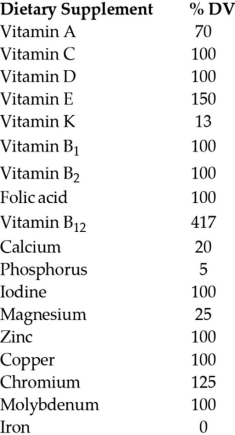 Figure 33.1
-The most likely reason that some of the vitamins and minerals in this supplement are found at less than 100% is that
Figure 33.1
-The most likely reason that some of the vitamins and minerals in this supplement are found at less than 100% is that (Multiple Choice)
4.8/5 (92)
(92) Fat digestion yields fatty acids and glycerol. Protein digestion yields amino acids. Both digestive processes
(Multiple Choice)
4.9/5 (78)
(78) Ingested dietary substances must cross cell membranes to be used by the body, a process known as
(Multiple Choice)
5.0/5 (80)
(80) A hiatal hernia that disrupts the functional relationship between the smooth muscle in the esophagus and that in the stomach would be most likely to increase the frequency of
(Multiple Choice)
4.9/5 (82)
(82) Most individuals diagnosed with type 1 diabetes have an increased probability of having inherited the disease from both parents. Additionally, Caucasians have the highest diagnosed rate of type 1 diabetes. What can you conclude from this information?
(Multiple Choice)
5.0/5 (85)
(85) Historically inaccurate diagnosis of acid reflux disorders and gastric ulcers has been improved by
(Multiple Choice)
4.8/5 (83)
(83) Complex nutrients are digested and then absorbed into the bloodstream as
(Multiple Choice)
4.8/5 (85)
(85) Digestive secretions with a pH of 2 are characteristic of the
(Multiple Choice)
4.7/5 (79)
(79) A general rule relating the capacity of a specific animal's digestive system to provide adequate access to substrates for biosynthesis of cellular components, as well as fuel molecules needed for ATP production, is that the animal should have access to
(Multiple Choice)
4.7/5 (83)
(83) Analysis of jawbones from the skeletal remains of a vertebrate animal reveal its dietary patterns owing to
(Multiple Choice)
4.8/5 (81)
(81) Once humans ingest food, the first category of macromolecules to be chemically digested by enzymes in the mouth is
(Multiple Choice)
4.8/5 (73)
(73) 
Filters
- Essay(0)
- Multiple Choice(0)
- Short Answer(0)
- True False(0)
- Matching(0)