



 Chat with AI
Exam 38: Nervous and Sensory Systems

Exam 1: Introduction: Evolution and the Foundations of Biology36 Questions
Exam 2: The Chemical Context of Life137 Questions
Exam 3: Carbon and the Molecular Diversity of Life136 Questions
Exam 4: A Tour of the Cell75 Questions
Exam 5: Membrane Transport and Cell Signaling97 Questions
Exam 6: An Introduction to Metabolism79 Questions
Exam 7: Cellular Respiration and Fermentation100 Questions
Exam 8: Photosynthesis72 Questions
Exam 9: The Cell Cycle56 Questions
Exam 10: Meiosis and Sexual Life Cycles62 Questions
Exam 11: Mendel and the Gene Idea63 Questions
Exam 12: The Chromosomal Basis of Inheritance46 Questions
Exam 13: The Molecular Basis of Inheritance67 Questions
Exam 14: Gene Expression: From Gene to Protein80 Questions
Exam 15: Regulation of Gene Expression50 Questions
Exam 16: Development, Stem Cells, and Cancer34 Questions
Exam 17: Viruses35 Questions
Exam 18: Genomes and Their Evolution29 Questions
Exam 19: Descent With Modification55 Questions
Exam 20: Phylogeny60 Questions
Exam 21: The Evolution of Populations70 Questions
Exam 22: The Origin of Species67 Questions
Exam 23: Broad Patterns of Evolution45 Questions
Exam 24: Early Life and the Diversification of Prokaryotes88 Questions
Exam 25: The Origin and Diversification of Eukaryotes71 Questions
Exam 26: The Colonization of Land by Plants and Fungi126 Questions
Exam 27: The Rise of Animal Diversity88 Questions
Exam 28: Plant Structure and Growth59 Questions
Exam 29: Resource Acquisition, Nutrition, and Transport in Vascular Plants110 Questions
Exam 30: Reproduction and Domestication of Flowering Plants67 Questions
Exam 31: Plant Responses to Internal and External Signals75 Questions
Exam 32: Homeostasis and Endocrine Signaling120 Questions
Exam 33: Animal Nutrition67 Questions
Exam 34: Circulation and Gas Exchange88 Questions
Exam 35: The Immune System91 Questions
Exam 36: Reproduction and Development118 Questions
Exam 37: Neurons, Synapses, and Signaling76 Questions
Exam 38: Nervous and Sensory Systems99 Questions
Exam 39: Motor Mechanisms and Behavior79 Questions
Exam 40: Population Ecology and the Distribution of Organisms93 Questions
Exam 41: Species Interactions60 Questions
Exam 42: Ecosystems and Energy90 Questions
Exam 43: Global Ecology and Conservation Biology72 Questions
Select questions type


 Figure 38.3
-The sense of head motion begins with sensory transduction by the structure(s) at which number(s)?
Figure 38.3
-The sense of head motion begins with sensory transduction by the structure(s) at which number(s)? (Multiple Choice)
4.8/5  (83)
(83) The cochlea is an organ of auditory transduction that contains
(Multiple Choice)
4.8/5 (83)
(83) Immediately after putting on a shirt, your skin might feel itchy. However, this perception soon fades due to
(Multiple Choice)
4.8/5 (62)
(62) What would you expect to see in an fMRI analysis of person who is experiencing hunger?
(Multiple Choice)
5.0/5 (84)
(84) The system that modulates excitation and inhibition of the smooth and cardiac muscles of the digestive, cardiovascular, and excretory systems is the
(Multiple Choice)
4.8/5 (70)
(70)  Figure 38.1
-
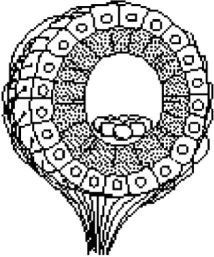 Figure 38.2
The structure diagrammed in Figure 38.2 is a
Figure 38.1
- Figure 38.2
The structure diagrammed in Figure 38.2 is a (Multiple Choice)
4.7/5 (83)
(83) After earning an A in your biology course, your instructor gives you a firm handshake. You can feel the deep pressure of the handshake, and it is so strong it even starts to hurt a little. What type(s) of receptor was (were) activated by the handshake?
(Multiple Choice)
4.9/5 (75)
(75) Sensory transduction of light/dark information in the vertebrate retina is accomplished by
(Multiple Choice)
4.9/5 (84)
(84) Figure 38.1
-In Figure 38.1, which letter points to the hippocampus?
Figure 38.1
-In Figure 38.1, which letter points to the hippocampus? (Multiple Choice)
4.7/5 (87)
(87) Please use the following information to answer the question(s) below.
The southern grasshopper mouse feeds regularly on the Arizona bark scorpion, the most venomous scorpion in the United States. While attempting to capture the scorpion, the mouse usually gets stung multiple times by the scorpion but does not seem to be affected.
-While attempting to capture the scorpion, the mouse's heart rate increases, and there is an increase in epinephrine in the mouse's blood. What nervous system division is responsible for the mouse's physiological state?
(Multiple Choice)
4.8/5 (92)
(92) The generation of action potentials in olfactory neurons initiated by odors drawn into the nasal cavity is an example of
(Multiple Choice)
4.7/5 (81)
(81) Please use the following information to answer the question(s) below.
The southern grasshopper mouse feeds regularly on the Arizona bark scorpion, the most venomous scorpion in the United States. While attempting to capture the scorpion, the mouse usually gets stung multiple times by the scorpion but does not seem to be affected.
-What type of sensory receptor in the mouse seems to be immune to the scorpion's sting and venom?
(Multiple Choice)
5.0/5 (94)
(94) Short-term memory information processing usually causes changes in the
(Multiple Choice)
4.8/5 (86)
(86) A patient has been diagnosed with a tumor that has destroyed the center of her optic chiasm. How has this affected her vision?
(Multiple Choice)
4.8/5 (79)
(79) 
Filters
- Essay(0)
- Multiple Choice(0)
- Short Answer(0)
- True False(0)
- Matching(0)