



 Chat with AI
Exam 40: Population Ecology and the Distribution of Organisms

Exam 1: Introduction: Evolution and the Foundations of Biology36 Questions
Exam 2: The Chemical Context of Life137 Questions
Exam 3: Carbon and the Molecular Diversity of Life136 Questions
Exam 4: A Tour of the Cell75 Questions
Exam 5: Membrane Transport and Cell Signaling97 Questions
Exam 6: An Introduction to Metabolism79 Questions
Exam 7: Cellular Respiration and Fermentation100 Questions
Exam 8: Photosynthesis72 Questions
Exam 9: The Cell Cycle56 Questions
Exam 10: Meiosis and Sexual Life Cycles62 Questions
Exam 11: Mendel and the Gene Idea63 Questions
Exam 12: The Chromosomal Basis of Inheritance46 Questions
Exam 13: The Molecular Basis of Inheritance67 Questions
Exam 14: Gene Expression: From Gene to Protein80 Questions
Exam 15: Regulation of Gene Expression50 Questions
Exam 16: Development, Stem Cells, and Cancer34 Questions
Exam 17: Viruses35 Questions
Exam 18: Genomes and Their Evolution29 Questions
Exam 19: Descent With Modification55 Questions
Exam 20: Phylogeny60 Questions
Exam 21: The Evolution of Populations70 Questions
Exam 22: The Origin of Species67 Questions
Exam 23: Broad Patterns of Evolution45 Questions
Exam 24: Early Life and the Diversification of Prokaryotes88 Questions
Exam 25: The Origin and Diversification of Eukaryotes71 Questions
Exam 26: The Colonization of Land by Plants and Fungi126 Questions
Exam 27: The Rise of Animal Diversity88 Questions
Exam 28: Plant Structure and Growth59 Questions
Exam 29: Resource Acquisition, Nutrition, and Transport in Vascular Plants110 Questions
Exam 30: Reproduction and Domestication of Flowering Plants67 Questions
Exam 31: Plant Responses to Internal and External Signals75 Questions
Exam 32: Homeostasis and Endocrine Signaling120 Questions
Exam 33: Animal Nutrition67 Questions
Exam 34: Circulation and Gas Exchange88 Questions
Exam 35: The Immune System91 Questions
Exam 36: Reproduction and Development118 Questions
Exam 37: Neurons, Synapses, and Signaling76 Questions
Exam 38: Nervous and Sensory Systems99 Questions
Exam 39: Motor Mechanisms and Behavior79 Questions
Exam 40: Population Ecology and the Distribution of Organisms93 Questions
Exam 41: Species Interactions60 Questions
Exam 42: Ecosystems and Energy90 Questions
Exam 43: Global Ecology and Conservation Biology72 Questions
Select questions type


What is the limiting factor for the growth of trees in the tundra?
(Multiple Choice)
4.9/5  (82)
(82) Exponential growth of a population is represented by dN/dt =
(Multiple Choice)
4.8/5 (89)
(89) Why is the climate drier on the leeward side of mountain ranges that are subjected to prevailing winds?
(Multiple Choice)
4.8/5 (88)
(88) Which of the following is most likely to contribute to density-dependent regulation of populations?
(Multiple Choice)
4.9/5 (89)
(89) Deserts typically occur in a band around 30 degrees north and 30 degrees south latitude because
(Multiple Choice)
4.9/5 (81)
(81) Which of the following methods would most accurately measure the density of the population being studied?
(Multiple Choice)
4.9/5 (71)
(71) A population of ground squirrels has an annual per capita birth rate of 0.06 and an annual per capita death rate of 0.02. Calculate an estimate of the number of individuals added to (or lost from) a population of 1,000 individuals in one year.
(Multiple Choice)
4.7/5 (73)
(73) Please use the following information to answer the question(s) below.
In areas of permafrost, stands of black spruce are frequently observed in the landscape, whereas other tree species are noticeably absent. Often these stands are referred to as "drunken forests" because many of the black spruce are displaced from their normal vertical alignment.
-When climbing a mountain, we can observe transitions in biological communities that are analogous to the changes
(Multiple Choice)
4.9/5 (83)
(83) Why do some invertebrates, such as lobsters, show a "stair-step" survivorship curve?
(Multiple Choice)
4.8/5 (78)
(78) Which of the following is a physical factor that can limit the geographic distribution of species?
(Multiple Choice)
4.9/5 (76)
(76) Palm trees and subtropical plants are commonplace in Land's End, England, whose latitude is the equivalent of Labrador in coastal Canada, where the local flora is subarctic. Which statement best explains why this apparent anomaly exists between North America and Europe?
(Multiple Choice)
4.7/5 (83)
(83) In 2008, the New Zealand population was approximately 4,275,000. If the birth rate was 14 births for every 1,000 people, approximately how many births occurred in New Zealand in 2008?
(Multiple Choice)
4.7/5 (59)
(59) Which of the following equations represents zero population growth?
(Multiple Choice)
4.7/5 (74)
(74) 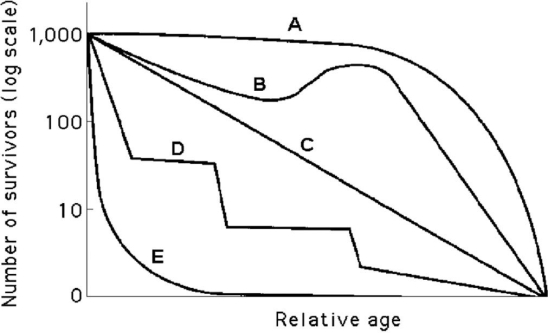 Figure 40.3
-In Figure 40.3, which curve best describes survivorship in marine molluscs?
Figure 40.3
-In Figure 40.3, which curve best describes survivorship in marine molluscs? (Multiple Choice)
4.8/5 (82)
(82) The main reason that polar regions are cooler than the equator is that
(Multiple Choice)
4.8/5 (79)
(79) Which of the following describes a Type II survivorship curve?
(Multiple Choice)
4.9/5 (90)
(90) A population is correctly defined as having which of the following characteristics?
I. inhabits the same general area
II. belongs to the same species
III. possesses a constant and uniform density and dispersion
(Multiple Choice)
4.9/5 (77)
(77) Consider two forests: one is an undisturbed old-growth forest and the other has recently been logged. In which forest are species likely to experience exponential growth, and why?
(Multiple Choice)
4.9/5 (83)
(83) 
Filters
- Essay(0)
- Multiple Choice(0)
- Short Answer(0)
- True False(0)
- Matching(0)