



 Chat with AI
Exam 41: Species Interactions

Exam 1: Introduction: Evolution and the Foundations of Biology36 Questions
Exam 2: The Chemical Context of Life137 Questions
Exam 3: Carbon and the Molecular Diversity of Life136 Questions
Exam 4: A Tour of the Cell75 Questions
Exam 5: Membrane Transport and Cell Signaling97 Questions
Exam 6: An Introduction to Metabolism79 Questions
Exam 7: Cellular Respiration and Fermentation100 Questions
Exam 8: Photosynthesis72 Questions
Exam 9: The Cell Cycle56 Questions
Exam 10: Meiosis and Sexual Life Cycles62 Questions
Exam 11: Mendel and the Gene Idea63 Questions
Exam 12: The Chromosomal Basis of Inheritance46 Questions
Exam 13: The Molecular Basis of Inheritance67 Questions
Exam 14: Gene Expression: From Gene to Protein80 Questions
Exam 15: Regulation of Gene Expression50 Questions
Exam 16: Development, Stem Cells, and Cancer34 Questions
Exam 17: Viruses35 Questions
Exam 18: Genomes and Their Evolution29 Questions
Exam 19: Descent With Modification55 Questions
Exam 20: Phylogeny60 Questions
Exam 21: The Evolution of Populations70 Questions
Exam 22: The Origin of Species67 Questions
Exam 23: Broad Patterns of Evolution45 Questions
Exam 24: Early Life and the Diversification of Prokaryotes88 Questions
Exam 25: The Origin and Diversification of Eukaryotes71 Questions
Exam 26: The Colonization of Land by Plants and Fungi126 Questions
Exam 27: The Rise of Animal Diversity88 Questions
Exam 28: Plant Structure and Growth59 Questions
Exam 29: Resource Acquisition, Nutrition, and Transport in Vascular Plants110 Questions
Exam 30: Reproduction and Domestication of Flowering Plants67 Questions
Exam 31: Plant Responses to Internal and External Signals75 Questions
Exam 32: Homeostasis and Endocrine Signaling120 Questions
Exam 33: Animal Nutrition67 Questions
Exam 34: Circulation and Gas Exchange88 Questions
Exam 35: The Immune System91 Questions
Exam 36: Reproduction and Development118 Questions
Exam 37: Neurons, Synapses, and Signaling76 Questions
Exam 38: Nervous and Sensory Systems99 Questions
Exam 39: Motor Mechanisms and Behavior79 Questions
Exam 40: Population Ecology and the Distribution of Organisms93 Questions
Exam 41: Species Interactions60 Questions
Exam 42: Ecosystems and Energy90 Questions
Exam 43: Global Ecology and Conservation Biology72 Questions
Select questions type


There are more species in tropical areas than in places more distant from the equator. This is probably a result of
(Multiple Choice)
4.9/5  (72)
(72) What are usually the first photosynthetic organisms to colonize during primary succession?
(Multiple Choice)
4.7/5 (72)
(72) Evidence shows that some grasses benefit from being grazed. Which of the following terms would best describe this plant-herbivore interaction?
(Multiple Choice)
4.9/5 (87)
(87) Why do moderate levels of disturbance result in an increase in community diversity?
(Multiple Choice)
4.9/5 (80)
(80) Based on the intermediate disturbance hypothesis, a community's species diversity is increased by
(Multiple Choice)
4.8/5 (95)
(95) Which of the following best describes the consequences of white-band disease in Caribbean coral reefs?
(Multiple Choice)
4.8/5 (89)
(89) As you study two closely related predatory insect species, the two-spot and the three-spot
Avenger beetles, you notice that each species seeks prey at dawn in areas without the other species. However, where their ranges overlap, the two-spot avenger beetle hunts at night and the three-spot hunts in the morning. When you bring them into the laboratory and isolate the two different species, you discover that the offspring of both species are nocturnal. You have discovered an example of
(Multiple Choice)
4.9/5 (74)
(74) In a lake with three trophic levels (fish, zooplankton, algae), how might an algal bloom be prevented?
(Multiple Choice)
4.8/5 (88)
(88) Why do tropical communities tend to have greater species diversity than temperate or polar communities?
(Multiple Choice)
4.9/5 (73)
(73) Use the diagram in Figure 41.4 of five islands formed at around the same time near a particular mainland, as well as MacArthur and Wilson's island biogeography principles, to answer the following question(s). 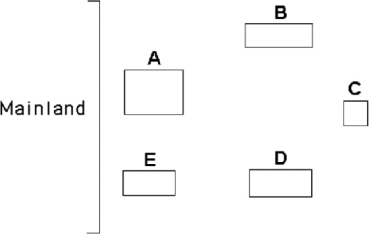 Figure 41.4
-Which island would likely exhibit the most impoverished species diversity?
Figure 41.4
-Which island would likely exhibit the most impoverished species diversity? (Multiple Choice)
4.9/5 (85)
(85) In a tide pool, 15 species of invertebrates were reduced to 8 after one species was removed. The species removed was likely a(n)
(Multiple Choice)
4.7/5 (81)
(81) Please use the following information to answer the question(s) below.
The symbols +, -, and 0 are to be used to show the results of interactions between individuals and groups of individuals in the examples that follow. The symbol + denotes a positive interaction, - denotes a negative interaction, and 0 denotes an interaction that has no effect on the individuals involved. The first symbol refers to the first organism mentioned.
-What interactions exist between a tick on a dog and the dog?
(Multiple Choice)
5.0/5 (76)
(76) Which of the following is an example of cryptic coloration?
(Multiple Choice)
4.9/5 (78)
(78) The feeding relationships between species in a community is called
(Multiple Choice)
4.9/5 (84)
(84) Please use the following information to answer the question(s) below.
The symbols +, -, and 0 are to be used to show the results of interactions between individuals and groups of individuals in the examples that follow. The symbol + denotes a positive interaction, - denotes a negative interaction, and 0 denotes an interaction that has no effect on the individuals involved. The first symbol refers to the first organism mentioned.
-What interactions exist between cellulose-digesting organisms in the gut of a termite and the termite?
(Multiple Choice)
4.8/5 (72)
(72) The feeding relationships among the species in a community determine the community's
(Multiple Choice)
4.9/5 (89)
(89) Please use the following information to answer the question(s) below.
The symbols +, -, and 0 are to be used to show the results of interactions between individuals and groups of individuals in the examples that follow. The symbol + denotes a positive interaction, - denotes a negative interaction, and 0 denotes an interaction that has no effect on the individuals involved. The first symbol refers to the first organism mentioned.
-What interactions exist between mycorrhizae and evergreen tree roots?
(Multiple Choice)
4.7/5 (80)
(80) White-breasted nuthatches and Downy woodpeckers both eat insects that hide in the furrows of bark in hardwood trees. The Downy woodpecker searches for insects by hunting from the bottom of the tree trunk toward the top, whereas the white-breasted nuthatch searches from the top of the trunk down. These hunting behaviors best illustrate which of the following ecological concepts?
(Multiple Choice)
4.8/5 (67)
(67) Why is a pathogen generally more virulent in a new habitat?
(Multiple Choice)
4.7/5 (69)
(69) 
Filters
- Essay(0)
- Multiple Choice(0)
- Short Answer(0)
- True False(0)
- Matching(0)