



 Chat with AI
Exam 41: Species Interactions

Exam 1: Introduction: Evolution and the Foundations of Biology36 Questions
Exam 2: The Chemical Context of Life137 Questions
Exam 3: Carbon and the Molecular Diversity of Life136 Questions
Exam 4: A Tour of the Cell75 Questions
Exam 5: Membrane Transport and Cell Signaling97 Questions
Exam 6: An Introduction to Metabolism79 Questions
Exam 7: Cellular Respiration and Fermentation100 Questions
Exam 8: Photosynthesis72 Questions
Exam 9: The Cell Cycle56 Questions
Exam 10: Meiosis and Sexual Life Cycles62 Questions
Exam 11: Mendel and the Gene Idea63 Questions
Exam 12: The Chromosomal Basis of Inheritance46 Questions
Exam 13: The Molecular Basis of Inheritance67 Questions
Exam 14: Gene Expression: From Gene to Protein80 Questions
Exam 15: Regulation of Gene Expression50 Questions
Exam 16: Development, Stem Cells, and Cancer34 Questions
Exam 17: Viruses35 Questions
Exam 18: Genomes and Their Evolution29 Questions
Exam 19: Descent With Modification55 Questions
Exam 20: Phylogeny60 Questions
Exam 21: The Evolution of Populations70 Questions
Exam 22: The Origin of Species67 Questions
Exam 23: Broad Patterns of Evolution45 Questions
Exam 24: Early Life and the Diversification of Prokaryotes88 Questions
Exam 25: The Origin and Diversification of Eukaryotes71 Questions
Exam 26: The Colonization of Land by Plants and Fungi126 Questions
Exam 27: The Rise of Animal Diversity88 Questions
Exam 28: Plant Structure and Growth59 Questions
Exam 29: Resource Acquisition, Nutrition, and Transport in Vascular Plants110 Questions
Exam 30: Reproduction and Domestication of Flowering Plants67 Questions
Exam 31: Plant Responses to Internal and External Signals75 Questions
Exam 32: Homeostasis and Endocrine Signaling120 Questions
Exam 33: Animal Nutrition67 Questions
Exam 34: Circulation and Gas Exchange88 Questions
Exam 35: The Immune System91 Questions
Exam 36: Reproduction and Development118 Questions
Exam 37: Neurons, Synapses, and Signaling76 Questions
Exam 38: Nervous and Sensory Systems99 Questions
Exam 39: Motor Mechanisms and Behavior79 Questions
Exam 40: Population Ecology and the Distribution of Organisms93 Questions
Exam 41: Species Interactions60 Questions
Exam 42: Ecosystems and Energy90 Questions
Exam 43: Global Ecology and Conservation Biology72 Questions
Select questions type


Resource partitioning would be most likely to occur between
(Multiple Choice)
4.9/5  (85)
(85) Which statement best describes the evolutionary significance of mutualism?
(Multiple Choice)
5.0/5 (79)
(79) Which of the following is a likely explanation for why invasive species take over communities into which they have been introduced?
(Multiple Choice)
4.9/5 (77)
(77) Imagine five forest communities, each with 100 individuals distributed among four different tree species (W, X, Y, and Z). Which forest community would be most diverse?
(Multiple Choice)
4.8/5 (97)
(97) The oak tree pathogen Phytophthora ramorum has migrated 800 km in 15 years. West Nile virus spread from New York State to 46 other states in 5 years. The difference in the rate of spread is probably related to
(Multiple Choice)
4.7/5 (86)
(86) Which of the following could qualify as a top-down control on a grassland community?
(Multiple Choice)
4.9/5 (80)
(80) Please use the following information to answer the question(s) below.
The symbols +, -, and 0 are to be used to show the results of interactions between individuals and groups of individuals in the examples that follow. The symbol + denotes a positive interaction, - denotes a negative interaction, and 0 denotes an interaction that has no effect on the individuals involved. The first symbol refers to the first organism mentioned.
-What interactions exist between a bee and a flower?
(Multiple Choice)
4.8/5 (75)
(75) According to bottom-up and top-down control models of community organization, which of the following expressions would imply that an increase in the size of a carnivore (C) population would negatively impact on its prey (P) population, but not vice versa?
(Multiple Choice)
5.0/5 (81)
(81) Please use the following information to answer the question(s) below.
The symbols +, -, and 0 are to be used to show the results of interactions between individuals and groups of individuals in the examples that follow. The symbol + denotes a positive interaction, - denotes a negative interaction, and 0 denotes an interaction that has no effect on the individuals involved. The first symbol refers to the first organism mentioned.
-What interactions exist between a lion pride and a hyena pack if they utilize the same food sources?
(Multiple Choice)
4.9/5 (80)
(80) Please use the following information to answer the question(s) below.
The effect of invasive species on the diversity of communities can be large, and protecting native communities from the invasion of non-native species is often a priority for conservation. You conduct an experiment to study how the impact that invasive plant species have on the diversity of plant communities varies as a function of distance from the source of the invasive species. In this experiment, you create five communities with equal numbers of three native plant species at the beginning. Each of these communities is located at increasing distances from a large patch of an invasive species. You and your research assistant return 1 year later to measure the relative abundance of each species. The results are shown in the table.
Relative Abundance  -Your research assistant forgets to label the distance at which each community was located. While you wait for your assistant to go back and check on the correct labels, you attempt to match the communities to their distances based on the results. Predict the order of the communities from closest to farthest from the source patch of invasive species.
 (Multiple Choice)
4.8/5 (79)
(79) Which of the following is an example of aposematic coloration?
(Multiple Choice)
4.8/5 (77)
(77) Which of the following terms is used by ecologists to describe the community interaction in which one organism makes the environment more suitable for another organism?
(Multiple Choice)
4.8/5 (77)
(77) How might an ecologist test whether a species is occupying its complete fundamental niche or only a portion of it?
(Multiple Choice)
4.8/5 (77)
(77) 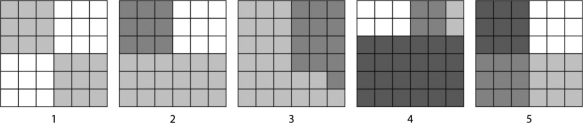 Figure 41.2
Examine Figure 41.2. According to the Shannon diversity index, which block shows the greatest diversity?
Figure 41.2
Examine Figure 41.2. According to the Shannon diversity index, which block shows the greatest diversity? (Multiple Choice)
4.9/5 (83)
(83) In terms of community ecology, why are pathogens often more virulent now than before?
(Multiple Choice)
4.8/5 (90)
(90) According to the competitive exclusion principle, two species cannot continue to occupy the same
(Multiple Choice)
4.8/5 (73)
(73) 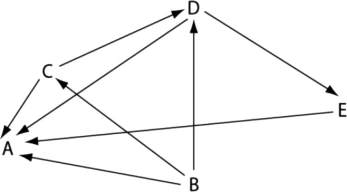 Figure 41.3
Examine the diagram of a hypothetical food web in Figure 41.3. The arrows represent the transfer of energy between the various trophic levels. Which letter represents an organism that could be a primary producer?
Figure 41.3
Examine the diagram of a hypothetical food web in Figure 41.3. The arrows represent the transfer of energy between the various trophic levels. Which letter represents an organism that could be a primary producer? (Multiple Choice)
4.9/5 (85)
(85) Which of the following best describes resource partitioning?
(Multiple Choice)
4.8/5 (75)
(75) 
Filters
- Essay(0)
- Multiple Choice(0)
- Short Answer(0)
- True False(0)
- Matching(0)