



 Chat with AI
Exam 43: Global Ecology and Conservation Biology

Exam 1: Introduction: Evolution and the Foundations of Biology36 Questions
Exam 2: The Chemical Context of Life137 Questions
Exam 3: Carbon and the Molecular Diversity of Life136 Questions
Exam 4: A Tour of the Cell75 Questions
Exam 5: Membrane Transport and Cell Signaling97 Questions
Exam 6: An Introduction to Metabolism79 Questions
Exam 7: Cellular Respiration and Fermentation100 Questions
Exam 8: Photosynthesis72 Questions
Exam 9: The Cell Cycle56 Questions
Exam 10: Meiosis and Sexual Life Cycles62 Questions
Exam 11: Mendel and the Gene Idea63 Questions
Exam 12: The Chromosomal Basis of Inheritance46 Questions
Exam 13: The Molecular Basis of Inheritance67 Questions
Exam 14: Gene Expression: From Gene to Protein80 Questions
Exam 15: Regulation of Gene Expression50 Questions
Exam 16: Development, Stem Cells, and Cancer34 Questions
Exam 17: Viruses35 Questions
Exam 18: Genomes and Their Evolution29 Questions
Exam 19: Descent With Modification55 Questions
Exam 20: Phylogeny60 Questions
Exam 21: The Evolution of Populations70 Questions
Exam 22: The Origin of Species67 Questions
Exam 23: Broad Patterns of Evolution45 Questions
Exam 24: Early Life and the Diversification of Prokaryotes88 Questions
Exam 25: The Origin and Diversification of Eukaryotes71 Questions
Exam 26: The Colonization of Land by Plants and Fungi126 Questions
Exam 27: The Rise of Animal Diversity88 Questions
Exam 28: Plant Structure and Growth59 Questions
Exam 29: Resource Acquisition, Nutrition, and Transport in Vascular Plants110 Questions
Exam 30: Reproduction and Domestication of Flowering Plants67 Questions
Exam 31: Plant Responses to Internal and External Signals75 Questions
Exam 32: Homeostasis and Endocrine Signaling120 Questions
Exam 33: Animal Nutrition67 Questions
Exam 34: Circulation and Gas Exchange88 Questions
Exam 35: The Immune System91 Questions
Exam 36: Reproduction and Development118 Questions
Exam 37: Neurons, Synapses, and Signaling76 Questions
Exam 38: Nervous and Sensory Systems99 Questions
Exam 39: Motor Mechanisms and Behavior79 Questions
Exam 40: Population Ecology and the Distribution of Organisms93 Questions
Exam 41: Species Interactions60 Questions
Exam 42: Ecosystems and Energy90 Questions
Exam 43: Global Ecology and Conservation Biology72 Questions
Select questions type


Please use the following information to answer the question(s) below.
The contamination of soils with heavy metals has become more common as a result of the burning of fossil fuels, industrial activities, and agricultural fertilizer application. These heavy metals can be toxic depending on the concentrations that accumulate in an organism. A scientist hypothesizes that biological magnification of heavy metals in fragment-dwelling, insect-eating birds should be greater in forest fragments with relatively more edge habitat because edge-dwelling bird species may forage for insects in contaminated areas outside of the forest. Forest fragments with more interior habitat would not have as much biological magnification because insect-eating interior bird species would have less exposure to insects that contain heavy metals.
-How should the scientist draw a graph of the data to best address the hypothesis?
(Multiple Choice)
4.8/5  (85)
(85) Which of the following conditions is the most likely indicator of a population in an extinction vortex?
(Multiple Choice)
4.7/5 (86)
(86) Which of the following is true about the current research regarding forest fragmentation?
(Multiple Choice)
4.8/5 (94)
(94) Please use the following information to answer the question(s) below.
Three forest areas are being considered for a conservation reserve. Each area contains the same number of trees and is the same cumulative size. The area surrounding the forest patches is a mix of agricultural land and residential homes.  -The American lady butterfly (Vanessa virginiensis) inhabits only forest edges and does not disperse well across unsuitable habitat. Which of the following area(s) would support the highest numbers of this butterfly?
 (Multiple Choice)
5.0/5 (81)
(81) Which of the following provides the best evidence of a biodiversity crisis?
(Multiple Choice)
4.8/5 (87)
(87)  Figure 43.3
Use the graph in Figure 43.3 and the information provided in the paragraph below to answer the following questions.
Flycatcher birds that migrate from Africa to Europe feed their nestlings a diet that is almost exclusively moth caterpillars. The graph in Figure 43.3 shows the mean (peak) dates of bird arrival, bird hatching, and caterpillar season for the years 1980 and 2000.
-Suppose you attend a town meeting at which some experts tell the audience that they have performed a cost-benefit analysis of a proposed transit system that would probably reduce overall air pollution and fossil fuel consumption. The analysis, however, reveals that ticket prices will not cover the cost of operating the system when fuel, wages, and equipment are taken into account. As a biologist, you know that if ecosystem services had been included in the analysis the experts might have arrived at a different answer. Why are ecosystem services rarely included in economic analyses?
Figure 43.3
Use the graph in Figure 43.3 and the information provided in the paragraph below to answer the following questions.
Flycatcher birds that migrate from Africa to Europe feed their nestlings a diet that is almost exclusively moth caterpillars. The graph in Figure 43.3 shows the mean (peak) dates of bird arrival, bird hatching, and caterpillar season for the years 1980 and 2000.
-Suppose you attend a town meeting at which some experts tell the audience that they have performed a cost-benefit analysis of a proposed transit system that would probably reduce overall air pollution and fossil fuel consumption. The analysis, however, reveals that ticket prices will not cover the cost of operating the system when fuel, wages, and equipment are taken into account. As a biologist, you know that if ecosystem services had been included in the analysis the experts might have arrived at a different answer. Why are ecosystem services rarely included in economic analyses? (Multiple Choice)
4.9/5 (73)
(73) 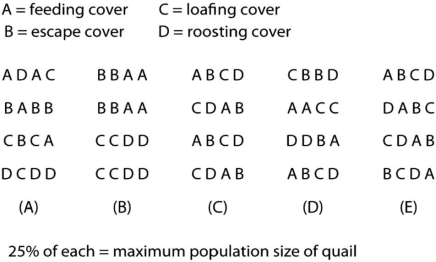 Figure 43.1
 shows five patches that can potentially serve as quail habitat. Each patch contains four plots, and the types of cover that are available in each plot are listed in each row of the patch. Assuming that only one quail can occupy a plot where all cover requirements are met, what is the maximum number of quail that could inhabit all of the patches?
Figure 43.1
Figure 43.1 shows five patches that can potentially serve as quail habitat. Each patch contains four plots, and the types of cover that are available in each plot are listed in each row of the patch. Assuming that only one quail can occupy a plot where all cover requirements are met, what is the maximum number of quail that could inhabit all of the patches? (Multiple Choice)
4.9/5 (85)
(85) If the sex ratio in a population is significantly different from 50:50, then which of the following will always be true?
(Multiple Choice)
4.8/5 (75)
(75) Please use the following information to answer the question(s) below.
The contamination of soils with heavy metals has become more common as a result of the burning of fossil fuels, industrial activities, and agricultural fertilizer application. These heavy metals can be toxic depending on the concentrations that accumulate in an organism. A scientist hypothesizes that biological magnification of heavy metals in fragment-dwelling, insect-eating birds should be greater in forest fragments with relatively more edge habitat because edge-dwelling bird species may forage for insects in contaminated areas outside of the forest. Forest fragments with more interior habitat would not have as much biological magnification because insect-eating interior bird species would have less exposure to insects that contain heavy metals.
-To test this hypothesis, the scientist conducts an experiment. Which of the following designs would be most informative?
(Multiple Choice)
4.8/5 (72)
(72) The difference between an endangered species and a threatened one is that
(Multiple Choice)
4.9/5 (80)
(80) 
Filters
- Essay(0)
- Multiple Choice(0)
- Short Answer(0)
- True False(0)
- Matching(0)