



 Chat with AI
Exam 43: Global Ecology and Conservation Biology

Exam 1: Introduction: Evolution and the Foundations of Biology36 Questions
Exam 2: The Chemical Context of Life137 Questions
Exam 3: Carbon and the Molecular Diversity of Life136 Questions
Exam 4: A Tour of the Cell75 Questions
Exam 5: Membrane Transport and Cell Signaling97 Questions
Exam 6: An Introduction to Metabolism79 Questions
Exam 7: Cellular Respiration and Fermentation100 Questions
Exam 8: Photosynthesis72 Questions
Exam 9: The Cell Cycle56 Questions
Exam 10: Meiosis and Sexual Life Cycles62 Questions
Exam 11: Mendel and the Gene Idea63 Questions
Exam 12: The Chromosomal Basis of Inheritance46 Questions
Exam 13: The Molecular Basis of Inheritance67 Questions
Exam 14: Gene Expression: From Gene to Protein80 Questions
Exam 15: Regulation of Gene Expression50 Questions
Exam 16: Development, Stem Cells, and Cancer34 Questions
Exam 17: Viruses35 Questions
Exam 18: Genomes and Their Evolution29 Questions
Exam 19: Descent With Modification55 Questions
Exam 20: Phylogeny60 Questions
Exam 21: The Evolution of Populations70 Questions
Exam 22: The Origin of Species67 Questions
Exam 23: Broad Patterns of Evolution45 Questions
Exam 24: Early Life and the Diversification of Prokaryotes88 Questions
Exam 25: The Origin and Diversification of Eukaryotes71 Questions
Exam 26: The Colonization of Land by Plants and Fungi126 Questions
Exam 27: The Rise of Animal Diversity88 Questions
Exam 28: Plant Structure and Growth59 Questions
Exam 29: Resource Acquisition, Nutrition, and Transport in Vascular Plants110 Questions
Exam 30: Reproduction and Domestication of Flowering Plants67 Questions
Exam 31: Plant Responses to Internal and External Signals75 Questions
Exam 32: Homeostasis and Endocrine Signaling120 Questions
Exam 33: Animal Nutrition67 Questions
Exam 34: Circulation and Gas Exchange88 Questions
Exam 35: The Immune System91 Questions
Exam 36: Reproduction and Development118 Questions
Exam 37: Neurons, Synapses, and Signaling76 Questions
Exam 38: Nervous and Sensory Systems99 Questions
Exam 39: Motor Mechanisms and Behavior79 Questions
Exam 40: Population Ecology and the Distribution of Organisms93 Questions
Exam 41: Species Interactions60 Questions
Exam 42: Ecosystems and Energy90 Questions
Exam 43: Global Ecology and Conservation Biology72 Questions
Select questions type


Of the following statements about protected areas that have been established to preserve biodiversity, which one is not correct?
(Multiple Choice)
4.9/5  (86)
(86) Which of the following nations has become a world leader in the establishment of zoned reserves?
(Multiple Choice)
4.9/5 (69)
(69) Brown-headed cowbirds utilize fragmented forests effectively by
(Multiple Choice)
4.8/5 (95)
(95) The success with which plants extend their range northward following glacial retreat is best determined by
(Multiple Choice)
4.8/5 (68)
(68) Which of the following best illustrates the sustainable use of a resource?
(Multiple Choice)
4.7/5 (71)
(71) Which of the following ecological locations, if destroyed, would result in the greatest loss of species diversity?
(Multiple Choice)
4.8/5 (89)
(89) Which of the following species was driven to extinction by overharvesting by hunters/fishermen?
(Multiple Choice)
4.8/5 (79)
(79) Review the formula for effective population size: Ne =  . Imagine a population of 1,000 small rodents. Of these, 300 are breeding females, 300 are breeding males, and 400 are nonbreeding juveniles. What is the effective population size?
 (Multiple Choice)
4.9/5 (74)
(74) What is caused by excessive nutrient runoff into aquatic ecosystems?
(Multiple Choice)
4.8/5 (82)
(82) Managing southeastern forests specifically for the red-cockaded woodpecker
(Multiple Choice)
4.7/5 (82)
(82) The word triage originated during World War I and was first used by French doctors in prioritizing patients based on the severity of their wounds because there were more wounded soldiers in need of urgent care than there were resources to treat them. Conservation biologists have to make similar determinations with degraded ecosystems. Which of the following is the most important consideration when it comes to managing for maintenance of biodiversity?
(Multiple Choice)
4.8/5 (72)
(72) Agricultural lands frequently require nutrient augmentation because
(Multiple Choice)
4.8/5 (78)
(78) Burning fossil fuels releases oxides of sulfur and nitrogen. These air pollutants can be responsible for
(Multiple Choice)
4.7/5 (76)
(76) The primary difference between the small-population approach (S-PA) and the declining-population approach (D-PA) to biodiversity recovery is
(Multiple Choice)
4.8/5 (84)
(84) Biodiversity hot spots are not necessarily the best choice for nature preserves because
(Multiple Choice)
4.9/5 (88)
(88) Please use the following information to answer the question(s) below.
The contamination of soils with heavy metals has become more common as a result of the burning of fossil fuels, industrial activities, and agricultural fertilizer application. These heavy metals can be toxic depending on the concentrations that accumulate in an organism. A scientist hypothesizes that biological magnification of heavy metals in fragment-dwelling, insect-eating birds should be greater in forest fragments with relatively more edge habitat because edge-dwelling bird species may forage for insects in contaminated areas outside of the forest. Forest fragments with more interior habitat would not have as much biological magnification because insect-eating interior bird species would have less exposure to insects that contain heavy metals.
-The scientist wishes to summarize the data in a way that can be compared to other studies on biological magnification of heavy metals in insect-eating birds that live in other forest fragments. What is the best way for the scientist to summarize the data for comparative purposes?
(Multiple Choice)
4.8/5 (84)
(84) What is the biological significance of genetic diversity between populations?
(Multiple Choice)
4.7/5 (67)
(67) 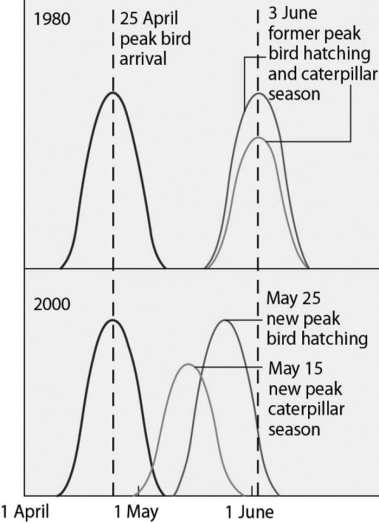 Figure 43.3
Use the graph in Figure 43.3 and the information provided in the paragraph below to answer the following questions.
Flycatcher birds that migrate from Africa to Europe feed their nestlings a diet that is almost exclusively moth caterpillars. The graph in Figure 43.3 shows the mean (peak) dates of bird arrival, bird hatching, and caterpillar season for the years 1980 and 2000.
-Why were ecologists concerned about the shift in the peak caterpillar season from June 3, 1980 to May 15, 2000?
Figure 43.3
Use the graph in Figure 43.3 and the information provided in the paragraph below to answer the following questions.
Flycatcher birds that migrate from Africa to Europe feed their nestlings a diet that is almost exclusively moth caterpillars. The graph in Figure 43.3 shows the mean (peak) dates of bird arrival, bird hatching, and caterpillar season for the years 1980 and 2000.
-Why were ecologists concerned about the shift in the peak caterpillar season from June 3, 1980 to May 15, 2000? (Multiple Choice)
4.9/5 (77)
(77) Which of the following is a consequence of biological magnification?
(Multiple Choice)
4.8/5 (86)
(86) 
Filters
- Essay(0)
- Multiple Choice(0)
- Short Answer(0)
- True False(0)
- Matching(0)