



 Chat with AI
Exam 7: Cellular Respiration and Fermentation

Exam 1: Introduction: Evolution and the Foundations of Biology36 Questions
Exam 2: The Chemical Context of Life137 Questions
Exam 3: Carbon and the Molecular Diversity of Life136 Questions
Exam 4: A Tour of the Cell75 Questions
Exam 5: Membrane Transport and Cell Signaling97 Questions
Exam 6: An Introduction to Metabolism79 Questions
Exam 7: Cellular Respiration and Fermentation100 Questions
Exam 8: Photosynthesis72 Questions
Exam 9: The Cell Cycle56 Questions
Exam 10: Meiosis and Sexual Life Cycles62 Questions
Exam 11: Mendel and the Gene Idea63 Questions
Exam 12: The Chromosomal Basis of Inheritance46 Questions
Exam 13: The Molecular Basis of Inheritance67 Questions
Exam 14: Gene Expression: From Gene to Protein80 Questions
Exam 15: Regulation of Gene Expression50 Questions
Exam 16: Development, Stem Cells, and Cancer34 Questions
Exam 17: Viruses35 Questions
Exam 18: Genomes and Their Evolution29 Questions
Exam 19: Descent With Modification55 Questions
Exam 20: Phylogeny60 Questions
Exam 21: The Evolution of Populations70 Questions
Exam 22: The Origin of Species67 Questions
Exam 23: Broad Patterns of Evolution45 Questions
Exam 24: Early Life and the Diversification of Prokaryotes88 Questions
Exam 25: The Origin and Diversification of Eukaryotes71 Questions
Exam 26: The Colonization of Land by Plants and Fungi126 Questions
Exam 27: The Rise of Animal Diversity88 Questions
Exam 28: Plant Structure and Growth59 Questions
Exam 29: Resource Acquisition, Nutrition, and Transport in Vascular Plants110 Questions
Exam 30: Reproduction and Domestication of Flowering Plants67 Questions
Exam 31: Plant Responses to Internal and External Signals75 Questions
Exam 32: Homeostasis and Endocrine Signaling120 Questions
Exam 33: Animal Nutrition67 Questions
Exam 34: Circulation and Gas Exchange88 Questions
Exam 35: The Immune System91 Questions
Exam 36: Reproduction and Development118 Questions
Exam 37: Neurons, Synapses, and Signaling76 Questions
Exam 38: Nervous and Sensory Systems99 Questions
Exam 39: Motor Mechanisms and Behavior79 Questions
Exam 40: Population Ecology and the Distribution of Organisms93 Questions
Exam 41: Species Interactions60 Questions
Exam 42: Ecosystems and Energy90 Questions
Exam 43: Global Ecology and Conservation Biology72 Questions
Select questions type


During aerobic respiration, which of the following directly donates electrons to the electron transport chain at the highest energy level?
(Multiple Choice)
4.9/5  (93)
(93) In chemiosmosis, what is the most direct source of energy that is used to convert ADP + ℗i to ATP?
(Multiple Choice)
4.7/5 (73)
(73) An organism is discovered that thrives in both the presence and absence of oxygen in the air. Curiously, the consumption of sugar increases as oxygen is removed from the organism's environment, even though the organism does not gain much weight. This organism
(Multiple Choice)
4.9/5 (77)
(77) Chemiosmosis is used to synthesize ATP in which of the following?
(Multiple Choice)
5.0/5 (86)
(86) The energy used to pump hydrogen ions from the mitochondrial matrix across the inner membrane and into the intermembrane space is derived from
(Multiple Choice)
4.7/5 (72)
(72) In the presence of oxygen, the three-carbon compound pyruvate can be catabolized in the citric acid cycle. First, however, the pyruvate (1) loses a carbon, (2) is oxidized to form a two-carbon compound, which (3) is covalently bound to coenzyme A. These three steps result in the formation of
(Multiple Choice)
5.0/5 (85)
(85) 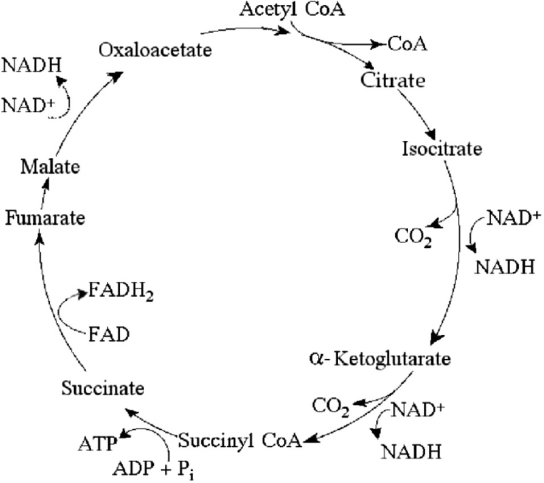 Figure 7.1
-Starting with citrate, which of the following combinations of products would result from three acetyl CoA molecules entering the citric acid cycle (see Figure 7.1)?
Figure 7.1
-Starting with citrate, which of the following combinations of products would result from three acetyl CoA molecules entering the citric acid cycle (see Figure 7.1)? (Multiple Choice)
4.9/5 (77)
(77) Carbon dioxide (CO₂) is released during which of the following stages of cellular respiration?
(Multiple Choice)
4.9/5 (82)
(82) What fraction of the carbon dioxide exhaled by animals is generated by the reactions of the citric acid cycle, if glucose is the sole energy source?
(Multiple Choice)
4.8/5 (89)
(89) Figure 7.1
-For each molecule of glucose that is metabolized by glycolysis and the citric acid cycle (see Figure 7.1), what is the total number of NADH + FADH₂ molecules produced?
Figure 7.1
-For each molecule of glucose that is metabolized by glycolysis and the citric acid cycle (see Figure 7.1), what is the total number of NADH + FADH₂ molecules produced? (Multiple Choice)
4.8/5 (76)
(76) Figure 7.1
-For each mole of glucose (C₆H₁₂O₆) completely oxidized by cellular respiration, how many moles of CO₂ are released in the citric acid cycle (see Figure 7.1)?
Figure 7.1
-For each mole of glucose (C₆H₁₂O₆) completely oxidized by cellular respiration, how many moles of CO₂ are released in the citric acid cycle (see Figure 7.1)? (Multiple Choice)
4.9/5 (76)
(76)  Figure 7.2
-Which of the following is an accurate description of the events that occur along the electron transport chain depicted in Figure 7.2?
Figure 7.2
-Which of the following is an accurate description of the events that occur along the electron transport chain depicted in Figure 7.2? (Multiple Choice)
4.8/5 (82)
(82) Glycolysis results in a net production of which of the following from each molecule of glucose?
(Multiple Choice)
4.9/5 (78)
(78) Starting with one molecule of glucose, the energy-containing products of glycolysis are
(Multiple Choice)
4.9/5 (94)
(94) Figure 7.2
-Figure 7.2 shows the electron transport chain. Which of the following is initially added to the chain with the highest free energy?
Figure 7.2
-Figure 7.2 shows the electron transport chain. Which of the following is initially added to the chain with the highest free energy? (Multiple Choice)
4.9/5 (76)
(76) Yeast cells with defective mitochondria are incapable of cellular respiration. These cells will be able to grow by catabolizing which of the following carbon sources for energy?
(Multiple Choice)
4.7/5 (95)
(95) How do the catabolic products of beta oxidation enter into the citric acid cycle?
(Multiple Choice)
4.8/5 (87)
(87) 
Filters
- Essay(0)
- Multiple Choice(0)
- Short Answer(0)
- True False(0)
- Matching(0)