



 Chat with AI
Exam 8: Photosynthesis

Exam 1: Introduction: Evolution and the Foundations of Biology36 Questions
Exam 2: The Chemical Context of Life137 Questions
Exam 3: Carbon and the Molecular Diversity of Life136 Questions
Exam 4: A Tour of the Cell75 Questions
Exam 5: Membrane Transport and Cell Signaling97 Questions
Exam 6: An Introduction to Metabolism79 Questions
Exam 7: Cellular Respiration and Fermentation100 Questions
Exam 8: Photosynthesis72 Questions
Exam 9: The Cell Cycle56 Questions
Exam 10: Meiosis and Sexual Life Cycles62 Questions
Exam 11: Mendel and the Gene Idea63 Questions
Exam 12: The Chromosomal Basis of Inheritance46 Questions
Exam 13: The Molecular Basis of Inheritance67 Questions
Exam 14: Gene Expression: From Gene to Protein80 Questions
Exam 15: Regulation of Gene Expression50 Questions
Exam 16: Development, Stem Cells, and Cancer34 Questions
Exam 17: Viruses35 Questions
Exam 18: Genomes and Their Evolution29 Questions
Exam 19: Descent With Modification55 Questions
Exam 20: Phylogeny60 Questions
Exam 21: The Evolution of Populations70 Questions
Exam 22: The Origin of Species67 Questions
Exam 23: Broad Patterns of Evolution45 Questions
Exam 24: Early Life and the Diversification of Prokaryotes88 Questions
Exam 25: The Origin and Diversification of Eukaryotes71 Questions
Exam 26: The Colonization of Land by Plants and Fungi126 Questions
Exam 27: The Rise of Animal Diversity88 Questions
Exam 28: Plant Structure and Growth59 Questions
Exam 29: Resource Acquisition, Nutrition, and Transport in Vascular Plants110 Questions
Exam 30: Reproduction and Domestication of Flowering Plants67 Questions
Exam 31: Plant Responses to Internal and External Signals75 Questions
Exam 32: Homeostasis and Endocrine Signaling120 Questions
Exam 33: Animal Nutrition67 Questions
Exam 34: Circulation and Gas Exchange88 Questions
Exam 35: The Immune System91 Questions
Exam 36: Reproduction and Development118 Questions
Exam 37: Neurons, Synapses, and Signaling76 Questions
Exam 38: Nervous and Sensory Systems99 Questions
Exam 39: Motor Mechanisms and Behavior79 Questions
Exam 40: Population Ecology and the Distribution of Organisms93 Questions
Exam 41: Species Interactions60 Questions
Exam 42: Ecosystems and Energy90 Questions
Exam 43: Global Ecology and Conservation Biology72 Questions
Select questions type


Please use the following information to answer the question(s) below.
Theodor W. Engelmann illuminated a filament of algae with light that passed through a prism, thus exposing different segments of algae to different wavelengths of light. He added aerobic bacteria and then noted in which areas the bacteria congregated. He found that the largest groups were found in the areas illuminated by the red and blue light.
-What did Engelmann conclude about the congregation of bacteria in the red and blue areas?
(Multiple Choice)
4.8/5  (86)
(86) A flask containing photosynthetic green algae and a control flask containing water with no algae are both placed under a bank of lights, which are set to cycle between 12 hours of light and 12 hours of dark. The dissolved oxygen concentrations in both flasks are monitored. Predict what the relative dissolved oxygen concentrations will be in the flask with algae compared to the control flask.
(Multiple Choice)
4.8/5 (92)
(92) Which of the following statements is a correct distinction between autotrophs and heterotrophs?
(Multiple Choice)
5.0/5 (78)
(78) Please use the following information to answer the question(s) below.
A spaceship is designed to support animal life for a multiyear voyage to the outer planets of the solar system. Plants will be grown to provide oxygen and to recycle carbon dioxide. Because the spaceship will be too far from the sun for photosynthesis, an artificial light source will be needed.
-What wavelengths of light should be used to maximize plant growth with a minimum of energy expenditure?
(Multiple Choice)
4.9/5 (80)
(80) Which of the following are products of the light reactions of photosynthesis that are utilized in the Calvin cycle?
(Multiple Choice)
4.8/5 (92)
(92) In the process of carbon fixation, three molecules of RuBP combine with three molecules of CO₂ to produce three six-carbon molecules, which are then split to produce 12 molecules of 3-phosphoglycerate. After phosphorylation and reduction produce 12 glyceraldehyde 3-phosphate (G3P), what more needs to happen to complete the Calvin cycle?
(Multiple Choice)
4.9/5 (75)
(75) 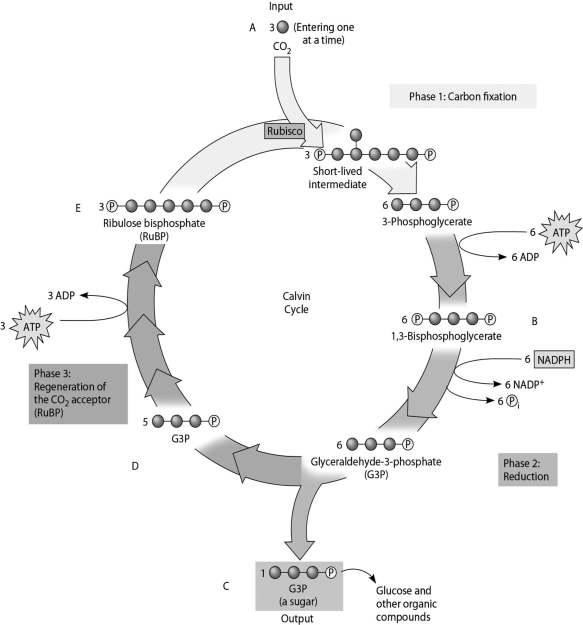 Figure 8.2
-Use Figure 8.2 and the compounds labeled A, B, C, D, and E to answer the following question. If the carbon atom of each of the incoming CO₂ molecules is labeled with a radioactive isotope of carbon, which organic molecules of the Calvin cycle will be radioactively labeled after one cycle?
Figure 8.2
-Use Figure 8.2 and the compounds labeled A, B, C, D, and E to answer the following question. If the carbon atom of each of the incoming CO₂ molecules is labeled with a radioactive isotope of carbon, which organic molecules of the Calvin cycle will be radioactively labeled after one cycle? (Multiple Choice)
4.9/5 (76)
(76) What does the chemiosmotic process in chloroplasts involve?
(Multiple Choice)
4.8/5 (89)
(89) Carotenoids are often found in foods that are considered to have antioxidant properties in human nutrition. What related function do they have in plants?
(Multiple Choice)
4.9/5 (82)
(82) In mitochondria, the electron transport chain pumps protons from the matrix into the intermembrane space, whereas in chloroplasts, the electron transport chain pumps protons from
(Multiple Choice)
4.9/5 (85)
(85) A reduction in the amount of NADP+ available in plant cells in the light will ultimately result in
(Multiple Choice)
4.8/5 (71)
(71) Which of the following does not occur during the Calvin cycle?
(Multiple Choice)
4.9/5 (73)
(73) What is the relationship between wavelength of light and the quantity of energy per photon?
(Multiple Choice)
4.9/5 (80)
(80) Which of the following is directly associated with photosystem I?
(Multiple Choice)
4.8/5 (64)
(64) Photorespiration lowers the efficiency of photosynthesis by
(Multiple Choice)
4.9/5 (85)
(85) 
Filters
- Essay(0)
- Multiple Choice(0)
- Short Answer(0)
- True False(0)
- Matching(0)