



 Chat with AI
Exam 17: Factors Influencing the Structure of Communities

Exam 1: The Nature of Ecology57 Questions
Exam 2: Climate72 Questions
Exam 3: The Aquatic Environment71 Questions
Exam 4: The Terrestrial Environment93 Questions
Exam 5: Adaptation and Natural Selection76 Questions
Exam 6: Plant Adaptations to the Environment90 Questions
Exam 7: Animal Adaptations to the Environment80 Questions
Exam 8: Properties of Populations64 Questions
Exam 9: Population Growth63 Questions
Exam 10: Life History66 Questions
Exam 11: Intraspecific Population Regulation70 Questions
Exam 12: Species Interactions, population Dynamics, and Natural Selection55 Questions
Exam 13: Interspecific Competition65 Questions
Exam 14: Predation81 Questions
Exam 15: Parasitism and Mutualism81 Questions
Exam 16: Community Structure70 Questions
Exam 17: Factors Influencing the Structure of Communities62 Questions
Exam 18: Community Dynamics64 Questions
Exam 19: Landscape Dynamics62 Questions
Exam 20: Ecosystem Energetics67 Questions
Exam 21: Decomposition and Nutrient Cycling64 Questions
Exam 22: Biogeochemical Cycles81 Questions
Exam 23: Terrestrial Ecosystems68 Questions
Exam 24: Aquatic Ecosystems78 Questions
Exam 25: Coastal and Wetland Ecosystems66 Questions
Exam 26: Large-Scale Patterns of Biological Diversity59 Questions
Exam 27: The Ecology of Climate Change55 Questions
Select questions type


When top-down control occurs within an intertidal zone along the rocky coastline of the Pacific Ocean,which of the following species controls the abundance of other species?

Free
(Multiple Choice)
4.8/5  (72)
(72) Correct Answer: Verified
D
As the fertility of soil on the forest floor increases,the
Free
(Multiple Choice)
4.9/5 (85)
(85) Correct Answer:Verified
VerifiedA
Patterns of temperature and ________ resulting from regional variations in climate are the major determinant of regional and global patterns of vegetation distribution.
Free
(Short Answer)
4.9/5 (74)
(74) Correct Answer:Verified
Verifiedmoisture
The populations of keystone predators are controlled by the populations of their prey species.
(True/False)
4.9/5 (66)
(66) The "world is green" hypothesis suggests that herbivore populations limit the number of predators,allowing plant biomass to accumulate.
(True/False)
4.8/5 (81)
(81) The control of an herbivore population by a parasitoid is an example of top-down control.
(True/False)
4.8/5 (72)
(72) Which of the following organisms have benefited from wolf reintroduction?
(Multiple Choice)
4.7/5 (99)
(99) 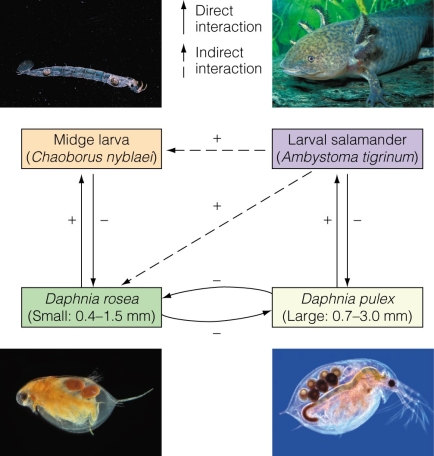 What is the term when one species benefits from an indirect interaction and the other has a neutral effect?
 (Multiple Choice)
4.8/5 (82)
(82) Why might increased nutrient availability result in increased species diversity in aquatic systems while it results in decreases in terrestrial systems?
(Multiple Choice)
4.8/5 (78)
(78) The diversity of an animal community is unrelated to the physical structure of a plant community.
(True/False)
4.8/5 (84)
(84) Why might biologists assemble species into functional groups when examining community structure?
(Multiple Choice)
4.9/5 (61)
(61) 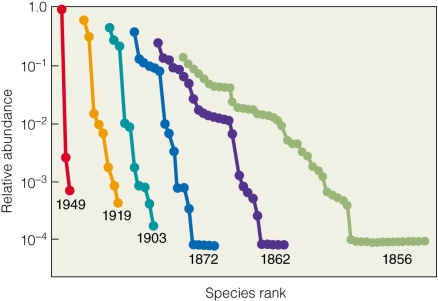 This figure suggests that adding more and more nutrients over time will result in
 (Multiple Choice)
4.9/5 (79)
(79) Variation in environmental conditions within a community is referred to as environmental ________.
(Short Answer)
4.9/5 (69)
(69) Which of the following is an example of a fundamental niche?
(Multiple Choice)
4.8/5 (85)
(85) Spartina alterniflora allocates more ________ to outcompete Juncus gerardi.
(Multiple Choice)
4.9/5 (90)
(90) The removal of a single species from a community can have unpredictable consequences.
(True/False)
4.9/5 (86)
(86) Diffuse interactions often occur among competing species but never among predator-prey species.
(True/False)
5.0/5 (69)
(69) Plant community structure along an environmental gradient can often be explained by
(Multiple Choice)
4.9/5 (69)
(69) When interspecific interactions involve more than just two species,they are said to be ________.
(Short Answer)
4.9/5 (72)
(72) 
Filters
- Essay(0)
- Multiple Choice(0)
- Short Answer(0)
- True False(0)
- Matching(0)