



 Chat with AI
Exam 26: Large-Scale Patterns of Biological Diversity

Exam 1: The Nature of Ecology57 Questions
Exam 2: Climate72 Questions
Exam 3: The Aquatic Environment71 Questions
Exam 4: The Terrestrial Environment93 Questions
Exam 5: Adaptation and Natural Selection76 Questions
Exam 6: Plant Adaptations to the Environment90 Questions
Exam 7: Animal Adaptations to the Environment80 Questions
Exam 8: Properties of Populations64 Questions
Exam 9: Population Growth63 Questions
Exam 10: Life History66 Questions
Exam 11: Intraspecific Population Regulation70 Questions
Exam 12: Species Interactions, population Dynamics, and Natural Selection55 Questions
Exam 13: Interspecific Competition65 Questions
Exam 14: Predation81 Questions
Exam 15: Parasitism and Mutualism81 Questions
Exam 16: Community Structure70 Questions
Exam 17: Factors Influencing the Structure of Communities62 Questions
Exam 18: Community Dynamics64 Questions
Exam 19: Landscape Dynamics62 Questions
Exam 20: Ecosystem Energetics67 Questions
Exam 21: Decomposition and Nutrient Cycling64 Questions
Exam 22: Biogeochemical Cycles81 Questions
Exam 23: Terrestrial Ecosystems68 Questions
Exam 24: Aquatic Ecosystems78 Questions
Exam 25: Coastal and Wetland Ecosystems66 Questions
Exam 26: Large-Scale Patterns of Biological Diversity59 Questions
Exam 27: The Ecology of Climate Change55 Questions
Select questions type


All living species of organisms have now been described by scientists.

Free
(True/False)
4.8/5  (83)
(83) Correct Answer: Verified
False
Patterns of species diversity for pelagic and benthic organisms appear to be influenced by the ________ of primary production rather than by the total productivity.
Free
(Short Answer)
4.8/5 (80)
(80) Correct Answer:Verified
Verifiedseasonality
As latitude increases,the number of marine species ________.
Free
(Short Answer)
4.9/5 (74)
(74) Correct Answer:Verified
Verifieddecreases
Total species diversity,or species richness,of individual communities is referred to as ________ diversity.
(Short Answer)
4.7/5 (76)
(76) 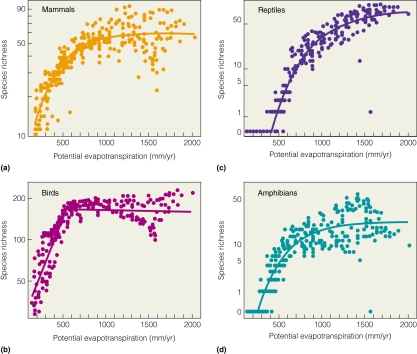 Which of the following taxa have greater richness at lower PET?
 (Multiple Choice)
4.8/5 (88)
(88) As structural diversity within plant communities increases,the number of animal species ________.
(Short Answer)
4.9/5 (87)
(87) Which of the following shows the correct chronological order (geologically oldest to most recent)of near or total extinctions for the organisms listed?
(Multiple Choice)
4.9/5 (78)
(78) 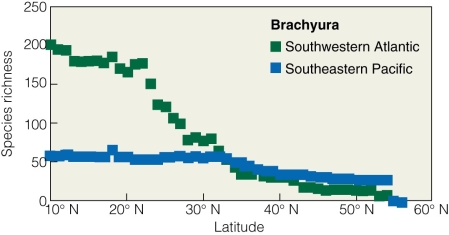 Which of the following is true for Brachyura marine crabs?
The diverse topography of mountainous regions generally supports more species of plants and animals than the consistent terrain of flatlands.
(True/False)
4.8/5 (62)
(62) Which of the following was seen as a significant predictor of diversity in the oceans?
(Multiple Choice)
4.8/5 (84)
(84) Variation in species richness of terrestrial species in North America correlates most strongly with estimates of
(Multiple Choice)
4.9/5 (83)
(83) Species richness in both terrestrial and marine environments generally declines with latitude.
(True/False)
4.8/5 (86)
(86) Which of the following is increased amphibian diversity correlated with?
(Multiple Choice)
4.9/5 (70)
(70) The number of species of living organisms on the planet is probably closest to
(Multiple Choice)
4.8/5 (78)
(78) In relation to the stability hypothesis of diversity,which area provides the best evidence that glaciation reduced temperate tree diversity?
(Multiple Choice)
4.8/5 (88)
(88) Over the past 100 million years,species richness has declined for gymnosperms and has increased for angiosperms.
(True/False)
4.7/5 (70)
(70) 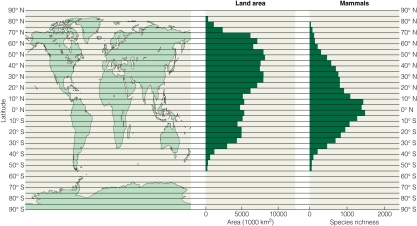 What does this figure suggest?
On a geological timescale,changes in climate do not influence overall regional patterns of species diversity.
(True/False)
4.9/5 (78)
(78) Which of the following is strongly associated with net primary productivity?
(Multiple Choice)
5.0/5 (72)
(72) Species richness of terrestrial plants and animals increases with
(Multiple Choice)
4.8/5 (89)
(89) 
Filters
- Essay(0)
- Multiple Choice(0)
- Short Answer(0)
- True False(0)
- Matching(0)