



 Chat with AI
Exam 26: Large-Scale Patterns of Biological Diversity

Exam 1: The Nature of Ecology57 Questions
Exam 2: Climate72 Questions
Exam 3: The Aquatic Environment71 Questions
Exam 4: The Terrestrial Environment93 Questions
Exam 5: Adaptation and Natural Selection76 Questions
Exam 6: Plant Adaptations to the Environment90 Questions
Exam 7: Animal Adaptations to the Environment80 Questions
Exam 8: Properties of Populations64 Questions
Exam 9: Population Growth63 Questions
Exam 10: Life History66 Questions
Exam 11: Intraspecific Population Regulation70 Questions
Exam 12: Species Interactions, population Dynamics, and Natural Selection55 Questions
Exam 13: Interspecific Competition65 Questions
Exam 14: Predation81 Questions
Exam 15: Parasitism and Mutualism81 Questions
Exam 16: Community Structure70 Questions
Exam 17: Factors Influencing the Structure of Communities62 Questions
Exam 18: Community Dynamics64 Questions
Exam 19: Landscape Dynamics62 Questions
Exam 20: Ecosystem Energetics67 Questions
Exam 21: Decomposition and Nutrient Cycling64 Questions
Exam 22: Biogeochemical Cycles81 Questions
Exam 23: Terrestrial Ecosystems68 Questions
Exam 24: Aquatic Ecosystems78 Questions
Exam 25: Coastal and Wetland Ecosystems66 Questions
Exam 26: Large-Scale Patterns of Biological Diversity59 Questions
Exam 27: The Ecology of Climate Change55 Questions
Select questions type


Hotspot regions make up only 2 percent of the total land mass but contain what percentage of the world's endemic plant species?
(Multiple Choice)
4.8/5  (94)
(94) Primary productivity in the oceans is lower in tropical latitudes than in temperate latitudes,primarily due to a permanent thermocline in tropical latitudes.
(True/False)
4.8/5 (87)
(87) 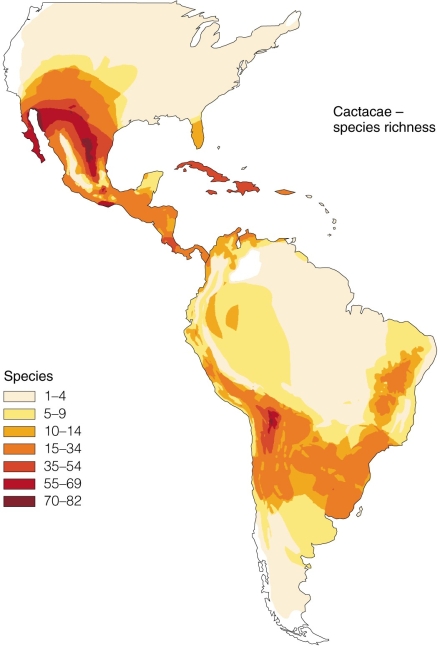 What does the figure suggest about patterns of biodiversity for particular groups of organisms?
 (Multiple Choice)
4.9/5 (83)
(83) In terrestrial habitats,species richness is negatively correlated with primary productivity.
(True/False)
4.8/5 (92)
(92) Compare two environments at 45° N latitude: environment A's altitude is 50 meters and environment B's altitude is 3000 meters.Which environment will support the greater level of species richness for mammals and birds?
(Multiple Choice)
4.8/5 (90)
(90) During what period did one of the greatest extinctions of mammals occur?
(Multiple Choice)
4.9/5 (89)
(89) The 1.4 million species identified are equally distributed across the Earth's surface.
(True/False)
4.9/5 (77)
(77) Patterns of species migrations,such as birds that nest in North America during the spring and in South America during the winter,do not alter seasonal patterns of regional diversity for a wide range of taxonomic groups.
(True/False)
4.9/5 (71)
(71) Over the past 600 million years,the overall trend in the number of species has been ________.
(Short Answer)
4.8/5 (76)
(76) Which of the following is seen as a significant predictor of increased diversity in trees?
(Multiple Choice)
4.9/5 (76)
(76) Which state is most likely to be a hotspot for biodiversity?
(Multiple Choice)
4.9/5 (83)
(83) A mass extinction of large mammals occurred during the ________ epoch.
(Short Answer)
4.7/5 (72)
(72) As the structural diversity of plant communities increases,the species richness of animals also increases.
(True/False)
4.9/5 (81)
(81) The end of the Permian period was characterized by a mass extinction of
(Multiple Choice)
4.8/5 (77)
(77) As latitude increases,the number of terrestrial species ________.
(Short Answer)
4.8/5 (75)
(75) 
Filters
- Essay(0)
- Multiple Choice(0)
- Short Answer(0)
- True False(0)
- Matching(0)