



 Chat with AI
Exam 22: Biogeochemical Cycles

Exam 1: The Nature of Ecology57 Questions
Exam 2: Climate72 Questions
Exam 3: The Aquatic Environment71 Questions
Exam 4: The Terrestrial Environment93 Questions
Exam 5: Adaptation and Natural Selection76 Questions
Exam 6: Plant Adaptations to the Environment90 Questions
Exam 7: Animal Adaptations to the Environment80 Questions
Exam 8: Properties of Populations64 Questions
Exam 9: Population Growth63 Questions
Exam 10: Life History66 Questions
Exam 11: Intraspecific Population Regulation70 Questions
Exam 12: Species Interactions, population Dynamics, and Natural Selection55 Questions
Exam 13: Interspecific Competition65 Questions
Exam 14: Predation81 Questions
Exam 15: Parasitism and Mutualism81 Questions
Exam 16: Community Structure70 Questions
Exam 17: Factors Influencing the Structure of Communities62 Questions
Exam 18: Community Dynamics64 Questions
Exam 19: Landscape Dynamics62 Questions
Exam 20: Ecosystem Energetics67 Questions
Exam 21: Decomposition and Nutrient Cycling64 Questions
Exam 22: Biogeochemical Cycles81 Questions
Exam 23: Terrestrial Ecosystems68 Questions
Exam 24: Aquatic Ecosystems78 Questions
Exam 25: Coastal and Wetland Ecosystems66 Questions
Exam 26: Large-Scale Patterns of Biological Diversity59 Questions
Exam 27: The Ecology of Climate Change55 Questions
Select questions type


Nearly all of the phosphorus in terrestrial ecosystems comes from the ________ of calcium phosphate minerals.

Free
(Short Answer)
5.0/5  (88)
(88) Correct Answer: Verified
weathering
Which of the following nutrients is most closely linked to the energy cycle in ecosystems?
Free
(Multiple Choice)
4.9/5 (94)
(94) Correct Answer:Verified
VerifiedA
Biological nitrogen fixation is accomplished by symbiotic ________ living in mutualistic association with plants.
Free
(Short Answer)
5.0/5 (96)
(96) Correct Answer:Verified
Verifiedbacteria
Carbon cycles more quickly through cold and dry ecosystems than it does through warm and wet ecosystems.
(True/False)
4.8/5 (85)
(85) The sulfur biogeochemical cycle is a sedimentary cycle with essentially no gaseous cycle.
(True/False)
4.8/5 (76)
(76) Most aerobic autotrophs produce and consume oxygen in order to live.
(True/False)
4.8/5 (82)
(82) Which of the following represents a loss of nutrients from an aquatic ecosystem?
(Multiple Choice)
4.8/5 (70)
(70) Large quantities of nutrients are bound tightly in ________ structure; they are not readily available until released by the activities of decomposers.
(Short Answer)
4.9/5 (75)
(75) Atmospheric sulfur dioxide returns to Earth in rain as weak sulfuric acid.
(True/False)
4.9/5 (65)
(65) One way that sulfur enters the atmosphere is through volcanic activity.
(True/False)
4.9/5 (69)
(69) 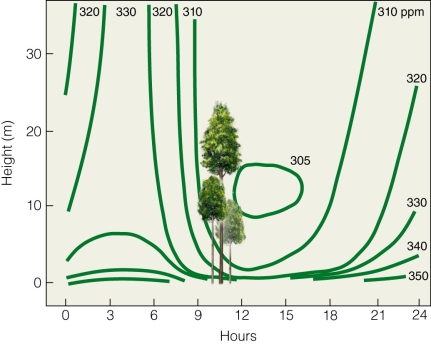 According to the figure,when is atmospheric CO₂ the highest?
 (Multiple Choice)
4.8/5 (85)
(85) Nutrients deposited on leaves as dust and materials leached from leaves through insect action are most often transported to the forest floor by
(Multiple Choice)
4.8/5 (80)
(80) Flowing-water aquatic systems (streams and rivers)contain high levels of organic matter so are rarely dependent on inputs from terrestrial systems.
(True/False)
4.9/5 (72)
(72) The process of nitrification produces a form of nitrogen that is easily lost from soil through leaching.
(True/False)
4.9/5 (78)
(78) Which region contains the largest amount of the global carbon pool?
(Multiple Choice)
4.8/5 (65)
(65) Lightning converts N₂ to a nitrogen form that enters soil and can be readily assimilated by plants.
(True/False)
4.8/5 (68)
(68) Which region contains the largest amount of the global nitrogen pool?
(Multiple Choice)
4.9/5 (73)
(73) 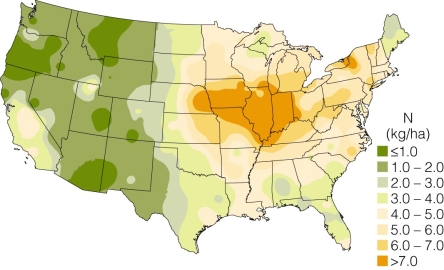 Which area has the highest nitrogen deposition?

Filters
- Essay(0)
- Multiple Choice(0)
- Short Answer(0)
- True False(0)
- Matching(0)