



 Chat with AI
Exam 14: Aromatic Compounds

Exam 1: The Basics158 Questions
Exam 2: Families of Carbon151 Questions
Exam 3: Acids and Bases149 Questions
Exam 4: Nomenclature and Conformations of Alkanes and Cycloalkanes163 Questions
Exam 5: Stereochemistry179 Questions
Exam 6: Nucleophilic Reactions91 Questions
Exam 7: Alkenes and Alkynes I220 Questions
Exam 8: Alkenes and Alkynes II163 Questions
Exam 9: Nuclear Magnetic Resonance and Mass Spectrometry158 Questions
Exam 10: Radical Reactions148 Questions
Exam 11: Alcohols and Ethers256 Questions
Exam 12: Alcohols From Carbonyl Compounds210 Questions
Exam 13: Conjugated Unsaturated Systems201 Questions
Exam 14: Aromatic Compounds186 Questions
Exam 15: Reactions of Aromatic Compounds207 Questions
Exam 16: Aldehydes and Ketones189 Questions
Exam 17: Carboxylic Acids and Their Derivatives213 Questions
Exam 18: Reactions at the Α Carbon of Carbonyl Compounds190 Questions
Exam 19: Condensation and Conjugate Addition Reactions of Carbonyl Compounds182 Questions
Exam 20: Amines207 Questions
Exam 21: Transition Metal Complexes86 Questions
Exam 22: Carbohydrates124 Questions
Exam 23: Lipids127 Questions
Exam 24: Amino Acids and Proteins135 Questions
Exam 25: Nucleic Acids and Protein Synthesis126 Questions
Select questions type


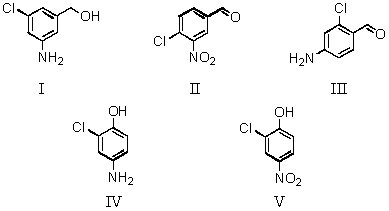
The Lewis structures of both pyridine and pyrrole have an electron pair on the nitrogen atom,suggesting that both substances might possess basic properties.However,only pyridine reacts readily with HCl to form pyridinium chloride,while pyrrole is rather unreactive.Explain clearly,using relevant diagrams to illustrate/clarify your answer.
(Essay)
4.8/5  (92)
(92) 
Briefly explain why the aromatic hydrocarbon shown possesses a significant dipole moment.Use diagrams as needed to illustrate/clarify your answer. 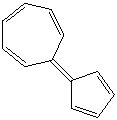
(Essay)
4.9/5 (63)
(63) Consider the molecular orbital model of cyclopentadienyl anion.In the ground state how many molecular orbitals are filled with electrons?
(Multiple Choice)
4.8/5 (70)
(70) 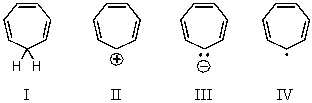
Which of the following statements regarding the cyclopentadienyl radical is correct?
(Multiple Choice)
4.8/5 (59)
(59) How many resonances would be expected in the broadband proton-decoupled 13C spectrum of: 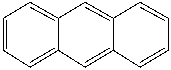
(Multiple Choice)
4.9/5 (72)
(72) In which of the following compounds would the shortest carbon-carbon bond(s)be found?
(Multiple Choice)
4.9/5 (82)
(82) Which of the following statements about cyclooctatetraene is NOT true?
(Multiple Choice)
4.8/5 (80)
(80) In the molecular orbital model of cycloheptadienyl cation,how many pi electrons are delocalized about the ring?
(Multiple Choice)
4.8/5 (84)
(84) How many resonances would be expected in the broadband proton-decoupled 13C spectrum of: 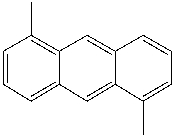
(Multiple Choice)
4.8/5 (78)
(78) Which of the following would you expect to be antiaromatic? 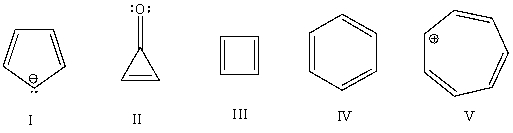
(Multiple Choice)
4.9/5 (76)
(76) Which isomer of C7H7Cl exhibits strong IR absorbances at 690 and 750 cm-1? 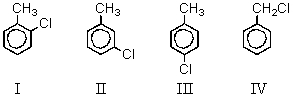
(Multiple Choice)
4.9/5 (85)
(85) Cycloheptatriene is found to readily undergo a hydride transfer with triphenylmethyl arbocation to generate the cycloheptatrienyl cation and triphenylmethane.Explain why this transformation is facile. 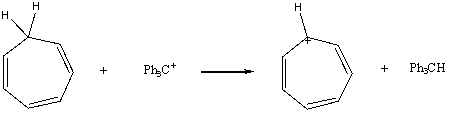
(Essay)
4.9/5 (70)
(70) Which of these would you expect to have significant resonance stabilization energy? 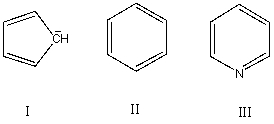
(Multiple Choice)
4.8/5 (81)
(81) Recalling that benzene has a resonance energy of 152 kJ mol-1 and naphthalene has a resonance energy of 255 kJ mol-1,predict the positions which would be occupied by bromine when phenanthrene (below)undergoes addition of Br2. 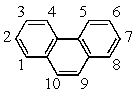
(Multiple Choice)
4.7/5 (78)
(78) If thiophene is an aromatic molecule and reacts similarly to benzene,how many (neutral)monobromothiophenes could be obtained in the following reaction? 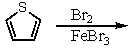
(Multiple Choice)
4.9/5 (79)
(79) On the basis of molecular orbital theory and Hückel's rule,which molecules and/or ions should be aromatic? 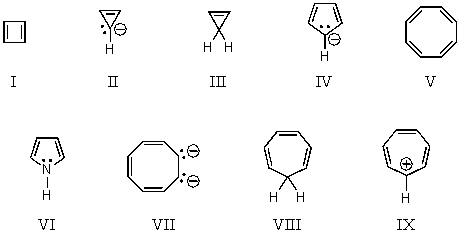
(Multiple Choice)
4.9/5 (82)
(82) 
Filters
- Essay(0)
- Multiple Choice(0)
- Short Answer(0)
- True False(0)
- Matching(0)