



 Chat with AI
Exam 14: Aromatic Compounds

Exam 1: The Basics158 Questions
Exam 2: Families of Carbon151 Questions
Exam 3: Acids and Bases149 Questions
Exam 4: Nomenclature and Conformations of Alkanes and Cycloalkanes163 Questions
Exam 5: Stereochemistry179 Questions
Exam 6: Nucleophilic Reactions91 Questions
Exam 7: Alkenes and Alkynes I220 Questions
Exam 8: Alkenes and Alkynes II163 Questions
Exam 9: Nuclear Magnetic Resonance and Mass Spectrometry158 Questions
Exam 10: Radical Reactions148 Questions
Exam 11: Alcohols and Ethers256 Questions
Exam 12: Alcohols From Carbonyl Compounds210 Questions
Exam 13: Conjugated Unsaturated Systems201 Questions
Exam 14: Aromatic Compounds186 Questions
Exam 15: Reactions of Aromatic Compounds207 Questions
Exam 16: Aldehydes and Ketones189 Questions
Exam 17: Carboxylic Acids and Their Derivatives213 Questions
Exam 18: Reactions at the Α Carbon of Carbonyl Compounds190 Questions
Exam 19: Condensation and Conjugate Addition Reactions of Carbonyl Compounds182 Questions
Exam 20: Amines207 Questions
Exam 21: Transition Metal Complexes86 Questions
Exam 22: Carbohydrates124 Questions
Exam 23: Lipids127 Questions
Exam 24: Amino Acids and Proteins135 Questions
Exam 25: Nucleic Acids and Protein Synthesis126 Questions
Select questions type


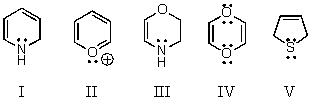

We now know that the two Kekulé structures for benzene are related in the following way:
(Multiple Choice)
4.9/5  (74)
(74) Draw the structure corresponding to the following name:
3-bromo-5-phenylaniline
(Essay)
4.7/5 (80)
(80) In the molecular orbital model of the cyclopentadienyl cation,how many non-bonding molecular orbitals are there?
(Multiple Choice)
4.9/5 (98)
(98) The compound illustrated below is found to have the following signals in its broadband decoupled 13C spectrum:
190.77,140.91,134.82,130.89 and 129.45
Using resonance theory,assign the C-13 peaks to the appropriate carbons. 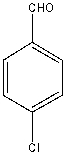
(Essay)
4.8/5 (75)
(75) Which dichlorobenzene might theoretically yield three mononitro products?
(Multiple Choice)
4.8/5 (83)
(83) Which dihydroxybenzene can yield only one mononitro derivative?
(Multiple Choice)
4.8/5 (78)
(78) In the molecular orbital model of cyclobutadiene,how many pairs of degenerate -antibonding molecular orbitals are there?
(Multiple Choice)
4.8/5 (73)
(73) Benzene,while unusually unreactive with electrophiles,will react under certain conditions.However,when it does react,it does so by ___ rather than by addition.
(Short Answer)
4.7/5 (89)
(89) Which of the following would you expect to be antiaromatic? 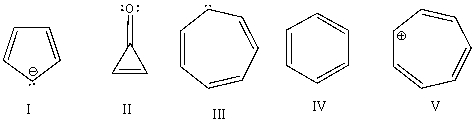
(Multiple Choice)
4.7/5 (88)
(88) Explain briefly why cyclopentadiene readily reacts with strong bases.
(Essay)
4.8/5 (76)
(76) The heats of hydrogenation for cyclohexene and benzene are given below.Calculate the resonance stabilization energy of benzene.
C6H10 + H2 C6H12 Ho = -120 kJ/mol
C6H6 + 3H2 C6H12 Ho = -208 kJ/mol
(Essay)
4.8/5 (75)
(75) Which of these would you expect to have significant resonance stabilization energy? 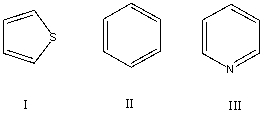
(Multiple Choice)
4.9/5 (61)
(61) In the molecular orbital model of cyclobutadiene,how many non-bonding molecular orbitals are there?
(Multiple Choice)
4.9/5 (80)
(80) How many resonances would be expected in the broadband proton-decoupled 13C spectrum of: 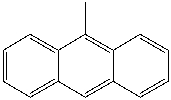
(Multiple Choice)
4.9/5 (89)
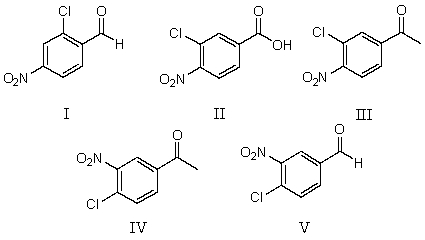
(89) 

Filters
- Essay(0)
- Multiple Choice(0)
- Short Answer(0)
- True False(0)
- Matching(0)