



 Chat with AI
Exam 6: Nucleophilic Reactions

Exam 1: The Basics158 Questions
Exam 2: Families of Carbon151 Questions
Exam 3: Acids and Bases149 Questions
Exam 4: Nomenclature and Conformations of Alkanes and Cycloalkanes163 Questions
Exam 5: Stereochemistry179 Questions
Exam 6: Nucleophilic Reactions91 Questions
Exam 7: Alkenes and Alkynes I220 Questions
Exam 8: Alkenes and Alkynes II163 Questions
Exam 9: Nuclear Magnetic Resonance and Mass Spectrometry158 Questions
Exam 10: Radical Reactions148 Questions
Exam 11: Alcohols and Ethers256 Questions
Exam 12: Alcohols From Carbonyl Compounds210 Questions
Exam 13: Conjugated Unsaturated Systems201 Questions
Exam 14: Aromatic Compounds186 Questions
Exam 15: Reactions of Aromatic Compounds207 Questions
Exam 16: Aldehydes and Ketones189 Questions
Exam 17: Carboxylic Acids and Their Derivatives213 Questions
Exam 18: Reactions at the Α Carbon of Carbonyl Compounds190 Questions
Exam 19: Condensation and Conjugate Addition Reactions of Carbonyl Compounds182 Questions
Exam 20: Amines207 Questions
Exam 21: Transition Metal Complexes86 Questions
Exam 22: Carbohydrates124 Questions
Exam 23: Lipids127 Questions
Exam 24: Amino Acids and Proteins135 Questions
Exam 25: Nucleic Acids and Protein Synthesis126 Questions
Select questions type


Increasing the temperature of a chemical reaction usually increases greatly the rate of the reaction.The most important reason for this is that increasing the temperature
(Multiple Choice)
5.0/5  (82)
(82) Which of the following alkyl bromide isomers would most readily undergo an SN2 reaction?
(Multiple Choice)
5.0/5 (97)
(97) Increasing the temperature of a reaction will speed up the overall rate as this will increase the energy of activation for reaction.
(True/False)
4.8/5 (82)
(82) The difference in the bond energies of reactants and the transition state of a reaction is designated by the notation:
(Multiple Choice)
4.9/5 (88)
(88) Select the potential energy diagram that represents a two-step endothermic (endergonic)reaction. 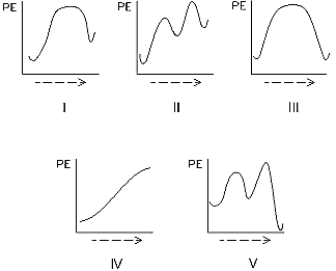
(Multiple Choice)
4.8/5 (79)
(79) An increase in the kinetic energy of reacting molecules results in
(Multiple Choice)
4.8/5 (74)
(74) Which is the weakest nucleophile in polar aprotic solvents?
(Multiple Choice)
4.7/5 (89)
(89) In a highly exergonic SN2 reaction we can assume the transition state is similar to the products formed in the reaction.
(True/False)
4.8/5 (74)
(74) Which of the following is not true concerning the strength of a nucleophile?
(Multiple Choice)
4.9/5 (86)
(86) A true statement about the transition state(s)of an SN2 reaction is:
(Multiple Choice)
4.9/5 (85)
(85) The reaction,  has the following thermodynamic values at 27.0 ºC: H = -75.3 kJ mol-1; S = 54.4 J K-1 mol-1.What is the value of G for this reaction?
 (Multiple Choice)
4.7/5 (80)
(80) 
Filters
- Essay(0)
- Multiple Choice(0)
- Short Answer(0)
- True False(0)
- Matching(0)