



 Chat with AI
Exam 6: Nucleophilic Reactions

Exam 1: The Basics158 Questions
Exam 2: Families of Carbon151 Questions
Exam 3: Acids and Bases149 Questions
Exam 4: Nomenclature and Conformations of Alkanes and Cycloalkanes163 Questions
Exam 5: Stereochemistry179 Questions
Exam 6: Nucleophilic Reactions91 Questions
Exam 7: Alkenes and Alkynes I220 Questions
Exam 8: Alkenes and Alkynes II163 Questions
Exam 9: Nuclear Magnetic Resonance and Mass Spectrometry158 Questions
Exam 10: Radical Reactions148 Questions
Exam 11: Alcohols and Ethers256 Questions
Exam 12: Alcohols From Carbonyl Compounds210 Questions
Exam 13: Conjugated Unsaturated Systems201 Questions
Exam 14: Aromatic Compounds186 Questions
Exam 15: Reactions of Aromatic Compounds207 Questions
Exam 16: Aldehydes and Ketones189 Questions
Exam 17: Carboxylic Acids and Their Derivatives213 Questions
Exam 18: Reactions at the Α Carbon of Carbonyl Compounds190 Questions
Exam 19: Condensation and Conjugate Addition Reactions of Carbonyl Compounds182 Questions
Exam 20: Amines207 Questions
Exam 21: Transition Metal Complexes86 Questions
Exam 22: Carbohydrates124 Questions
Exam 23: Lipids127 Questions
Exam 24: Amino Acids and Proteins135 Questions
Exam 25: Nucleic Acids and Protein Synthesis126 Questions
Select questions type


Which will be true for any actual or potential nucleophilic substitution reaction?
(Multiple Choice)
5.0/5  (81)
(81) Which nucleophilic substitution reaction is not likely to occur?
(Multiple Choice)
4.8/5 (77)
(77) A student has isolated a chiral alkyl halide (shown below)with a specific rotation of [ ] = +22.1o.The student decided to store the compound in the solvent MeOH overnight.However,reanalysis of the alkyl halide showed a new chemical formula of C11H16O with a specific rotation of [ ] = 0o.Suggest a mechanism to justify these results. 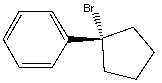
(Essay)
4.9/5 (82)
(82) The substitution mechanism whose rate depends primarily on the degree of steric hindrance around the leaving group is the ___.
(Short Answer)
4.9/5 (81)
(81) The p orbital of the charged carbon in the isopropyl cation,(CH3)2CH+,contains how many electrons?
(Multiple Choice)
4.8/5 (77)
(77) Which of the following statements is (are)true of SN1 reactions of alkyl halides in general?
(Multiple Choice)
4.8/5 (78)
(78) Consider the SN2 reaction of butyl bromide with OH- ion. CH3CH2CH2CH2Br + OH- CH3CH2CH2CH2OH + Br-
Assuming no other changes,what effect on the rate would result from simultaneously doubling the concentrations of both butyl bromide and OH- ion?
(Multiple Choice)
4.9/5 (74)
(74) 
Which is the most reactive nucleophile in DMF (structure shown below)? 
(Multiple Choice)
4.8/5 (71)
(71) Which alkyl halide would you expect to undergo an SN2 reaction most slowly?
(Multiple Choice)
4.7/5 (84)
(84) An increase in the temperature at which a reaction is carried out increases
(Multiple Choice)
4.9/5 (81)
(81) Consider the SN2 reaction of 1-chloro-5-methylhexane with CN- ion.  Assuming no other changes,what effect on the rate would result from simultaneously doubling the concentrations of both 1-chloro-5-methylhexane and NaCN?
 (Multiple Choice)
4.8/5 (81)
(81) Select the potential energy diagram that represents an exothermic (exergonic)reaction. 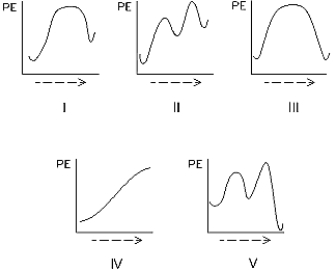
(Multiple Choice)
4.7/5 (81)
(81) Which of the following nucleophiles will react the fastest with 1-bromoptopane in ethanol?
(Multiple Choice)
4.7/5 (75)
(75) Which alkyl halide would be most reactive in an SN1 reaction? 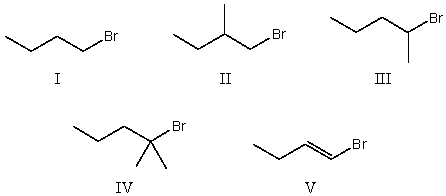
(Multiple Choice)
4.8/5 (76)
(76) Ambident nucleophiles are ones which can react with a substrate at either of two nucleophilic sites.Which of the following is not an ambident nucleophile? 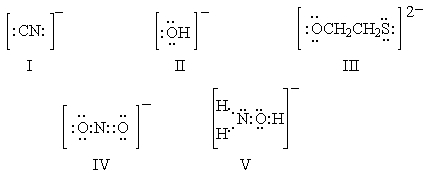
(Multiple Choice)
4.8/5 (94)
(94) The substitution mechanism whose rate depends primarily on the relative stability of the intermediate carbocation is the ___.
(Short Answer)
4.9/5 (91)
(91) Identify the nucleophile in the following reaction: 2 H2O + RX ROH + H3O+ + X-
(Multiple Choice)
4.9/5 (81)
(81) 
Filters
- Essay(0)
- Multiple Choice(0)
- Short Answer(0)
- True False(0)
- Matching(0)