



 Chat with AI
Exam 8: Alkenes and Alkynes II

Exam 1: The Basics158 Questions
Exam 2: Families of Carbon151 Questions
Exam 3: Acids and Bases149 Questions
Exam 4: Nomenclature and Conformations of Alkanes and Cycloalkanes163 Questions
Exam 5: Stereochemistry179 Questions
Exam 6: Nucleophilic Reactions91 Questions
Exam 7: Alkenes and Alkynes I220 Questions
Exam 8: Alkenes and Alkynes II163 Questions
Exam 9: Nuclear Magnetic Resonance and Mass Spectrometry158 Questions
Exam 10: Radical Reactions148 Questions
Exam 11: Alcohols and Ethers256 Questions
Exam 12: Alcohols From Carbonyl Compounds210 Questions
Exam 13: Conjugated Unsaturated Systems201 Questions
Exam 14: Aromatic Compounds186 Questions
Exam 15: Reactions of Aromatic Compounds207 Questions
Exam 16: Aldehydes and Ketones189 Questions
Exam 17: Carboxylic Acids and Their Derivatives213 Questions
Exam 18: Reactions at the Α Carbon of Carbonyl Compounds190 Questions
Exam 19: Condensation and Conjugate Addition Reactions of Carbonyl Compounds182 Questions
Exam 20: Amines207 Questions
Exam 21: Transition Metal Complexes86 Questions
Exam 22: Carbohydrates124 Questions
Exam 23: Lipids127 Questions
Exam 24: Amino Acids and Proteins135 Questions
Exam 25: Nucleic Acids and Protein Synthesis126 Questions
Select questions type


Provide a mechanistic explanation for the following observation: The same major product is obtained when 2-ethyl-1-hexene and 3-methyl-2-heptene are allowed to react with HCl.
(Essay)
4.9/5  (91)
(91) The interaction of the bond of an alkene with an electrophile can initially result in the formation of a species termed a complex.Which of these cannot combine with an alkene to form a complex?
(Multiple Choice)
4.7/5 (86)
(86) What is the major product of the following reaction sequence? 
(Multiple Choice)
4.9/5 (66)
(66) An alkene adds hydrogen in the presence of a catalyst to give 3,4-dimethylhexane.Ozonolysis of the alkene followed by treatment with zinc and acetic acid gives a single organic product.The structure of the alkene is:
(Multiple Choice)
5.0/5 (76)
(76) What is the major product of the following reaction sequence? 
(Multiple Choice)
4.9/5 (74)
(74) A pair of enantiomers results from which of these reactions?
(Multiple Choice)
4.9/5 (79)
(79) Cyclohexene is treated with cold dilute alkaline KMnO4.Assuming syn addition,the spatial arrangement of the two hydroxyl groups in the product would be:
(Multiple Choice)
4.8/5 (96)
(96) Draw Fischer projection formulas of the major product of the reaction between E-2-methyl-3-hexene and aqueous Br2.
(Essay)
4.8/5 (74)
(74) 

Addition of excess HCl to 2-methyl-3-heptyne would produce: 2-methyl-3,3-dichloroheptane 2-methyl-2,3-dichloroheptane
I II
2-methyl-4,4-dichloroheptane 2-methyl-3,4-dichloroheptane
III IV
2-methyl-3-chloroheptene
V
(Multiple Choice)
4.8/5 (61)
(61) 
The reaction of BrCl (bromine monochloride)with 1-methylcyclopentene will produce which of the following as the predominant product: 
(Multiple Choice)
4.8/5 (74)
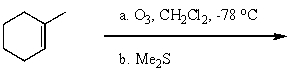
(74) Predict the major product(s)of the following reaction,giving regiochemical and/or stereochemical details as relevant. 
(Essay)
4.8/5 (81)
(81) 

Consider the addition of HCl to 3-methyl-1-butene.The major product of the reaction would be:
(Multiple Choice)
4.9/5 (81)
(81) 
Filters
- Essay(0)
- Multiple Choice(0)
- Short Answer(0)
- True False(0)
- Matching(0)