



 Chat with AI
Exam 8: Alkenes and Alkynes II

Exam 1: The Basics158 Questions
Exam 2: Families of Carbon151 Questions
Exam 3: Acids and Bases149 Questions
Exam 4: Nomenclature and Conformations of Alkanes and Cycloalkanes163 Questions
Exam 5: Stereochemistry179 Questions
Exam 6: Nucleophilic Reactions91 Questions
Exam 7: Alkenes and Alkynes I220 Questions
Exam 8: Alkenes and Alkynes II163 Questions
Exam 9: Nuclear Magnetic Resonance and Mass Spectrometry158 Questions
Exam 10: Radical Reactions148 Questions
Exam 11: Alcohols and Ethers256 Questions
Exam 12: Alcohols From Carbonyl Compounds210 Questions
Exam 13: Conjugated Unsaturated Systems201 Questions
Exam 14: Aromatic Compounds186 Questions
Exam 15: Reactions of Aromatic Compounds207 Questions
Exam 16: Aldehydes and Ketones189 Questions
Exam 17: Carboxylic Acids and Their Derivatives213 Questions
Exam 18: Reactions at the Α Carbon of Carbonyl Compounds190 Questions
Exam 19: Condensation and Conjugate Addition Reactions of Carbonyl Compounds182 Questions
Exam 20: Amines207 Questions
Exam 21: Transition Metal Complexes86 Questions
Exam 22: Carbohydrates124 Questions
Exam 23: Lipids127 Questions
Exam 24: Amino Acids and Proteins135 Questions
Exam 25: Nucleic Acids and Protein Synthesis126 Questions
Select questions type


In halohydrin formation the reason why the halohydrin is the major product is because the solvent is more reactive that the bromide nucleophile.
(True/False)
4.8/5  (84)
(84) What is the major product of the following reaction sequence? 
(Multiple Choice)
4.9/5 (74)
(74) (R)-3-Chloro-1-butene reacts with HCl by Markovnikov addition,and the products are separated by gas chromatography.How many total fractions would be obtained and how many would be optically active?
(Multiple Choice)
4.8/5 (75)
(75) One mole of an optically active compound,X,with the molecular formula C6H8 reacts with three moles of hydrogen in the presence of a catalyst to yield an optically inactive product that cannot be resolved.X also exhibits IR absorption at approximately 3300 cm-1.Which is a possible structure for X?
(Multiple Choice)
4.7/5 (67)
(67) What is the major product of the following reaction sequence? 
(Multiple Choice)
4.7/5 (78)
(78) An alkene with the molecular formula C8H16 undergoes ozonolysis to yield a mixture of (CH3)2C=O and (CH3)3CCHO.The alkene is:
(Multiple Choice)
4.9/5 (88)
(88) 
Which of the following would be produced upon ozonolysis of camphene? 
(Multiple Choice)
4.8/5 (74)
(74) What is the major product of the following reaction sequence? 
(Multiple Choice)
4.9/5 (82)
(82) Even when one or more stereogenic centers are produced as the result of an addition reaction to an alkene,the product is always formed as a racemic mixture.Why is that?
(Essay)
4.9/5 (78)
(78) Which reaction sequence would convert cis-2-butene to trans-2-butene?
(Multiple Choice)
4.8/5 (82)
(82) What is the product(s)formed by treating 3,3 dimethylcyclopentene with H3O+ and heating? 
(Multiple Choice)
5.0/5 (73)
(73) 

What is the major product of the following reaction sequence? 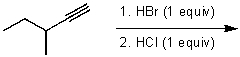
(Multiple Choice)
4.8/5 (76)
(76) 

An optically active compound,Y,with the molecular formula C7H12 gives a positive test with cold dilute KMnO4 and shows IR absorption at about 3300 cm-1.On catalytic hydrogenation,Y yields Z(C7H16)and Z is also optically active.Which is a possible structure for Y?
(Multiple Choice)
4.8/5 (65)
(65) The rule that correctly predicts the regiochemistry of most ionic additions to alkenes is called ___.
(Short Answer)
4.9/5 (78)
(78) 
Filters
- Essay(0)
- Multiple Choice(0)
- Short Answer(0)
- True False(0)
- Matching(0)